
กลไกความเข้มแข็งขององค์กรในบริบทธุรกิจครอบครัวในประเทศไทย
Article Sidebar
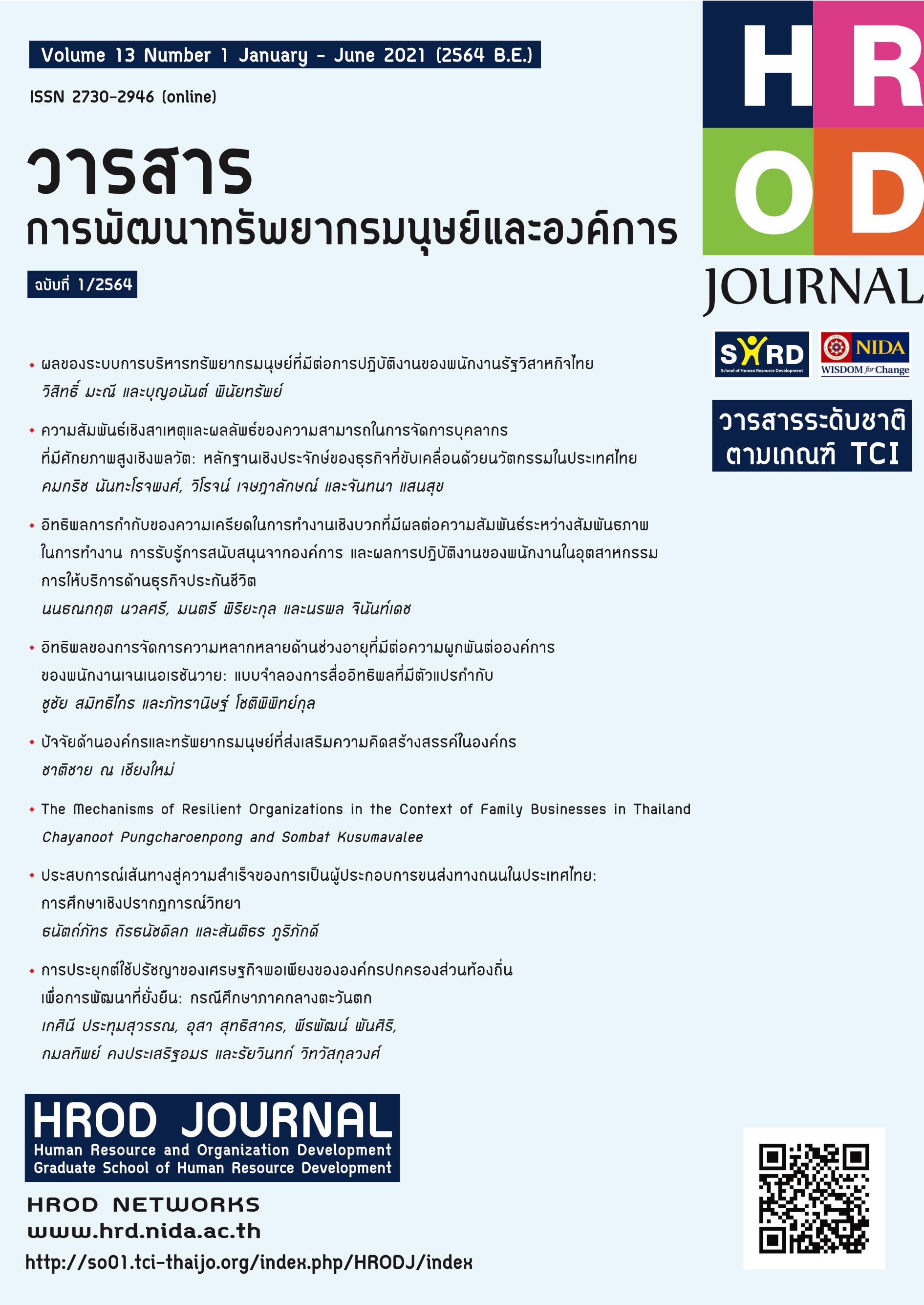
Main Article Content
บทคัดย่อ
การศึกษาเชิงคุณภาพนี้ มีวัตถุประสงค์เพื่ออธิบายถึงกลไกความเข้มแข็งขององค์กร โดยใช้กรณีศึกษาเพื่ออธิบายของ Yin (2014) ธุรกิจครอบครัวได้ถูกเลือกเป็นบริบทในการศึกษา เพราะ 1) เป็นธุรกิจที่มีความเข้มแข็งมากกว่าธุรกิจอื่น 2) เป็นธุรกิจที่มีความสำคัญต่อเศรษฐกิจไทย ผลการศึกษาจากสิบห้ากรณีธุรกิจครอบครัวในประเทศไทย พบว่า กลไกที่ทำให้องค์กรเข้มแข็งเกิดจากปัจจัยในสามช่วงเวลา กล่าวคือ 1) ปัจจัยก่อนวิกฤต คือ การจัดการองค์กร (เช่น การพัฒนาองค์กร) และด้านบุคคลากร (เช่น คุณธรรมในภาวะปกติ, ความสัมพันธ์ที่ดีในองค์กร) 2) ปัจจัยตระหนักรู้ถึงวิกฤต คือ การทราบถึงผลจากวิกฤตที่อาจได้รับ, การทราบถึงผลจากวิกฤต, การทราบถึงสภาพด้วยความเข้าใจ, การทราบถึงสภาพด้วยความรู้และประสบการณ์ 3) ปัจจัยขณะจัดการกับวิกฤต คือ การจัดการองค์กร (เช่น การลดความเสียหายของทรัพย์สิน, การสื่อสาร, การให้ความช่วยเหลือทั้งในและระหว่างองค์กร, การพัฒนาระบบองค์กร, การดำเนินธุรกิจที่หลากหลาย) ด้านบุคคลากร (เช่น ความร่วมมือของบุคคลากร, ความผูกพันธ์ต่อองค์กร, คุณธรรมในภาวะวิกฤต, ความใส่ใจต่อพนักงาน, ผู้นำ) และการจัดการทางการเงิน ผลการศึกษานี้ยังพบว่า ปัจจัยก่อนวิกฤตช่วยองค์กรในช่วงที่จัดการกับวิกฤตและหลังวิกฤต ทำให้สามารถเป็นองค์กรที่เข้มแข็งได้
Article Details
1) เนื้อหาทั้งหมดของบทความที่ลงตีพิมพ์ในวารสารการพัฒนาทรัพยากรมนุษย์และองค์การ เจ้าของผลงานมีการคิด ค้นคว้า ทบทวนวิเคราะห์ สรุป เรียบเรียงและอ้างอิงข้อมูลโดยผู้แต่งเอง กองบรรณาธิการไม่มีส่วนร่วมรับผิดชอบ
2) บทความที่ตีพิมพ์ในวารสารนี้ ต้องไม่เคยได้รับการตีพิมพ์เผยแพร่ที่ใดมาก่อน และไม่อยู่ระหว่างการเสนอเพื่อพิจารณาตีพิมพ์ในวารสารฉบับอื่น หากตรวจพบว่า มีการตีพิมพ์ซ้ำซ้อน ถือเป็นความรับผิดชอบของผู้แต่งแต่เพียงผู้เดียวในการละเมิดลิขสิทธิ์
3) ผลงานที่ได้รับการตีพิมพ์ในวารสารวิชาการ ถือเป็นกรรมสิทธิ์ของวารสารห้ามนำข้อความทั้งหมดหรือบางส่วนไปพิมพ์ซ้ำ เว้นเสียแต่ว่าจะได้รับอนุญาตจากทางกองบรรณาธิการวารสารฯ
เอกสารอ้างอิง
Amann, B., & Jaussaud, J. (2012). Family and non-family business resilience in the economic downturn. Asia Pacific Business Review, 18(2), 203-223. doi:10.1080/13602381.2010.537057
Bateman, S. & Pridgeon, K. (Eds.) (2020). Oxford advanced learner’ dictionary of current English (10th ed.). Oxford, United Kingdom: Oxford University Press.
Boin, A. (2004). Lessons from crisis research. International Studies Review, 6(1), 165-194. doi:10.1111/j.1521-9488.2004.393_2.x
Boin, A., ‘t Hart, P., & Kuipers, S. (2018). The crisis approach. In H. Rodríguez, W. Donner, & J. E. Trainor (Eds.), Handbook of disaster research (2nd ed., pp. 23-38). Cham, Switzerland: Springer International Publishing.
Bright, D. S., Cameron, K. S., & Caza, A. (2006). The amplifying and buffering effects of virtuousness in downsized organizations. Journal of Business Ethics, 64(3), 249-269. doi:10.1007/s10551-005-5904-4
Bundy, J., Pfarrer, M. D., Short, C. E., & Coombs, W. T. (2017). Crises and crisis management: Integration, interpretation, and research development. Journal of Management, 43(6), 1661–1692. doi: 10.1177/0149206316680030
Cameron, K. S. (2010). Introduction. In K. S. Cameron (Ed.), Organizational effectiveness (pp. xiii-xxviii). Cheltenham, United Kingdom: Edward Elgar.
Charmaz, K. (1990). ‘Discovering’ chronic illness: Using grounded theory. Social Science & Medicine, 30(11), 1161-1172. doi:10.1016/0277-9536(90)90256-R
Charmaz, K. (2006). Constructing grounded theory: A practical guide through qualitative analysis. New Delhi, India: Sage.
Clément, V., & Rivera, J. (2017). From adaptation to transformation: An extended research agenda for organizational resilience to adversity in the natural environment. Organization & Environment, 30(4), 346-365. doi: 10.1177 /1086026616658333
Comfort, L. K., Boin, A., & Demchak, C. C. (Eds.). (2010). Designing resilience: Preparing for extreme events. Pittsburgh, PA: University of Pittsburgh Press.
Crisis. (n.d.). In Thesaurus.com. Retrieved from https://www.thesaurus.com /browse/crisis?s=t
Denhardt, J., & Denhardt, R. (2010). Building organizational resilience and adaptive management. In J. W. Reich, A. J. Zautra, & J. S. Hall (Eds.), Handbook of adult resilience (pp. 333-349). New York, NY: The Guilford Press.
deRoche, J. E., & deRoche, C. (2010). Ethics. In A. J. Mills, G. Durepos, & E. Wiebe (Eds.), Encyclopedia of case study research (Vol 1, pp. 336-344). Far East Square, Singapore: SAGE Publications Asia-Pacific Pte.
Duchek, S. (2020). Organizational resilience: A capability-based conceptualization. Business Research, 13, 215-246. doi:10.1007/s40685-019-0085-7
Duchek, S., Raetze, S., & Scheuch, I. (2020). The role of diversity in organizational resilience: A theoretical framework. Business Research, 13, 387–423. doi:10.1007/s40685-019-0084-8
Glaser, B. G., & Strauss, A. L. (2006). The discovery of grounded theory: Strategies for qualitative research. London, United Kingdom: AldineTransaction.
Gueben-Venière, S. (2020). Crisis management as an evolutive and adaptable infrastructure. Retrieved from https://hal-enpc.archives-ouvertes.fr/hal-02518041/file/Gueben-Veniere_November%20CrisisManagement
_as%20Infrastructure.pdf
Hermann, C. F. (1963). Some consequences of crisis which limit the viability of organizations. Administrative Science Quarterly, 8(1), 61-82. doi:10.2307/2390887
Indirli, M. (2019). An historical flight and some open questions towards a pluralistic but holistic view of resilience. In P. Farabollini, F. R. Lugeri, & S. Mugnano (Eds). Earthquake risk perception, communication and mitigation strategies across Europe (Vol. 2, pp. 194-248). Rende (CS), Italy: Il Sileno Edizioni.
Kachaner, N., Stalk, G., & Bloch, A. (2012). What you can learn from family businesses: Focus on resilience, not short term performance. Harvard Business Review, 90(11), 103-106.
Koronis, E., & Ponis, S. (2018). Better than before: The resilient organization in crisis mode. Journal of Business Strategy, 39(1), 32-42. doi: 10.1108/JBS-10-2016-0124
Lengnick-Hall, C. A. (2008). Organizational resilience. In S. R. Clegg & J. R. Bailey (Eds.), International encyclopedia of organization studies (Vol. 3, pp. 1160-1161). Thousand Oaks, CA: Sage.
Li, P. P. (2020). Organizational resilience for a new normal: Balancing the paradox of global interdependence. Management and Organization Review, 16(3), 503–509. doi: 10.1017/mor.2020.30
Ministry of Industry. (2016). Khao krasuang utsahakam prajam wan [Daily news from the Ministry of Industry]. Retrieved from http://www.industry.go.th/industry /index.php/th/knowledge/item/10603-2016-05-23-05-38-40
Office of the National Economic and Social Development Board. (n.d.). The twelfth plan national economic and social development plan of Thailand (2017-2021). Retrieved from https://www.oneplanetnetwork.org/sites/default/files/thailand_national_economic_and_social_development_plan_nesdp.pdf
Pursiainen, C. (2018). The crisis management cycle: Theory and practice. New York, NY: Routledge.
Seville, E. (2017). Resilient organizations: How to survive, thrive and create opportunities through crisis and change. The United States: Kogan Page Limited.
Shaluf, I. M., Ahmadun, F., & Mat Said, A. (2003). A review of disaster and crisis. Disaster Prevention and Management, 12(1), 24-32. doi:10.1108 /09653560310463829
Suehiro, A. (1997). Modern family business and corporate capability in Thailand: A case study of the CP group. Japanese Yearbook on Business History, 14, 31-57. Retrieve from https://www.jstage.jst.go.jp/article/jrbh1984/14/0 /14_0_31/_pdf
Turner, B. A. (1976). The organizational and interorganizational development of disasters. Administrative Science Quarterly, 21(3), 378-397. doi:10.2307 /2391850
van der Vegt, G. S., Essens, P., Wahlström, M., & George, G. (2015). From the editors: Managing risk and resilience [Editorial]. Academy of Management Journal, 58(4), 971–980. doi:10.5465/amj.2015.4004
Vogus, T. J. (2012). Mindful organizing: Establishing and extending the foundations of highly reliable performance. In K. S. Cameron & G. M. Spreitzer (Eds.), The Oxford handbook of positive organizational scholarship (pp. 664-676). New York, NY: Oxford University Press.
Wailerdsak, N., & Suehiro, A. (2010). Business groups in Thailand. In A. M. Colpan, T. Hikino, & J. R. Lincoln (Eds.), The Oxford handbook of business groups (pp. 237-266). New York, NY: Oxford University Press.
Watters, J. (2014). Disaster recover, crisis response, & business continuity: A management desk reference. Apress.
Weick, K. E., & Sutcliffe, K. M. (2006). Mindfulness and the quality of organizational attention. Organization Science, 17(4), 514-524. doi: 10.1287/orsc.1060.0196
Williams, T. A., Gruber, D. A., Sutcliffe, K. M., Shepherd, D. A., & Zhao, E. Y. (2017). Organizational response to adversity: Fusing crisis management and resilience research streams. Academy of Management Annals, 11(2), 733–769. doi: 10.5465/annals.2015.0134
Yin, R. K. (2011). Qualitative research from start to finish. New York, NY: The Guilford Press.
Yin, R. K. (2014). Case study research: Design and methods (5th ed.). Thousand Oaks, CA: Sage.
Zafari, K., Biggemann, S., & Garry, T. (2020). Mindful management of relationships during periods of crises: A model of trust, doubt and relational adjustments. Industrial Marketing Management, 88, 278–286. doi: 10.1016/j.indmarman .2020.05.026
