
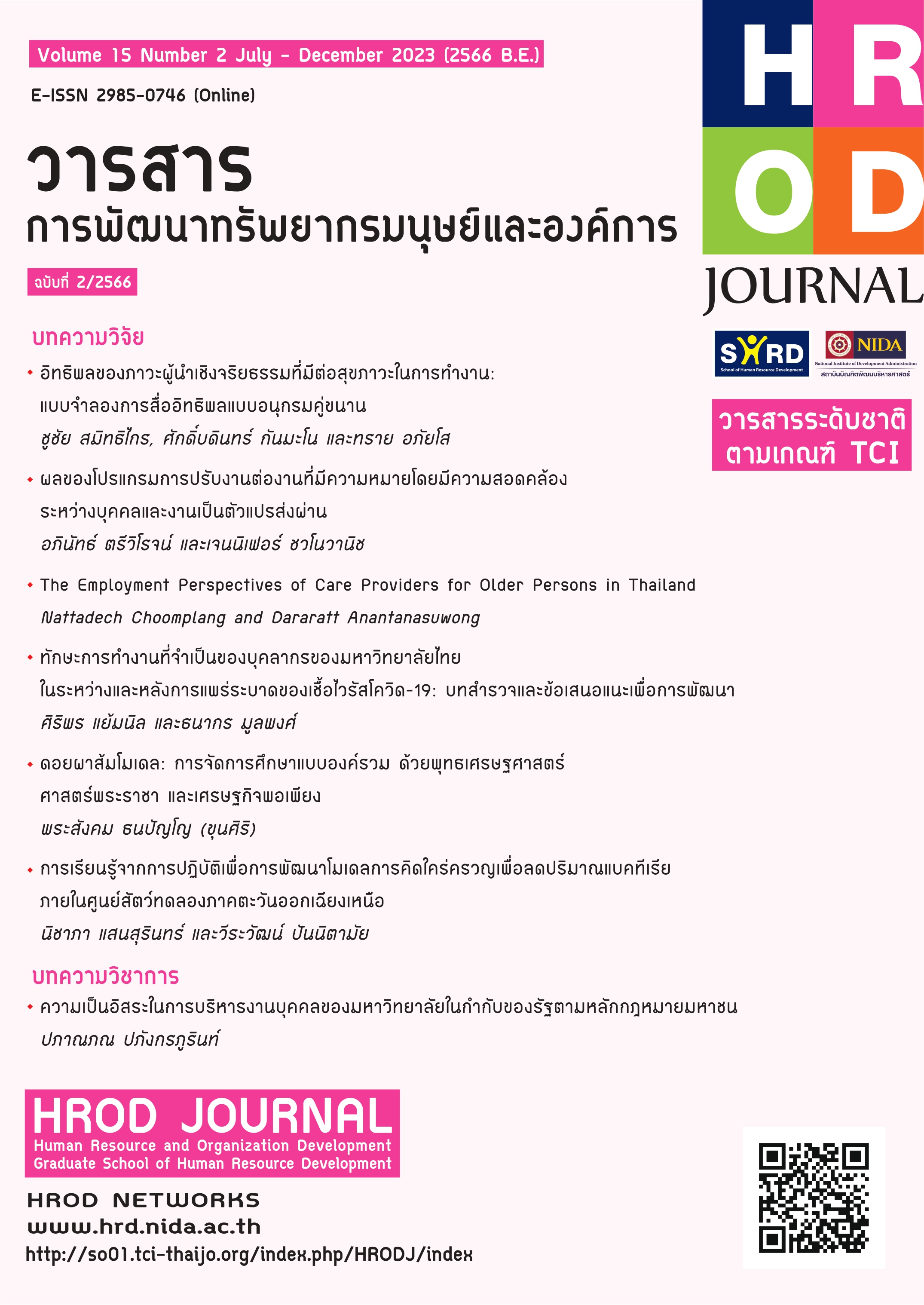
ทักษะการทำงานที่จำเป็นของบุคลากรของมหาวิทยาลัยไทย ในระหว่างและหลังการแพร่ระบาดของเชื้อไวรัสโควิด-19: บทสำรวจและข้อเสนอแนะเพื่อการพัฒนา
Article Sidebar
Main Article Content
บทคัดย่อ
การศึกษานี้มีวัตถุประสงค์เพื่อสำรวจความต้องการในการพัฒนาทักษะการทำงานของบุคลากรมหาวิทยาลัยไทย ในระหว่างการแพร่ระบาดของเชื้อไวรัสโควิด-19 รวมถึงจัดทำข้อเสนอแนะเพื่อการพัฒนาทักษะของบุคลากรที่มีความแตกต่างหลากหลาย ภายหลังการแพร่ระบาดของเชื้อไวรัสโควิด-19 ผู้วิจัยใช้การสำรวจออนไลน์กับพนักงานมหาวิทยาลัยมหิดล ผ่านการสุ่มตัวอย่างแบบไม่อาศัยความน่าจะเป็นวิธีการสุ่มตามสะดวก (Convenient sampling) มีผู้ตอบแบบสอบถามจำนวน 1,116 คน และพบว่า ทักษะในลำดับแรกสุดที่พนักงานมหาวิทยาลัยทุกกลุ่มต้องการ คือ ทักษะเกี่ยวกับการใช้งานคอมพิวเตอร์และเทคโนโลยีสารสนเทศเพื่อการทำงานที่บ้าน อย่างไรก็ตาม ผู้วิจัยพบความแตกต่างกันในเรื่องของความต้องการพัฒนาทักษะในการทำงานระหว่างกลุ่มพนักงานที่มีช่วงอายุแตกต่างกัน กล่าวคือ พนักงานในกลุ่ม Baby boomers (เกิดก่อนปี พ.ศ. 2507) และ Gen X (เกิดก่อนปี พ.ศ. 2522) ยังคงต้องการการพัฒนาทักษะในด้านโปรแกรมสำนักงานอิเล็กทรอนิกส์ ในขณะที่พนักงานกลุ่ม Gen Y (เกิดหลังปี พ.ศ. 2522) และ Gen Z (เกิดหลังปี พ.ศ. 2538 ) ต้องการพัฒนาทักษะในด้านการตัดสินใจและแก้ไขปัญหาในช่วงสถานการณ์วิกฤต ผลการศึกษาที่ได้สะท้อนให้เห็นถึงความแตกต่างกันของช่วงวัยในประเด็นของการพัฒนาทรัพยากรมนุษย์ และนำไปสู่ข้อเสนอแนะในการศึกษา ประกอบไปด้วย (1) การปรับแต่งหลักสูตรฝึกอบรมและพัฒนาให้เหมาะสมกับแต่ละบุคคล (HRD customization) (2) การประยุกต์ใช้เทคโนโลยีสารสนเทศอย่างเช่น Virtual human resources development (VHRD) หรือ AI มาช่วยเพิ่มประสิทธิภาพของ HRD และ (3) การพัฒนาทักษะทางสังคมและการตระหนักรู้ทางสังคมให้แก่บุคลากรของสถาบันการศึกษาในช่วงวิกฤตดังเช่นปัจจุบัน
Article Details

อนุญาตภายใต้เงื่อนไข Creative Commons Attribution-NonCommercial-NoDerivatives 4.0 International License.
1) เนื้อหาทั้งหมดของบทความที่ลงตีพิมพ์ในวารสารการพัฒนาทรัพยากรมนุษย์และองค์การ เจ้าของผลงานมีการคิด ค้นคว้า ทบทวนวิเคราะห์ สรุป เรียบเรียงและอ้างอิงข้อมูลโดยผู้แต่งเอง กองบรรณาธิการไม่มีส่วนร่วมรับผิดชอบ
2) บทความที่ตีพิมพ์ในวารสารนี้ ต้องไม่เคยได้รับการตีพิมพ์เผยแพร่ที่ใดมาก่อน และไม่อยู่ระหว่างการเสนอเพื่อพิจารณาตีพิมพ์ในวารสารฉบับอื่น หากตรวจพบว่า มีการตีพิมพ์ซ้ำซ้อน ถือเป็นความรับผิดชอบของผู้แต่งแต่เพียงผู้เดียวในการละเมิดลิขสิทธิ์
3) ผลงานที่ได้รับการตีพิมพ์ในวารสารวิชาการ ถือเป็นกรรมสิทธิ์ของวารสารห้ามนำข้อความทั้งหมดหรือบางส่วนไปพิมพ์ซ้ำ เว้นเสียแต่ว่าจะได้รับอนุญาตจากทางกองบรรณาธิการวารสารฯ
เอกสารอ้างอิง
กมลพร กัลยาณมิตร. (2021). ทักษะจำเป็นแห่งอนาคตการทำงานยุคหลังโควิด-19. วารสาร มจร พุทธปัญญาปริทรรศน์. 6(3), 163-176.
ณัฐวี โฆษะฐิ. (2564). การพัฒนาบุคลากรรับมือกับความเปลี่ยนแปลงจากผลกระทบของ Covid-19. https://sasinconsulting.com/wp-content/uploads/2020/08/การพัฒนาบุคลากรรับมือกับความเปลี่ยนแปลงจากผลกระทบของ-Covid.pdf
ธนากร มูลพงศ์ และ ศิริพร แย้มนิล. (2565). รายงานการวิจัยฉบับสมบูรณ์ เรื่อง การประยุกต์ใช้ระบบการปฏิบัติงานแบบยืดหยุ่นของมหาวิทยาลัยมหิดลในระหว่างการแพร่ระบาดของเชื้อไวรัสโคโรนา 2019 (Covid-19) และในยุคความปรกติใหม่: การศึกษาแนวปฏิบัติ ปัญหาและอุปสรรค และข้อเสนอแนะ. คณะสังคมศาสตร์และมนุษยศาสตร์ มหาวิทยาลัยมหิดล
เสาวรัจ รัตนคำฟู และ เมธาวี รัชตวิจิน. (2553). ผลกระทบของการทำงานที่บ้าน (Work from home) ในช่วงโควิด-19: กรณีศึกษาของทีดีอาร์ไอ. https://tdri.or.th/2020/05/impact-of-working-from-home-covid-19/
Aczel, B., Kovacs, M., van der Lippe, T., & Szaszi, B. (2021). Researchers working from home: Benefits and challenges. PLOS ONE, 16(3), e0249127. https://doi.org/10.1371/journal.pone.0249127
Akkermans, J., Richardson, J., & Kraimer, M. L. (2020). The Covid-19 crisis as a career shock: Implications for careers and vocational behavior. Journal of Vocational Behavior, 119, 103434. https://doi.org/10.1016/j.jvb.2020.103434
Al-Habaibeh, A., Watkins, M., Waried, K., & Javareshk, M. B. (2021). Challenges and opportunities of remotely working from home during Covid-19 pandemic. Global Transitions, 3, 99–108. https://doi.org/10.1016/j.glt.2021.11.001
Ali, W. (2020). Online and remote learning in higher education institutes: A necessity in light of COVID-19 pandemic. Higher Education Studies, 10(3), 16–25. https://doi.org/10.5539/hes.v10n3p16
Anderson, A. J., Kaplan, S. A., & Vega, R. P. (2015). The impact of telework on emotional experience: When, and for whom, does telework improve daily affective well-being? European Journal of Work and Organizational Psychology, 24(6), 882–897. https://doi.org/10.1080/1359432X.2014.966086
Armstrong-Stassen, M., & Templer, A. (2005). Adapting training for older employees: The Canadian response to an aging workforce. Journal of Management Development, 24(1), 57–67. https://doi.org/10.1108/02621710510572353
Arora, P., & Suri, D. (2020). Redefining, relooking, redesigning, and reincorporating HRD in the post Covid 19 context and thereafter. Human Resource Development International, 23(4), 438–451. https://doi.org/10.1080/13678868.2020.1780077
Baek, P., & Kim, N. (2017). The subjective perceptions of critical HRD scholars on the current state and the future of CHRD: Subjective perceptions of CHRD scholars. Human Resource Development Quarterly, 28(2), 135–161. https://doi.org/10.1002/hrdq.21275
Bennett, E. E. (2010). The coming paradigm shift: Synthesis and future directions for virtual HRD. Advances in Developing Human Resources, 12(6), 728–741. https://doi.org/10.1177/1523422310394796
Bennett, E. E., & McWhorter, R. R. (2021). Virtual HRD’s role in crisis and the post Covid-19 professional lifeworld: Accelerating skills for digital transformation. Advances in Developing Human Resources, 23(1), 5-25. https://doi.org/10.1177/1523422320973288
Bughin, J., Hazan, E., Lund, S., Dahlstrom, P., Wiesinger, A., & Subramaniam, A. (2018). Skill shift: Automation and the future of the workforce: McKinsey Global Institute Discussion paper. https://www.mckinsey.com/featured-insights/future-of-work/skill-shift-automation-and-the-future-of-the-workforce
Centre for Economics and Business Research. (2018). The economic impact of digital inclusion in the UK. http://hdl.voced.edu.au/10707/499911
Chen, Z. (2021). Influence of working from home during the COVID-19 crisis and HR practitioner response. Frontiers in Psychology, 12, 710517. https://doi.org/10.3389/fpsyg.2021.710517
De Meuse, K. P., & Hostager, T. J. (2001). Developing an instrument for measuring attitudes toward and perceptions of workplace diversity: An initial report. Human Resource Development Quarterly, 12(1), 33–51. https://doi.org/10.1002/1532-1096(200101/02)12:1<33::AID-HRDQ4>3.0.CO;2-P
Dirani, K. M., Abadi, M., Alizadeh, A., Barhate, B., Garza, R. C., Gunasekara, N., Ibrahim, G., & Majzun, Z. (2020). Leadership competencies and the essential role of human resource development in times of crisis: A response to Covid-19 pandemic. Human Resource Development International, 23(4), 380–394. https://doi.org/10.1080/13678868.2020.1780078
Elavarasan, R. M., Pugazhendhi, R., Shafiullah, G. M., Kumar, N. M., Arif, M. T., Jamal, T., Chopra, S. & S., Dyduch, J. (2021). Impacts of COVID-19 on Sustainable Development Goals and effective approaches to maneuver them in the post-pandemic environment. Environmental Science and Pollution Research, 29, 33957-33987. https://doi.org/10.1007/s11356-021-17793-9
Frey, C. B., & Osborne, M. A. (2017). The future of employment: How susceptible are jobs to computerisation? Technological Forecasting and Social Change, 114, 254–280. https://doi.org/10.1016/j.techfore.2016.08.019
Galanti, T., Guidetti, G., Mazzei, E., Zappal, S., & Toscano, F. (2021). Work from Home during the COVID-19 outbreak: The impact on employees’ remote work productivity, engagement and stress. Journal of Occupational & Environmental Medicine. https://doi.org/10.1097/JOM.0000000000002236
Gedro, J., Allain, N. M., De-Souza, D., Dodson, L., & Mawn, M. V. (2020). Flattening the learning curve of leadership development: Reflections of five women higher education leaders during the Coronavirus pandemic of 2020. Human Resource Development International, 23(4), 395–405. https://doi.org/10.1080/13678868.2020.1779911
Hite, L. M., & McDonald, K. S. (2020). Careers after COVID-19: Challenges and changes. Human Resource Development International, 23(4), 427–437. https://doi.org/10.1080/13678868.2020.1779576
Hughes, C. (2018). The role of HRD in using diversity intelligence to enhance leadership skill development and talent management strategy. Advances in Developing Human Resources, 20(3), 259–262. https://doi.org/10.1177/1523422318778016
Hughes, C. (2019). Workforce inter-personnel diversity: The power to influence human productivity and career development. Springer Berlin Heidelberg.
Hughes, C. (2021). The changing learning technological landscape for trainers in the wake of COVID-19. Advances in Developing Human Resources, 23(1), 66–74. https://doi.org/10.1177/1523422320972108
Kim, S., & McLean, G. N. (2012). Global talent management: Necessity, challenges, and the roles of HRD. Advances in Developing Human Resources, 14(4), 566–585. https://doi.org/10.1177/1523422312455610
Kitagawa, R., Kuroda, S., Okudaira, H., & Owan, H. (2021). Working from home and productivity under the COVID-19 pandemic: Using survey data of four manufacturing firms. PLOS ONE, 16(12), e0261761. https://doi.org/10.1371/journal.pone.0261761
Kormanik, M. B., & Chyle Rajan, H. (2010). Implications for diversity in the HRD curriculum drawn from current organizational practices on addressing workforce diversity in management training. Advances in Developing Human Resources, 12(3), 367–384. https://doi.org/10.1177/1523422310375033
Kossek, E. E., & Buzzanell, P. M. (2018). Women’s career equality and leadership in organizations: Creating an evidence-based positive change. Human Resource Management, 57(4), 813–822. https://doi.org/10.1002/hrm.21936
Li, J., & Nimon, K. (2008). The importance of recognizing generational differences in HRD policy and practices: A study of workers in Qinhuangdao. Human Resource Development International, 11(2), 167–182. https://doi.org/10.1080/13678860801932980
Lockwood, N. R. (2005). Crisis management in today’s business environment: HR’s strategic role. Hr Magazine, 1–10. https://www.shrm.org/hr-today/news/hr-magazine/Documents/1205RQuartpdf.pdf
Muyia Nafukho, F., Roessler, R. T., & Kacirek, K. (2010). Disability as a diversity factor: Implications for human resource practices. Advances in Developing Human Resources, 12(4), 395–406. https://doi.org/10.1177/1523422310379209
Shirmohammadi, M., Au, W. C., & Beigi, M. (2022). Remote work and work-life balance: Lessons learned from the covid-19 pandemic and suggestions for HRD practitioners. Human Resource Development International, 25(2), 163–181. https://doi.org/10.1080/13678868.2022.2047380
The Open University. (2019). Bridging the digital divide. https://www.readkong.com/page/the-open-university-bridging-the-digital-divide-june-2019-8696465
Thomas, K. J. (2014). Workplace technology and the creation of boundaries: The role of VHRD in a 24/7 work environment. Advances in Developing Human Resources, 16(3), 281–295. https://doi.org/10.1177/1523422314532092
Torraco, R. J., & Lundgren, H. (2020). What HRD is doing—What HRD should be doing: The case for transforming HRD. Human Resource Development Review, 19(1), 39–65. https://doi.org/10.1177/1534484319877058
Turner, R. C., & Carlson, L. (2003). Indexes of item-objective congruence for multidimensional items. International Journal of Testing, 3(2), 163–171. https://doi.org/10.1207/S15327574IJT0302_5
Twenge, J. M. (2017). iGen: Why Today's Super-Connected Kids Are Growing Up Less Rebellious, More Tolerant, Less Happy--and Completely Unprepared for Adulthood--and What That Means for the Rest of Us. Atria Books.
Van der Sluis, L. E. C. (2007). Umbrella for research into Human Resource Development (HRD). Human Resource Development International, 10(1), 99–106. https://doi.org/10.1080/13678860601170450
Wang, J., Hutchins, H. M., & Garavan, T. N. (2009). Exploring the strategic role of human resource development in organizational crisis management. Human Resource Development Review, 8(1), 22–53. https://doi.org/10.1177/1534484308330018
Webb, A., McQuaid, R., Webster, C., & William R. (2021). Moving learning online and the COVID-19 pandemic: A university response. World Journal of Science, Technology and Sustainable Development, 18(1), 1-9. https://doi.org/10.1108/wjstsd-11-2020-0090
Webster, J. R., Adams, G. A., Maranto, C. L., Sawyer, K., & Thoroughgood, C. (2018). Workplace contextual supports for LGBT employees: A review, meta-analysis, and agenda for future research. Human Resource Management, 57(1), 193–210. https://doi.org/10.1002/hrm.21873
Wentling, R. M., & Palma-Rivas, N. (1998). Current status and future trends of diversity initiatives in the workplace: Diversity experts’ perspective. Human Resource Development Quarterly, 9(3), 235–253. https://doi.org/10.1002/hrdq.3920090304
Wong, M., Gardiner, E., Lang, W., & Coulon, L. (2008). Generational differences in personality and motivation: Do they exist and what are the implications for the workplace? Journal of Managerial Psychology, 23(8), 878–890. https://doi.org/10.1108/02683940810904376
Yarberry, S., & Sims, C. (2021). The impact of Covid-19-prompted virtual/remote work environments on employees’ career development: Social learning theory, belongingness, and self-empowerment. Advances in Developing Human Resources, 23(3), 237–252. https://doi.org/10.1177/15234223211017850
Zheng, C. (2009). Keeping talents for advancing service firms in Asia. Journal of Service Management, 20(5), 482–502. https://doi.org/10.1108/09564230910995107
