Strategic Scenario Analysis of Artificial Intelligence Application in the Thai Telecommunications Industry (2025-2033) Through the Resource-Based View and Dynamic Capabilities Frameworks
Keywords:
Artificial Intelligence, Telecommunications Industry, Scenario Analysis, Resource-Based View, Dynamic CapabilitiesAbstract
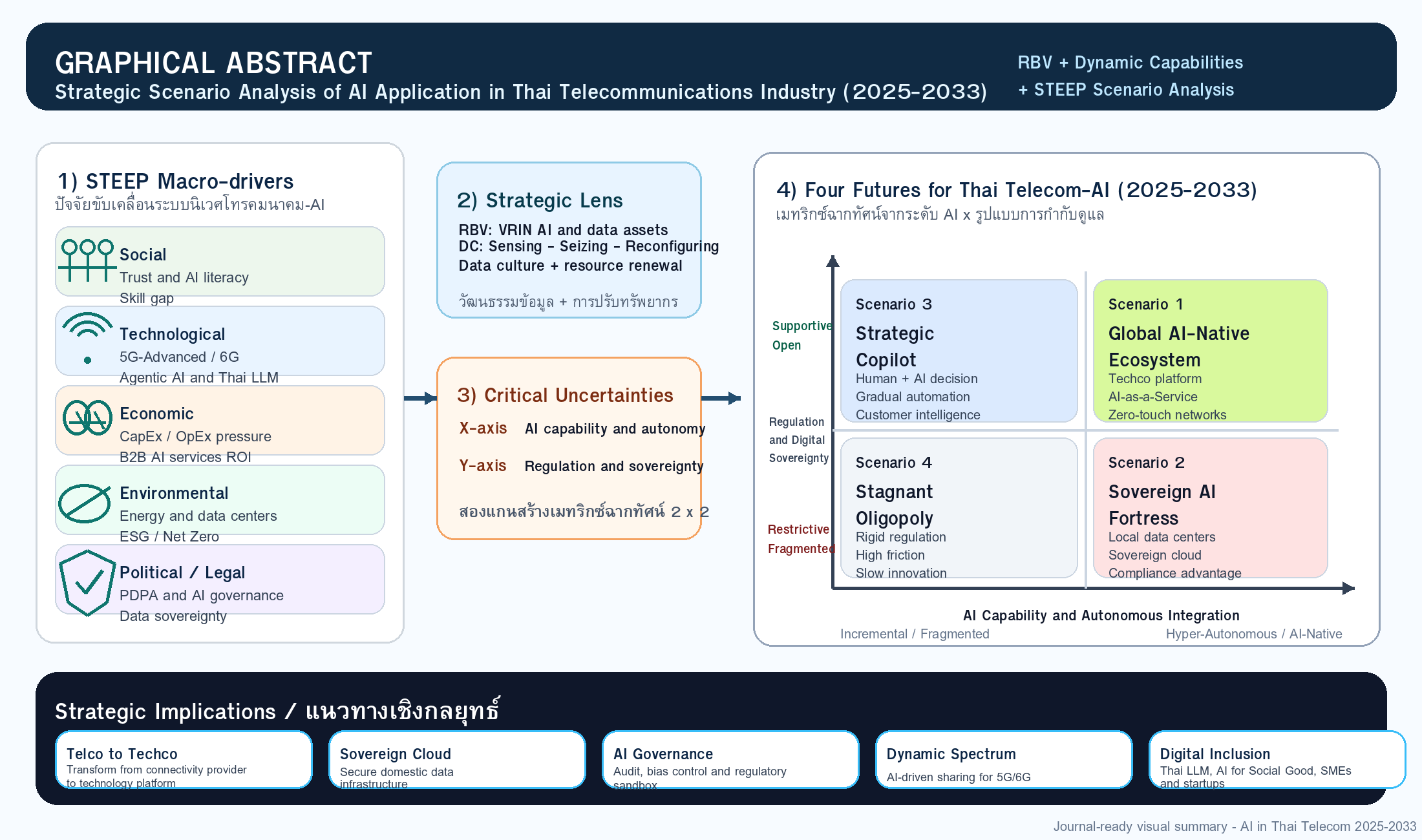
Purpose: This research aims to analyze the strategic dynamics and future scenarios of Artificial Intelligence (AI) applications within the Thai telecommunications industry for the period 2025-2033. It explores how telecom operators can achieve sustainable competitive advantage amidst the convergence of 5G-Advanced and 6G networks.
Design/Methodology/Approach: Employing a qualitative Scenario Analysis methodology, the study integrates two overarching theoretical frameworks: The Resource-Based View (RBV) and Dynamic Capabilities (DC). Driving factors shaping the industry were synthesized using the STEEP (Social, Technological, Economic, Environmental, Political) framework to identify critical uncertainties.
Findings: The analysis formulates four plausible strategic scenarios driven by AI maturation and regulatory environments. The findings emphasize that future success and competitive advantage do not depend solely on massive physical infrastructure or hyperscale data center investments. Instead, they rely heavily on an organization's dynamic capabilities to proactively restructure resources, cultivate a data-driven culture, and maintain high flexibility in responding to emerging data sovereignty and cybersecurity regulations.
Originality/Value: This study provides a comprehensive strategic foresight framework that assists both major telecom operators and policymakers in Thailand. It offers actionable guidelines for navigating the paradigm shift toward an AI-native ecosystem under the National AI Strategy Phase 2 (NAIS Phase 2).