
แนวทางการแก้ปัญหาน้ำท่วมซ้ำซากและการขาดแคลนน้ำโดยกระบวนการมีส่วนร่วมของชุมชน หมู่บ้านจาน จังหวัดกาฬสินธุ์
Article Sidebar
Main Article Content
บทคัดย่อ
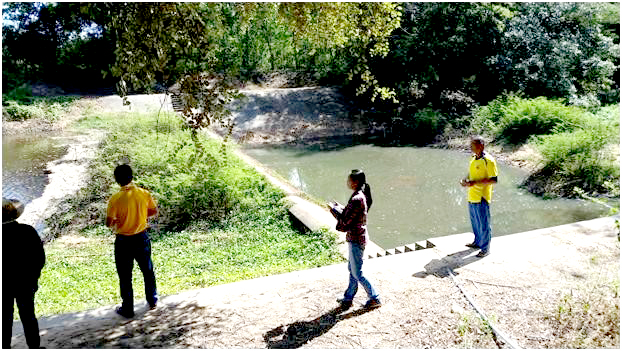
งานวิจัยนี้มีวัตถุประสงค์เพื่อนำเสนอแนวทางการแก้ปัญหาน้ำท่วมซ้ำซากและการขาดแคลนน้ำของชุมชนบ้านจาน ตำบลโนนนาจาน อำเภอนาคู จังหวัดกาฬสินธุ์ โดยใช้กระบวนการมีส่วนร่วมในการค้นหาแนวทางการแก้ปัญหา ระหว่างเดือนมีนาคม พ.ศ. 2562 ถึง มกราคม พ.ศ. 2563 การดำเนินการประกอบด้วยการสังเกตอย่างมีส่วนร่วม การจดบันทึกภาคสนาม การสนทนากลุ่ม แบบสอบถามข้อมูลพื้นฐานการใช้น้ำรายบุคคลและภาพรวมของชุมชน การทำแผนที่ชุมชน และเวทีคืนข้อมูล ผลจากการดำเนินการพบว่า แนวทางการแก้ปัญหาน้ำท่วมซ้ำซากในฤดูฝนคือ การอนุรักษ์และเพิ่มพื้นที่ป่าต้นน้ำ การสร้างฝายชะลอน้ำบริเวณต้นน้ำ และขุดลอกหนองแม่เก้งและลำห้วยขามเพื่อเพิ่มความจุในการกักเก็บน้ำ แนวทางการแก้ปัญหาการขาดแคลนน้ำในฤดูแล้งคือ ซ่อมแซมฝายน้ำล้นที่ชำรุด 2 แห่งและการสร้างฝายน้ำล้นในลำห้วยขามตอนบนเพิ่ม 1 ฝาย ผลจากการดำเนินงานส่งผลให้ ชุมชนเกิดการแลกเปลี่ยนเรียนรู้ในการจัดการแหล่งน้ำ มีการแต่งตั้งคณะกรรมการบริหารจัดการน้ำชุมชนจากกระบวนการมีส่วนร่วมของคนในชุมชน ทำให้เกิดการร่วมคิด ร่วมประเมินผล ร่วมสำรวจพื้นที่ที่เหมาะสมในการพัฒนาเป็นแหล่งกักเก็บน้ำไว้ใช้ในฤดูแล้งและการปรับปรุงฝายน้ำล้นที่สำคัญ 2 แห่ง ซึ่งจะช่วยลดระยะเวลาและปริมาณของน้ำท่วมขัง ส่งผลให้ชุมชนได้ทราบถึงแนวทางการแก้ปัญหาที่มีประสิทธิภาพ
Article Details

อนุญาตภายใต้เงื่อนไข Creative Commons Attribution-NonCommercial-NoDerivatives 4.0 International License.
Area Based Development Research Journal values copyright protection and licensing to safeguard author rights and facilitate the appropriate dissemination of research. Our policies ensure openness, accessibility, and attribution. Authors retain copyright ownership, and articles are published under a Creative Commons Attribution License (CC BY), allowing sharing, adaptation, and proper attribution. Authors have the freedom to publish under the CC BY license, granting broad reuse and distribution permissions. The journal supports posting articles on third-party repositories, adhering to institutional and funding restrictions. Author guidelines detail copyright and licensing requirements, empowering authors with knowledge about their rights and responsibilities. These policies cultivate an environment of collaboration, openness, and responsible sharing, benefiting authors and the research community while honoring intellectual property rights.
เอกสารอ้างอิง
Ahmad, M. S., & Talib, N. B. A. (2016). Analysis of community empowerment on projects sustainability: Moderating role of sense of community. Social Indicators Research, 129(3), 1039-1056.
Becker, D. R., Harris, C. C., McLaughlin, W. J., & Nielsen, E. A. (2003). A participatory approach to social impact assessment: The interactive community forum. Environmental Impact Assessment Review, 23(3), 367–382.
Bhadwal, S., Groot, A., Balakrishnan, S., Nair, S., Ghosh, S., Lingaraj, G. J., & Siderius, C. (2013). Adaptation to changing water resource availability in Northern India with respect to Himalayan Glacier retreat and changing monsoons using participatory approaches. Science of the Total Environment, 468–469(Supplement), S152-S161.
Bormann, H., Steinbrecher, J., Althoff, I., Roth, H., Baez, J., Frank, C. ..., & Sanchez, I. (2016). Recommendations for capacity development in water resources engineering and environmental management in Latin America. Water Resources Management, 30, 3409–3426.
Boretti, A., & Rosa, L. (2019). Reassessing the projections of the world water development report. Clean Water, 2(5), 1-6.
Bureau of Research, Development and Hydrology. (2009). Promoting and developing community involvement in water resources management (participatory action research: PAR). Bangkok: Department of Water Resources, Ministry of Natural Resources and Environment. (in Thai).
Cai, Y., Yue, W., Xu, L., Yang, Z., & Rong, Q. (2016). Sustainable urban water resources management considering life-cycle environmental impacts of water utilization under uncertainty. Resources, Conservation and Recycling, 108, 21-40.
Chinprateep, A. (2013). Agricultural based to manufacturing oriented growth: In the case of Thailand. NIDA Case Research Journal, 5(1), 101-125. (in Thai).
FAO. (2018). Country fact sheet on food and agriculture policy trends. Food and Agriculture Organization of the United Nations. Retrieved January 5, 2020, from http://www.fao.org/3/I8683EN/i8683en.pdf. (in Thai).
Jeong, J. S., García-Moruno, L., Hernández-Blanco, J., Sánchez-Ríos, A., & Ramírez-Gómez, Á. (2017). Identifying priority areas for rural housing development using the participatory multi-criteria and contingent valuation methods in Alange reservoir area, Central Extremadura (Spain). Journal of Rural Studies, 50, 117-128.
Kumar, M. D., Viswanathan P. K., & Bassi, N. (2015). Water scarcity and pollution in South and Southeast Asia: Problems and challenges. (Chapter 12) In P.G. Harris & G. Lang (Eds.), Handbook of Environment and Society in Asia (197-215). London: Routledge, Taylor & Francis Group.
Mankoksung. P. (2017). Water management for agriculture suitable for drought crops with the participation of farmers and network partners in Huai Kho Irrigation Area, Tao Ngoi sub-district, Tao Ngoi district, Sakon Nakhon province (Research report). Bangkok: Thailand research fund. (in Thai).
Michailidou, A. V., Vlachokostas, C., & Moussiopoulos, N. (2016). Interactions between climate change and the tourism sector: Multiple-criteria decision analysis to assess mitigation and adaptation options in tourism areas. Tourism Management, 55, 1-12.
Nsubuga, F., Namutebi, E., & Nsubuga-Ssenfuma, M. (2014). Resources of Uganda: An assessment and review. Journal of Water Resource and Protection, 6(14), 1297-1315.
Nyumba, W., & Mukherjee, D. (2018). The use of focus group discussion methodology: Insights from two decades of application in conservation. Methods in Ecology and Evolution, 9(1), 20–32.
Office of the National Water Resources. (2019). Study for establishing water resource management plan in Northeast Basin. Group meeting presented at Arawan Hotel, Khon Kaen, November 7, 2019. (in Thai).
Olga, L., & Maider. B. (2014). The challenges of participant observations of cultural encounters within an ethnographic study. Presented at 6th International Conference on Intercultural Education and Health: From a transcultural perspective. Procedia - Social and Behavioral Sciences, 132, 522-526.
Pandey, N., & Sharma, D. (2016). Participatory approach of water resource management: A case study of Marathwada. IOSR Journal of Business and Management, 1, 32-38.
Rahman, M. T. U., Rasheduzzaman, M., Habib, M. A., Ahmed, A., Tareq, S. M., & Muniruzzaman, S. M. (2017). Assessment of fresh water security in coastal Bangladesh: An insight from salinity, community perception and adaptation. Ocean and Coastal Management, 137, 68-81.
Rattana, P. (2011). The model of water management for agriculture with participation of the water users of Huai Wang Tham Reservoir, Ban Non Udom, Rai sub-district, Phanna Nikhom district, Sakon Nakhon province (Research report). Bangkok: Thailand research fund. (in Thai).
Sheikh, M. I., & Zahurul, K. (2019). World’s demand for food and water: The consequences of climate change. Retrieved March 19, 2020, from https://www.intechopen.com/online-first/world-s-demand-for-food-and-water-the-consequences-of-climate-change.
Suwannakwaw, C. (2013). Patterns of water management mechanisms for dry season farming in the lowland and upland areas: The case study of Huai Phong-Huai Luang catchment areas, Na Phong sub-district, Phon Phisai district, Nong Khai province (Research report). Bangkok: Thailand research fund. (in Thai).
Szolnoki, G., & Hoffmann, D. (2013). Online, face-to-face and telephone surveys: Comparing different sampling methods in wine consumer research. Wine Economics and Policy, 2(2), 57–66.
Thai Rice Department. (2016). The first report of rice farming situation 2016/17; The 7th assessment of situation in 15th August 2016. In Comprehensive production and marketing plan for rice. Retrieved March 20, 2019, from http://www.ricethailand.go.th/web/images/pdf/situationrice/10-300960.pdf. (in Thai).
The Dublin Statement. (1992) The international conference on water and the environment: Development issues for 21st century, 26th-31st January 1992. Dublin, Ireland.
Trott, C. D., Weinberg, A. E., & Sample McMeeking, L. B. (2018). Prefiguring sustainability through participatory action research experiences for undergraduates: Reflections and recommendations for student development. Sustainability, 10(9), 3332.
Wilk, J., & Jonsson, A. C. (2013). From water poverty to water prosperity: A more participatory approach to studying local water resources management. Water Resources Management, 27, 695–713.
