
เตาประหยัดพลังงานสำหรับการแปรรูปสมุนไพร วิสาหกิจชุมชนสมุนไพรคุณธรรมวัดคูเต่า จังหวัดสงขลา
Article Sidebar
Main Article Content
บทคัดย่อ
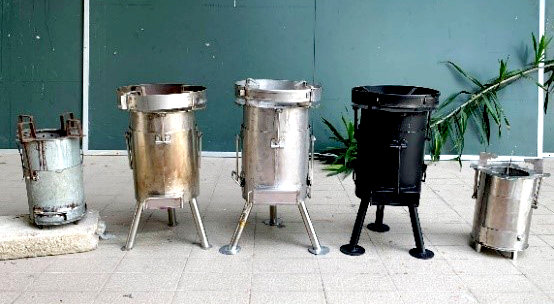
วิสาหกิจชุมชนสมุนไพรคุณธรรมวัดคูเต่า จังหวัดสงขลา แปรรูปสมุนไพรเพื่อใช้ในโรงพยาบาลและชุมชนบางกล่ำ โดยใช้เตาท้องถิ่นและเตาก๊าซหุงต้ม ทำให้การผลิตมีค่าใช้จ่ายสูงด้านเชื้อเพลิง งานวิจัยนี้จึงยกระดับคุณภาพกระบวนการผลิตสมุนไพรของวิสาหกิจชุมชนฯ โดยใช้เตาประหยัดพลังงาน ด้วยกระบวนการดังนี้ 1) การศึกษาทฤษฎีและเทคโนโลยีเตาชีวมวลประหยัดพลังงาน 2) การออกแบบและพัฒนาเตาประหยัดพลังงานต้นแบบ 3) การพัฒนาเทคโนโลยีเตาประหยัดพลังงาน และ 4) การวิเคราะห์ค่าประสิทธิภาพเชิงความร้อนของเตาประหยัดพลังงานต้นแบบ โดยชุมชนมีส่วนร่วมในการเตรียมวัตถุดิบและการทดสอบการใช้งาน ผลจากการดำเนินงานพบว่า การสกัดและเคี่ยวสมุนไพรใช้เวลาเพียง 40 นาทีต่อครั้ง ศักยภาพการผลิตยาหม่อง ณ หอมฟุ้งเจ้า เพิ่มขึ้นเป็น 5,400 ขวดต่อเดือน สร้างรายได้แก่วิสาหกิจชุมชนฯ ประมาณ 45,000 บาทต่อเดือน และส่งผลให้มีการสร้างเครือข่ายการแปรรูปสมุนไพรอย่างเป็นระบบ สมาชิกวิสาหกิจชุมชนฯ เพิ่มขึ้นเป็น 30 คน และมีการนำเทคโนโลยีเตาประหยัดพลังงานไปต้มสมุนไพรสำหรับเป็นเครื่องดื่มเพื่อสุขภาพและเกิดเครือข่ายการเรียนรู้เชิงสุขภาพ ทำให้ประหยัดพลังงานในการแปรรูปสมุนไพร ลดมลพิษในสิ่งแวดล้อม และเป็นการสืบสานภูมิปัญญาท้องถิ่นที่ดีให้คงอยู่ต่อไป
Article Details

อนุญาตภายใต้เงื่อนไข Creative Commons Attribution-NonCommercial-NoDerivatives 4.0 International License.
Area Based Development Research Journal values copyright protection and licensing to safeguard author rights and facilitate the appropriate dissemination of research. Our policies ensure openness, accessibility, and attribution. Authors retain copyright ownership, and articles are published under a Creative Commons Attribution License (CC BY), allowing sharing, adaptation, and proper attribution. Authors have the freedom to publish under the CC BY license, granting broad reuse and distribution permissions. The journal supports posting articles on third-party repositories, adhering to institutional and funding restrictions. Author guidelines detail copyright and licensing requirements, empowering authors with knowledge about their rights and responsibilities. These policies cultivate an environment of collaboration, openness, and responsible sharing, benefiting authors and the research community while honoring intellectual property rights.
เอกสารอ้างอิง
Bangkokbiznew. (2017). Thai herb. Retrieved November 15, 2019, from: https://www. Bangkokbiznew./pr/detail/29932. (in Thai).
Bhattacharya, S. C., & Salam, P. A. (2002). Low greenhouse gas biomass options for cooking in the developing countries. Biomass and Bioenergy, 22(4), 305-317.
Berrueta, V. M., Edwards, R. D., & Masera, O. R. (2008). Energy performance of wood-burning cookstoves in Michoacan, Mexico. Renewable Energy, 33(5), 859-870.
Chaichana, T., Ali, M., & Longsaman, M. (2012). The study of thermal efficiency of household cooking stove. Journal of Science and Technology Mahasarakham University, 32(5), 626-630. (in Thai).
Charoenboon, W. (2014). Rice husk gasifier stove-energy for Thai agriculturalist. KKU Science Journal, 45(1), 163-174. (in Thai).
Jaitong, W., & Wongsiriwittaya, M. (2018). The direct effect combustion of biomass in burner system by compressed air from the centrifugal blower. Thaksin University Journal, 21(3), 191-198. (in Thai).
Khaonuan, P., Prasongchan, S., & Bordeepong, S. (2020). Performance development of household biomass TLUD cookstove. UTK Research Journal, 14(1), 52-62. (in Thai).
Namkham, N. (2017). Efficiency evaluationon biomass furnace combustion chamber of refractory insulation. NSRU Science and Technology Journal, 9(9), 37-49. (in Thai).
Office of the Permanent Secretary for Energy. (2007). Energy training manual for community energy technology. Bangkok: Ministry of Energy. (in Thai).
Prasongchan, S., Khaonuan, P., & Wunsri, S. (2018). Technology of the TLUD biomass cookstove for energy saving and the integrated community development for sustainability. In the 28th Thaksin University National Academic Conference, Songkhla. (in Thai).
Tangngam, C., Siwakosit, W., & Ayawat, K. (2012). Design of a three-stage with rice husk as a fuel. In the 49th Kasetsart University Conferrence, Bangkok. (in Thai).
Thongsan, S., Prasit, B., Wansungnoen, W., & Rangketgam, C. (2015). Comparison insulation of biomass gas stove for using easy material in the community. Naresuan University Journal: Science and Technology, 23(2), 66-78. (in Thai).
Thumachat, W. (2014). Producer gas production using rice husk a fuel by inverted downdraft stove. Industrial Technology Lampang Rajabhat University Journal, 7(1), 26-39. (in Thai).
Tipyawong, N. (2010). Biomass conversion technology. Bangkok: Pimdee Printing Company limited. (in Thai).
