
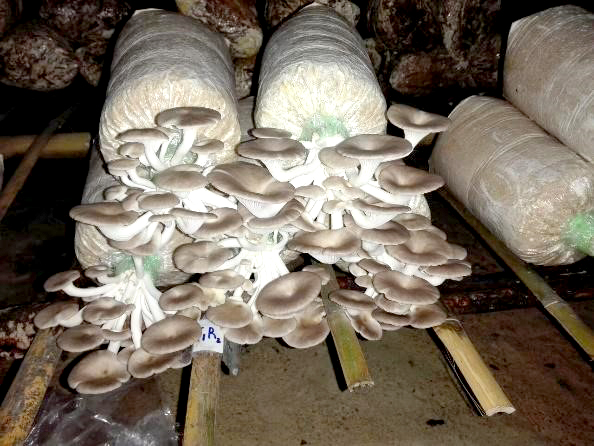
การใช้ประโยชน์จากฟางข้าวเพื่อการเพาะเห็ดนางฟ้า ตำบลโนนหมากมุ่น จังหวัดสระแก้ว
Article Sidebar
Main Article Content
บทคัดย่อ
การกำจัดฟางข้าวด้วยการเผาในชุมชนตำบลโนนหมากมุ่น อำเภอโคกสูง จังหวัดสระแก้ว ส่งผลให้เกิดปัญหาฝุ่นควันในชุมชน
งานวิจัยนี้จึงนำแนวคิดขยะเหลือศูนย์มาประยุกต์เพื่อลดมลพิษทางอากาศและลดต้นทุนการผลิตก้อนเห็ด โดยนำฟางข้าวซึ่งเป็นเศษเหลือทิ้งทางการเกษตรมาใช้ผลิตก้อนเห็ดนางฟ้า มีสมาชิกเข้าร่วมทั้งหมด 34 คน ด้วยกระบวนการ 2 ระยะ ดังนี้ ระยะที่ 1 ประกอบด้วยการศึกษาปัญหาและคัดเลือกพื้นที่กลุ่มเป้าหมาย และการเปรียบเทียบการใช้ฟางข้าวและขี้เลื่อยไม้ยางพาราเพื่อเป็นวัสดุเพาะเห็ดนางฟ้า และการวิเคราะห์คุณค่าทางอาหารของดอกเห็ด ระยะที่ 2 ประกอบด้วยการนำข้อมูลมาทบทวนและทำความเข้าใจกับชุมชน ระดมความคิด วิเคราะห์ และวางแผนการถ่ายทอดองค์ความรู้ การวิจารณ์ และแลกเปลี่ยนเรียนรู้ จากการดำเนินงานพบว่า ก้อนเห็ดที่ผลิตจากฟางข้าวมีต้นทุนถูกกว่าก้อนเห็ดที่ผลิตจากขี้เลื่อยไม้ยางพารา คุณค่าทางอาหารของดอกเห็ด
(ร้อยละของน้ำหนักแห้ง) จากก้อนเห็ดที่ผลิตจากฟางข้าว มีร้อยละของความชื้นและเยื่อใยของก้อนเห็ดสูงกว่าก้อนเห็ดที่ผลิตจากขี้เลื่อยไม้ยางพารา แต่มีโปรตีนต่ำกว่าก้อนเห็ดที่ผลิตจากขี้เลื่อยไม้ยางพารา ผลการถ่ายทอดองค์ความรู้พบว่าสมาชิกในชุมชนสามารถนำความรู้ไปใช้ประกอบอาชีพเสริม ทำให้คนในชุมชนมีรายได้เพิ่มขึ้น 3,000 บาทต่อเดือน นอกจากนี้ผู้นำชุมชนได้ถ่ายทอดองค์ความรู้เกี่ยวกับการผลิตก้อนเห็ดโดยใช้ฟางข้าวให้กับเยาวชนและผู้สูงอายุ ทำให้คนในชุมชนตระหนักถึงการรักษาสิ่งแวดล้อม และลดปัญหาการเผาเศษเหลือทิ้งทางการเกษตรในพื้นที่ได้
Article Details

อนุญาตภายใต้เงื่อนไข Creative Commons Attribution-NonCommercial-NoDerivatives 4.0 International License.
Area Based Development Research Journal values copyright protection and licensing to safeguard author rights and facilitate the appropriate dissemination of research. Our policies ensure openness, accessibility, and attribution. Authors retain copyright ownership, and articles are published under a Creative Commons Attribution License (CC BY), allowing sharing, adaptation, and proper attribution. Authors have the freedom to publish under the CC BY license, granting broad reuse and distribution permissions. The journal supports posting articles on third-party repositories, adhering to institutional and funding restrictions. Author guidelines detail copyright and licensing requirements, empowering authors with knowledge about their rights and responsibilities. These policies cultivate an environment of collaboration, openness, and responsible sharing, benefiting authors and the research community while honoring intellectual property rights.
เอกสารอ้างอิง
Air Quality and Noise Management. (2020). Situation and air quality report of Thailand. Retrieved June 12, 2020, from: http://air4thai.pcd.go.th. (in Thai).
Ampansirirat, A., & Wongchiya, P. (2017). The participatory action research: Key features and application in community. Journal of Humanities and Social Sciences Mahasarakham University, 36(6), 192-202. (in Thai).
Anchalee, J. (2014). Used composted garbage leaves in mixing with rubber tree sawdust for culturing phoenix mushroom. Thai Journal of Science and Technology, 22(4), 501-506. (in Thai).
AOAC. (2000) Official methods of analysis (17th Edition). Gaithersburg, USA: The association of official analytical chemists.
Boonjuang, P. (2020). Fund of the waste bank for life and giving of community welfare: A case study of Bakhae village – The first winner of zero waste award in Waeng Yai sub-district municipality, Waeng Yai district, Khon Kaen province. Journal of Legal Entity Management and Local Innovation, 6(2), 129-147. (in Thai).
Chinwang, S., Harnpichitvitaya, D., Wirunpan, K., Nanta, S., & Wanna, A. (2013). Lower production cost of oyster mushroom (Pleurotus ostreatus) by using agricultural wastes and weed plants as culturing substrates. Rajabhat Agriculture Journal, 12(1), 12-19. (in Thai).
Department of Environmental Quality Promotion. (2016). A success story lesson in zero waste school management. Retrieved March 15, 2021, from: www.deqp.go.th (in Thai).
Faijumpa, A. (2020). The model development of participation waste management in Jomsi sub-district administrative organization, Chiang Khan district, Loei province. Journal of Community Public Health, 6(2), 124-142. (in Thai).
Garibay-Orijel, R., Gordova, J., Cifuentes, J., Valenzuela, R., Estrada-Torres, A., & Kong, A. (2009). Integrating wild mushrooms use into a model of sustainable management for indigenous community forest. Forest Ecology and Management, 258, 122-131.
Harnkiattiwong, T. (2018). Community participation in tackling haze problem in Chiangmai province. Kasem Bundit Journal, 19 (Suppl.), 229-241. (in Thai).
Hombuppha, S., Sapruangthong, S., Tiewnukultham, B., & Subruangthong, W. (2020). The development of integrated farming system in order to solve the smog pollution problem from burning agricultural areas. Graduate Periscope Nakhon Sawan Buddhist College, 8(2), 1-16. (In Thai).
Hunhiang, N. (2017). The study of physical properties for relative humidity and temperature in the Bhutan oyster mushroom cultivating cement rounds based on the pot in pot refrigerator model. (Master’s Thesis). Faculty of Science, Burapha University. (in Thai).
Hunheing, N., Kruaphu, W., & Cheysuphaket, A. (2016). The study of physical parameters affecting on the temperature inside the cement rounds for bhutan oyster mushroom cultivation based on the pot-in-pot refrigerator model. 54th Kasetsart University Academic Conference (Natural Resources and Environment) (pp. 134-142). Bangkok: Kasetsart University. (In Thai).
Jara, A. (2014). Used composted garbage leaves in mixing with rubber tree sawdust for culturing phoenix mushroom. Thai Science and Technology Journal, 22(4), 501–506. (in Thai).
Jiumpanyarach, W. (2019). Economic impacts on cattle farmers: Forages and regions in Thailand. Humanities, Social Sciences and Arts, 12(4), 1539-1556. (in Thai).
Kasemsuk, C. (2018). Public participation approach for sustainable community development. Academic Journal of Humanities and Social Sciences, 26(50), 169-186. (in Thai).
Khamwongsa, A. (2011). Handbook of cultivating million-dollar mushrooms. Bangkok: Inter Media Printing Co., Ltd. (in Thai).
Limuntachai, N. (2018). MAI public and people participation in preventing wildfire and haze pollution in Doi Suthep-pui national park in Chiang Mai. ARU Research Journal, 5(2), 77-84. (in Thai).
Mekkapan-Opas, S., Buarapa, U. & Namhai, T. (2020). Designing agricultural landscapes for sustainable Wapi Pathum district Maha Sarakham province. Journal of Architecture, Design and Construction, 2(2), 41-51. (in Thai).
Non Mak Mun Subdistrict Administrative Organization. (2018). Four-year development plan 2018-2021. Retrieved March 10, 2021, from: www.noonmakmun.go.th (in Thai).
Phasinam, K., Wongphansuea, S., Seedaeng, P., Kassanuk, T., & Sreera-or, C. (2020). A study of optimal proportion on the growth of Mycelium Pleurotus sajor-caju by using rain tree sawdust, Para rubber sawdust and rice straw as material. Agricultural Science Journal, 51(1)(Suppl.), 163-167. (in Thai).
Pollution Control Department. (2018). The study of origin and management guidelines for dust particles size not more than 2.5 microns in Bangkok and metropolitan areas. Retrieved April 15, 2021, from: https://www.pcd.go.th. (in Thai).
Ruengpisan, R. (2007). A comparative study of the yield of Sarjor-caju mushroom cultivated with rubber wood sawdust under different resolution ratios. (Bachelor’s thesis). Faculty of Science, Buriram Rajabhat University.
Rupitak, Q., Peepanich, J., Dawruang, R., & Sophe, G. (2016). Study on mycelial growth and yield of Bhutanese oyster mushroom (Pleurotus pulmonarius) by using Bagasse and ground Bagasse as material. Songklanakarin Journal of Plant Science, 3(3) (Suppl.), 48-53. (in Thai).
Sa Kaeo Provincial Administrative Organization. (2019). Local development plan (2018-2022). Retrieved April 10, 2021, from: http://www.sakaeo.go.th. (in Thai).
Santiago, J. C., David, E. S., & Valentino, M. J. G. (2016). Proximate composition profiling of the rice straw enriched with mycoprotein of fungal endophytes. Advances in Applied Science Research, 7(4), 100-103.
Siangsuepchart, A., Khemwong, W., Phonhan, A., & Kalawong, S. (2020). Application of central composite design to optimize substrate mixture for oyster mushroom-Hungary production using water Hyacinth. Songklanakarin Journal of Plant Science, 7(1), 104-112. (in Thai).
Sirisumpan, R., & Karapan, R. (2018). The production of knowledge collection from cultural wisdom for community: Folkways and sufficiency from the application of knowledge with sufficiency economy philosophy. Chophayom Journal, 29(1), 453-462. (in Thai).
Sothiratviroj, N. (2018). Form of agriculture’s development for sustainable agricultural. Management of Koh Kret agricultural community, Amphoe. Pakkret, Nonthaburi. Panyapiwat Journal, 10(2), 210-224. (in Thai).
Sriprom, W. (2013). Reduction of microbial contamination in mushroom spawns and yield enhancement of Pleurotus ostreatus and Auricularia polytricha. (Master’s thesis). Faculty of Science, Chiang Mai University. (in Thai).
Sukkorn, K., Vipasrinimit, P., & Supachantarasuk, S. (2017). Communities participation on strategic management of Wang river. Veridian E-Journal, Silpakorn University (Humanities, Social Sciences and Arts), 10(2), 1969-1989. (in Thai).
Suthathip, W., Ployprilin, S., Thanwamas, K., & Khongdet, P. (2018). Study of using rain tree sawdust, rubber tree sawdust and rice straw for Pleurotus sajor caju mushroom cultivation material. The 24th National Agricultural Engineering Day (Engineering) (pp.169-176). Mahasarakham: Mahasarakham University. (in Thai).
Tanarungrangsee, K., Laohakunjit, N., & Kerdchoechuen, O. (2015). Physicochemical and functional properties of dietary fiber from rice straw by alkaline extraction. Agricultural Science Journal, 46(3)(Suppl.), 461-464. (in Thai).
Thampitak, N. (2011). Effect of using fermented rice husk as a substitute for rubber wood sawdust for cultivation of sarjor-caju mushroom and oyster mushrooms. (Bachelor’s thesis). Chiang Rai College of Agriculture and Technology, Chiang Rai Rajabhat University. (in Thai).
Tiptanatoranin, A. (2015). The solving guidelines of smog problem for Chiang Mai province. Journal of Public Administration and Politics, 4(1), 72-105. (in Thai).
Waste and Hazardous Substance Management Bureau. (2018). Operation manual (3R) to manage community waste (2nd edition). Bangkok: Hez Co., Ltd. (in Thai).
Worachisanupong, W. (2018). Community waste management in Ban Dong Mada Municipality, Mae Lao district, Chiang Rai province. National Academic Conference 14th (Social Sciences) (pages 289-313). Chiang Rai: Chiang Rai Rajabhat University. (in Thai).
