Contemporary painting creation of lotus According to the concept of creative economy
Article Sidebar
Main Article Content
Abstract
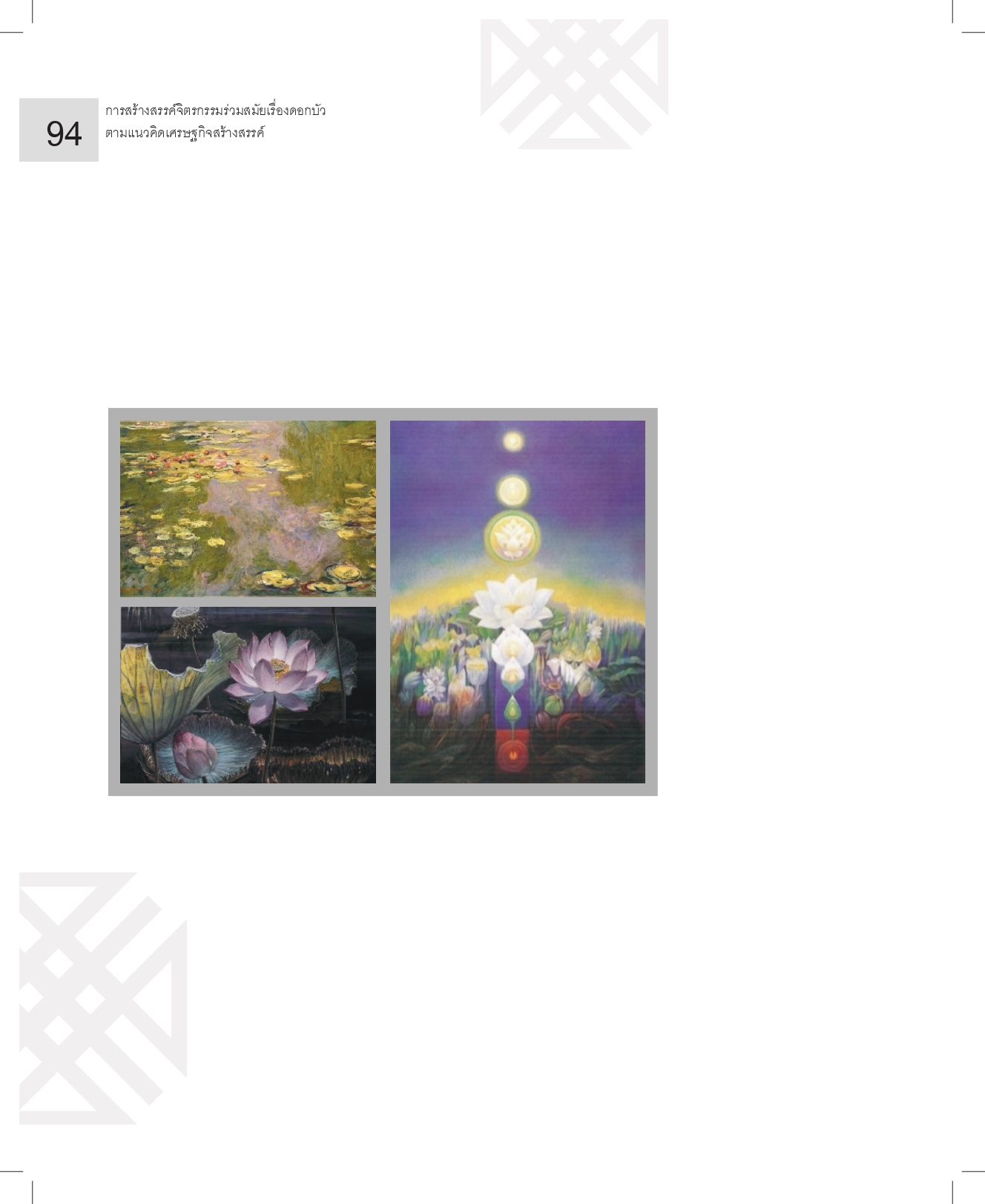
This research aims to study the forms, patterns, shapes, and meanings of lotuses within the Lotus Museum at Rajamangala University of Technology Thanyaburi under the context of local arts and culture. The knowledge acquired is utilized to create contemporary paintings that employ the lotus as a symbol reflecting belief, faith, and cultural identity, while further expanding into prototype product design based on the creative economy concept. Field surveys were conducted to collect data on the atmosphere, light, color, and physical characteristics of lotuses, which were then analyzed in conjunction with artists' concepts and contemporary artworks. The creative process focuses on transmitting spiritual values and local cultural capital through composition, color, and texture, thereby achieving unity between content and form in accordance with the Impressionist approach.
The research findings indicate that it is possible to create unique contemporary lotus paintings that reflect local beliefs, faith, and cultural values. Furthermore, these paintings can serve as blueprints for designing and developing products under the creative economy framework. This process yields contemporary prototype products and souvenirs, thereby generating economic value added and systematically supporting the preservation of local cultural capital.
Article Details

This work is licensed under a Creative Commons Attribution-NonCommercial-NoDerivatives 4.0 International License.
The original manuscript published in the Burapha Arts Journal, Faculty of Fine and Applied Arts, Burapha University, is the property of Burapha University. No part of this text may be reproduced in whole or in part without written permission from the university.
References
กัญญาภัค ผังดี. (2561). ความงามและจินตนาการจากดอกไม้ [ปริญญานิพนธ์ศิลปบัณฑิต, มหาวิทยาลัยนเรศวร].
ชัยนรงค์ อริยประเสริฐ, และ วาทานาพุน ครูทาส. (2566). การวิเคราะห์กิจกรรมศิลปะและการออกแบบเพื่อสร้างแหล่งท่องเที่ยวชนบทสมัยใหม่ในงานสวัสดีชัยนาท. วารสารศิลป์ พีระศรี, 11(1), 97–118.
ชลูด นิ่มเสมอ. (2534). องค์ประกอบศิลป์. ไทยวัฒนาพานิช.
ทวีวัฒน์ จิตติเวทกุล. (2565). แนวทางการจัดการศึกษาด้านศิลปกรรมที่ส่งเสริมเศรษฐกิจเชิงสร้างสรรค์. วารสารสังคมศาสตร์และวัฒนธรรม, 6(2), 49–63. https://so06.tci-thaijo.org/index.php/JSC/article/view/260463
วิรุณ ตั้งเจริญ. (2526). ศิลปะกับการรับรู้. วิศวกรรมสาร.
วิรุณ ตั้งเจริญ. (2545). สุนทรียศาสตร์. อีแอนด์โอ.
ศิยารัตน์ แก้วคีรี, และ ไชยพจน์ หวลมานพ. (2564). จิตรกรรมไทยร่วมสมัยรูปบัว: สัญลักษณ์ในการสื่อความหมายเชิงพุทธปรัชญา [วิทยานิพนธ์ศิลปมหาบัณฑิต, มหาวิทยาลัยเทคโนโลยีราชมงคลธัญบุรี].
สำนักงานจังหวัดปทุมธานี. (2566). แผนพัฒนาจังหวัดปทุมธานี พ.ศ. 2566–2570. สำนักงานจังหวัดปทุมธานี. https://gdcatalog.go.th/dataset/gdpublish-http-www-pathumthani-go-th-new-web-webplan-index-html/resource/9bf8a8ee-e4d3-4e0c-9b4b-e20852ffb904
สำนักงานสภาพัฒนาการเศรษฐกิจและสังคมแห่งชาติ. (2561). ยุทธศาสตร์ชาติ (พ.ศ. 2561–2580). สำนักนายกรัฐมนตรี. https://www.nesdc.go.th/download/01-ยุทธศาสตร์ชาติ-พ-ศ-2561-2580/
สำนักงานสภาพัฒนาการเศรษฐกิจและสังคมแห่งชาติ. (2565). แผนพัฒนาเศรษฐกิจและสังคมแห่งชาติ ฉบับที่ 13 พ.ศ. 2566–2570. สำนักนายกรัฐมนตรี. https://www.nesdc.go.th/the-national-economic-and-social-development-plan/the-thirteenth-plan-2023-2027/
อารี สุทธิพันธุ์. (2525). ทฤษฎีสีและการนำไปใช้. โอเดียนสโตร์.