
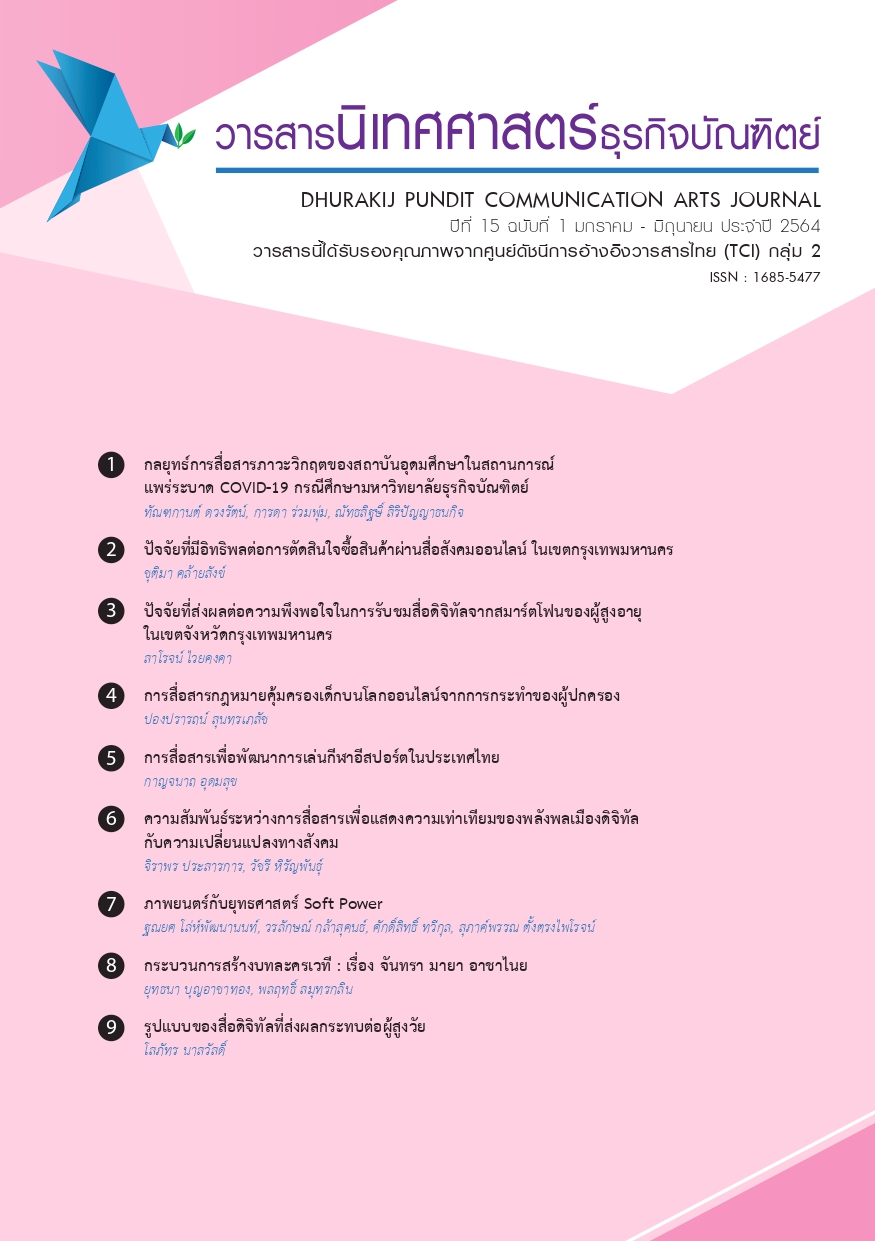
The Correlation between Communication for Equality of Digital Citizen Power and Social Change.
Keywords:
Communication for Equity/ Digital Citizen Power/ Social Change.Abstract
This research aimed to study communication behavior for equality of digital citizens and the correlation between attitudes towards communication for equality and social change. The concepts of digital citizen, attitude towards communication for equality and social change were adopted to be a research conceptual framework. The samples were 204 people, aged 15 to 50 years old and used to comment for social change at least once time on digital media. The questionnaires were used to collect data. Data were analyzed by using frequency, percentage, mean, standard deviation, and correlation analysis by Pearson's product correlation coefficient.
The results revealed that 15-20 years old was the first time that the samples communicated for equality in digital media. They explored their ideas through Facebook, Instagram and Twitter. They sent the messages and pictures posted in private areas, shared content about equality, present their points of view and criticized on the inequality that occurred in society. A lack of social equality is the main reason for commenting on social media. They realized that general people can be active as digital citizens and can provoke social change. The overall correlation between attitudes towards communication for equality and social change was at a moderate level (r = .590) with statistically significant at .01 level. The social change issues that have positive correlation were the different acceptance in society, the convenience for rights claiming and the respect others’ dignity of the people in society.
References
กระทรวงดิจิทัลเพื่อเศรษฐกิจและสังคม. สำนักงานส่งเสริมเศรษฐกิจดิจิทัล. (2561). ความเป็นพลเมืองดิจิทัล: พลเมืองแห่งศตวรรษที่ 21. สืบค้น 10 กุมภาพันธ์ 2564, จาก https://thaidigizen.com/digital-citizenship/ch1-digital-citizenship/
กรุณพร เชษฐ์พยัคฆ์. (2561). สังคมนิยมชายถูกสั่นคลอน เมื่อเกาหลีใต้ ส่งเสียงเคลื่อนไหวกับแคมเปญ MeToo. สืบค้น 10 ธันวาคม 2563, จาก https://thematter.co/social/metoo-movement-in-southkorea/47660
ความเป็นพลเมืองดิจิทัล: พลเมืองแห่งศตวรรษที่ 21. (ม.ป.ป.). สืบค้น 25 พฤศจิกายน 2563, จาก https://thaidigizen.com/digital-citizenship/ch1-digital-citizenship/
โครงการอินเทอร์เน็ตเพื่อกฎหมายประชาชน. (2564). เปิดกฎหมายอาญาแก้ไขใหม่ #ทำแท้งปลอดภัย ได้ในอายุครรภ์ 12 สัปดาห์. สืบค้น 26 มีนาคม 2564 จาก, https:// iLaw.or.th.
เฉลิมพล แจ่มจันทร์. (2563). วัยรุ่นและเยาวชนกับสื่อสังคมออนไลน์. สืบค้น 17 มีนาคม 2564, จาก https://www.thaihealthreport.com/article-july03-2020
ซันนี่วอล์คเกอร์. (2561, 22 มกราคม). MeToo เมื่อการติดแฮชแท็กเป็นการแสดงพลังต่อต้านการคุกคามทางเพศจากผู้มีอำนาจ. สืบค้น 19 ธันวาคม 2563, จาก https://www.blognone.com/node/99259
ซิปอีเวนท์. (2563). พฤติกรรมของ GEN Z ในบทบาทใหม่กับการขับเคลื่อนทางสังคม. สืบค้น 17 มีนาคม 2564, จาก https://www.zipeventapp.com/blog/2020/07/09/gen-z
โซเชียลตื่นตัวชวนคนร่วมแสดงความเห็นหนุนแก้กฎหมาย#สมรสเท่าเทียม. (2563, 7 กรกฎาคม). ไทยรัฐ. https://www.thairath.co.th/news/society/1883780
เดอะ บางกอก อินไซท์. (2563). ไม่เอา พ.ร.บ.คู่ชีวิต มาแรง ชาวเน็ตแห่ต้าน ชี้ไม่ใช่สมรสเท่าเทียม. สืบค้น 16 ธันวาคม 2563, จาก https://www.thebangkokinsight.com/391359/
ทั่วโลกร่วมประท้วงเรียกร้องยุติการเหยียดสีผิว. (2563, 8 มกราคม). ฐานเศรษฐกิจ. https://www.thansettakij.com/content/world/437536
ธีรวุฒิ เอกะกุล. (2543). ระเบียบวิธีวิจัยทางพฤติกรรมศาสตร์และสังคมศาสตร์. สถาบันราชภัฏอุบลราชธานี.
บริษัท เอาเวอร์ กรีนฟิช จำกัด. (2563). สถิติดิจิทัล ของประเทศไทยจาก Digital Thailand ประจำปี 2020. สืบค้น 17 มีนาคม 2564, จาก https://blog.ourgreenfish.com
ปฏิภาณ ชัยช่วย และกุลทิพย์ ศาสตระรุจิ. (2559). การสื่อสารประเด็นสาธารณะของสังคมไทยผ่านนวัตกรรมการสื่อสารเพื่อการรณรงค์ เว็บไซต์ Change.org. มหาวิทยาลัยศิลปากร.
ประภาเพ็ญ สุวรรณ. (2526). ทัศนคติการวัดความเปลี่ยนแปลงทางพฤติกรรมอนามัย. ไทยวัฒนาพานิช.
พงษ์ วิเศษสังข์. (2554). เทคโนโลยีสารสนเทศกับการเปลี่ยนแปลงทางสังคม Information Technologies and Social Changes. มหาวิทยาลัยกรุงเทพ.
เหยียดสีผิว กระแสที่ยังจุดติดเสมอในอิตาลี. (2556, 30 กรกฎาคม). วอยซ์ทีวี. สืบค้น 11 พฤศจิกายน 2563, จาก https://www.voicetv.co.th/read/77077
รัชดา ไชยคุปต์. (2562, 16 กันยายน). รู้จักและเข้าใจความเสมอภาคทางเพศ. คมชัดลึก. https://www.komchadluek.net/news/scoop/388697
วิกิพีเดีย สารานุกรมเสรี. (2563, 17 มิถุนายน). ความเสมอภาคทางสังคม. สืบค้น 21 พฤศจิกายน 2563, จาก https://th.wikipedia.org/wiki/ความเสมอภาคทางสังคม
ศิริชัย กาญจนวาสี. (2544). การเลือกใช้สถิติที่เหมาะสมสำหรับการวิจัย (พิมพ์ครั้งที่ 4). บุญศิริการพิมพ์.
สุกัญญา สุดบรรทัด. (2560). วิถีแห่งพลเมืองเน็ต. สืบค้น 18 กันยายน 2563, จากhttps://www.law.cmu.ac.th/law2011/goto.php?action=document&id=3585
สุพิชัย ศิริรักษ์. (2550). สิทธิและเสรีภาพของคนงานตามรัฐธรรมนูญแห่งราชอาณาจักรไทย พ.ศ. 2540. มหาวิทยาลัยธุรกิจบัณฑิตย์.
อานนท์ วรยิ่งยง, ทศพร วิมลเก็จ, วิภา ด่านธำรงกูล, อัมราวดี อินทะกนก,เกรียงไกร พึ่งเชื้อ, ณัฐวรรณ ดีเลิศยืนยง, ..., สมชาย อิสระวาณิชย์. (2547). เครือข่ายสังคมและเพศสัมพันธ์กลุ่มชายชอบชาย. จุฬาลงกรณ์มหาวิทยาลัย.
แอมเนสตี้ อินเตอร์เนชั่นแนล ไทยแลนด์. (2561). สิทธิมนุษยชนคืออะไร. สืบค้น 5 กุมภาพันธ์ 2564, จาก https://www.amnesty.or.th/latest/blog/62/
Bettinghaus, E. P., & Cody, M. J. (1987). Persuasive communication, (4th ed.). Holt, Rinehart and Winston.
Digital Technologies Hub. (2019). Digital cityzenchip. Retrieved January 15, 2021, from https://www.digitaltechnologieshub.edu.au/teachers/topics/digital-citizenship
Duck, S. (2007). Human relationships (7th ed.). Sage.
Electronic Transactions Development Agency. (2018). Thailand internet user profile 2018.
Retrieved December 22, 2020, from https://www.etda.or.th/publishing-detail/thailand-internet-user-profile-2018.html
Gavino, M. C., Williams, D., Jacobson, D., & Smith, I. (2019). Latino entrepreneurs and social media adoption: personal and business social network platforms. Management Research Review, 42(4), 469-494. doi: 10.1108/MRR-02-2018-0095
Giles, H., & Wiemann, J. M. (1987). Language, social comparison, and power. In S. Chaffee & C. R. Berger (Eds.), Handbook of communication science (pp. 350-384). Sage.
Gleason, B. (2016). New literacies practices of teenage twitter users. Learning, Media and Technology, 41(1), 31-54.
Gleason, B., & Von Gillern, S. (2018). Digital citizenship with social media: Participatory practices of teaching and learning in secondary education. Educational Technology & Society, 21(1), 200–212.
Human Rights Day. (2020, December 10). Retrieved January 3, 2021, from https://www.daysoftheyear.com/days/human-rights-day/
Internet Rights and Principles Dynamic Coalition. (2014). The charter of human rights and principles for the internet (4th ed.). Retrieved from https://www.ohchr.org/Documents/Issues/Opinion/Communications/InternetPrinciplesAndRightsCoalition.pdf
Mondel, P. (2021). Top 6 factors of social change – explained. Retrieved from https://www.yourarticlelibrary.com/sociology/top-6-factors-of-social-change-explained/35127
Persell, C. H. (1987). Understanding society: an introduction to sociology (2nd ed.). Harper & Row.
Ribble, M. S., Bailey, G. D., & Ross, T. W. (2004). Digital citizenship addressing appropriate technology behavior. ISTE International Society for Technology in Education, 32(1), 6- 12.
Saheb D. (2021). 7 Main factors which affect the social change in every society. Retrieved December 7, 2020, from https://www.shareyouressays.com/knowledge/7-main-factors-which-affect-the-social-change-in-every-society/112456
Downloads
Published
Issue
Section
License
ลิขสิทธิ์เป็นของวารสาร....


