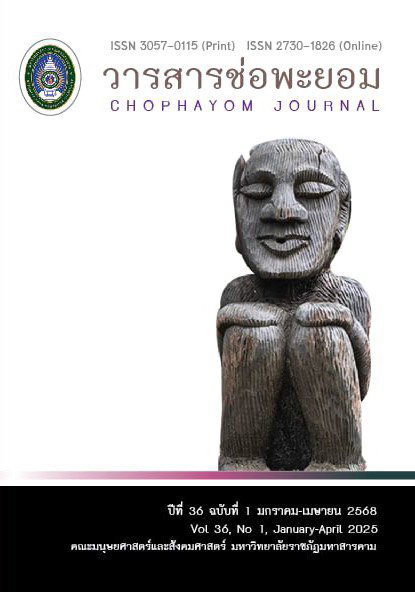
Woodcarving Handicrafts in the Wood Carving Community of Nong Bueng Village, Pathumphon Town, Champasak Province, Lao PDR.
Keywords:
woodcarving handicraftsAbstract
This study examines the wood carving handicrafts in the wood carving community of Nong Bueng Village, Pathumphon District, Champasak Province, Lao People's Democratic Republic. The objectives of the research are: (1) to investigate the historical background of wood carving handicrafts in the Nong Bueng community, and (2) to analyze the stylistic elements and belief systems reflected in the wood carving works.
The study employs a qualitative research methodology, including document analysis, fieldwork observations, and interviews. Research tools included observation and interviews with one local expert, two local artisans, and three entrepreneurs, supplemented by group discussions. The analysis was conducted using semiotic theory and the concept of myth to interpret the forms and beliefs inherent in the wood carving handicrafts.
The results reveal that Nong Bueng Village was established through the amalgamation of four villages, whose inhabitants are connected by kinship ties. Supplementary occupations that generate additional income for the villagers include wood and stone carving, both of which have developed from indigenous knowledge. The wood-carving souvenirs produced in the community can be categorized into three groups: human figures, animals, and objects. These groups reflect various influences on the artisans, namely: (1) cultural traditions and ways of life; (2) geographical and environmental factors; and (3) local belief systems.
In the context of the wood carvings located in the Hor Khuan (a traditional spiritual house), the artworks are classified into two types: free-standing sculptures and bas-relief carvings. Semiotic analysis revealed that the Hor Khuan houses a carved wooden sculpture of the community leader, with intricate carvings adorning all major structural elements. This reflects that Nong Bueng Village is situated in a fertile geographical area rich in forest resources and maintains traditional cultural practices involving spirit and deity worship. The carved depictions of deities at the building’s corners and scenes of local community life, analyzed through the concept
of myth, convey beliefs in ancestor worship, reverence for spirits, attachment to the natural environment, and the continuity of a humble, friendly, and culturally rich way of life.
Keywords: woodcarving handicrafts
References
กาญจนา แก้วเทพ. (2543). ศาสตร์แห่งสื่อและวัฒนศึกษา. กรุงเทพฯ: เอดิสันเพรส โปรดักส์.
นพดล วศินสนทร. (2556). แนวคิดสัญวิทยาและการสร้างความหมาย (Semiology and Signification) ( เอกสารประกอบการบรรยายเสริมความรู้ทางด้านทฤษฎี). เชียงใหม่: สาขาวิชานิเทศศาสตร์ คณะวิทยาการจัดการ มหาวิทยาลัยราชภัฏเชียงใหม่.
นิยมพรรณ วรรณศิริ. (2550). มนุษยวิทยาสังคมและวัฒนธรรม. กรุงเทพฯ: เอ็กซ์เปอร์เน็ท.
มะนีวอน แพงโสม. (2552). วาทกรรมว่าด้วยเรื่อง"บ้านพัฒนา": กรณีศึกษาหมู่บ้านหนองบึง เมืองปะทุมพอนแขวงจำปาสัก สาธารณรัฐประชาธิปไตยประชาชนลาว. อุบลราชธานี: มหาวิทยาลัยอุบลราชธานี.
มิน เกดมะนี. (2567, 16 ตุลาคม). ช่างแกะสลัก. สัมภาษณ์.
วิบูลย์ ลี้สุวรรณ. (2553). ศิลปทัตถกรรมพื้นบ้าน. พิมพ์ครั้งที่ 4 .กรุงเทพฯ: ต้นอ้อแกรมมี่.
ศุภชัย สิงห์ยะบุศย์. (2544). โครงการสารคดีลาวตอนล่าง. กรุงเทพฯ: จุฬาลงกรณ์มหาวิทยาลัย.
สุเนตร โพธิสาร (2558). ทฤษฎีทางวัฒนธรรม มนุษย์และสังคม. ขอนแก่น: คณะศิลปกรรมศาสตร์ มหาวิทยาลัยขอนแก่น.
Downloads
Published
How to Cite
Issue
Section
License
Copyright (c) 2025 Chophayom Journal

This work is licensed under a Creative Commons Attribution-NonCommercial-NoDerivatives 4.0 International License.