
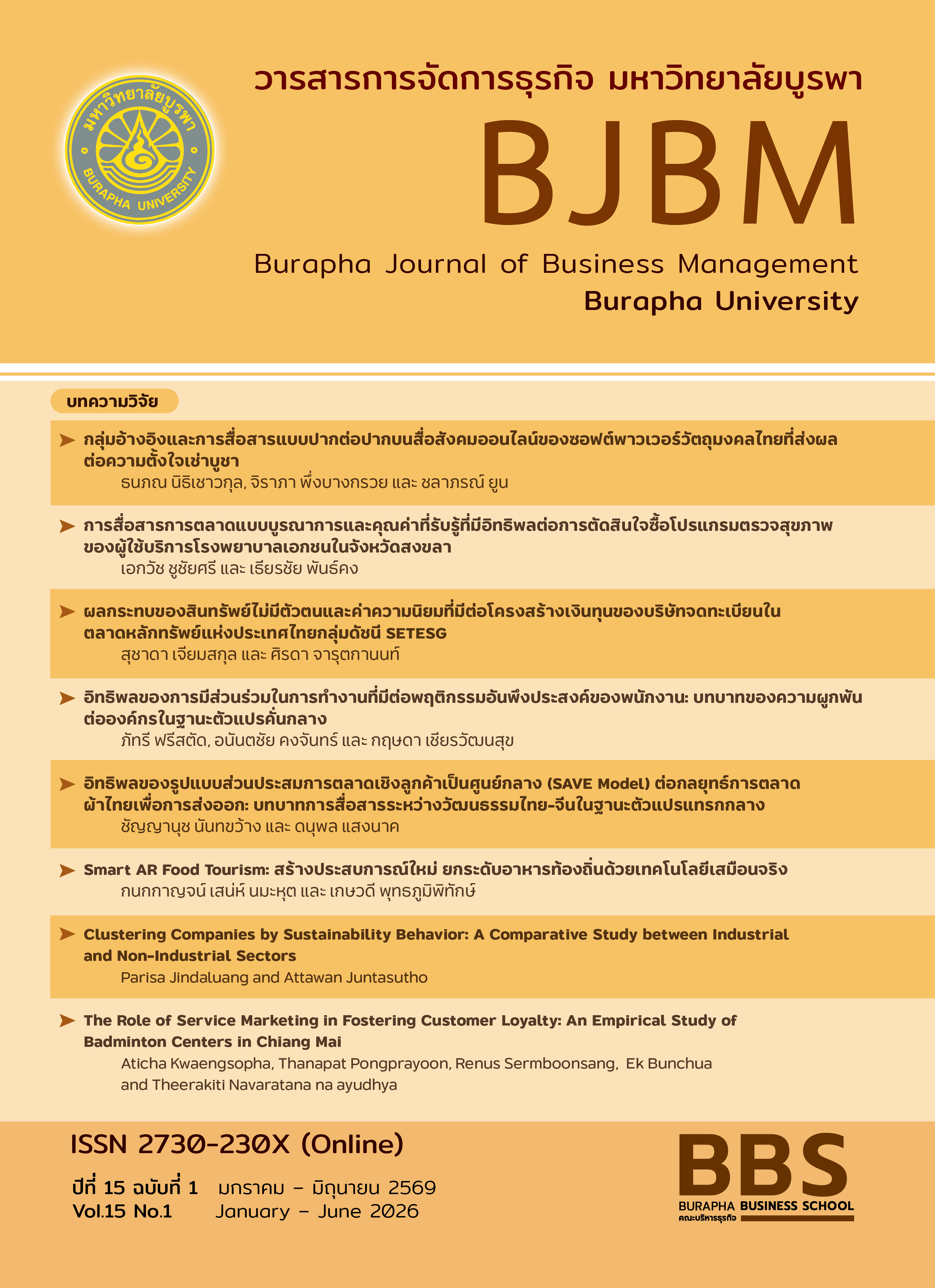
ผลกระทบของสินทรัพย์ไม่มีตัวตนและค่าความนิยมที่มีต่อโครงสร้างเงินทุน ของบริษัทจดทะเบียนในตลาดหลักทรัพย์แห่งประเทศไทยกลุ่มดัชนี SETESG
Article Sidebar
Main Article Content
บทคัดย่อ
งานวิจัยนี้มีวัตถุประสงค์เพื่อศึกษาโครงสร้างเงินทุน และผลกระทบของสินทรัพย์ไม่มีตัวตน และค่าความนิยมที่มีต่อโครงสร้างเงินทุนของบริษัทจดทะเบียนในตลาดหลักทรัพย์แห่งประเทศไทยในกลุ่มดัชนี SETESG โดยศึกษาข้อมูลจากกลุ่มตัวอย่างในระหว่างปีพ.ศ. 2562 - 2566 จำนวน 457 ตัวอย่าง จากการวิเคราะห์สมการถดถอยเชิงพหุ ผู้วิจัยพบว่าสินทรัพย์ไม่มีตัวตนรวมและสินทรัพย์ไม่มีตัวตนที่ไม่รวมค่าความนิยมมีความสัมพันธ์เชิงบวกอย่างมีนัยสำคัญทางสถิติกับโครงสร้างเงินทุนของบริษัท อย่างไรก็ตามผู้วิจัยไม่พบความสัมพันธ์ระหว่างค่าความนิยมและโครงสร้างเงินทุนของบริษัท
ผลวิจัยนี้สนับสนุนทฤษฎีการจัดลำดับขั้นและทฤษฎีการส่งสัญญาณ โดยแสดงให้เห็นว่าสินทรัพย์ไม่มีตัวตนของบริษัทจดทะเบียนในกลุ่มดัชนี SETESG ถูกใช้เป็นสินทรัพย์ในการก่อหนี้ได้เช่นเดียวกับสินทรัพย์ที่มีตัวตน บริษัทที่มีสินทรัพย์ไม่มีตัวตนสูงใช้ทางเลือกในการก่อหนี้แทนการระดมทุนจากผู้ถือหุ้น อาจเนื่องจากต้นทุนที่ต่ำกว่าและสามารถใช้ประโยชน์ของการประหยัดภาษีได้ อีกทั้งบริษัทที่มีสินทรัพย์ไม่มีตัวตนสูงใช้การก่อหนี้เป็นการส่งสัญญาณให้ทราบว่าสินทรัพย์ไม่มีตัวตนมีความเสี่ยงต่ำ
Article Details

อนุญาตภายใต้เงื่อนไข Creative Commons Attribution-NonCommercial-NoDerivatives 4.0 International License.
บทความที่จะตีพิมพ์เพื่อเผยแพร่ในวารสารการจัดการธุรกิจ มหาวิทยาลัยบูรพา จะต้องเป็นบทความที่ไม่เคยได้รับการตีพิมพ์เผยแพร่หรืออยู่ระหว่างการพิจารณาเพื่อตีพิมพ์เผยแพร่ในวารสารอื่น ๆ ทั้งนี้ หากพบว่ามีการละเมิดลิขสิทธิ์ ด้วยข้อคิดเห็นที่ปรากฏและแสดงในเนื้อหาบทความต่าง ๆ ให้ถือว่าเป็นความเห็นและความรับผิดชอบโดยตรงของผู้เขียนบทความนั้น ๆ มิใช่ความเห็นและความรับผิดชอบใด ๆ ของคณะบริหารธุรกิจ มหาวิทยาลัยบูรพา สำหรับในกรณีผู้ประสงค์จะนำข้อความในวารสารการจัดการธุรกิจ มหาวิทยาลัยบูรพา ไปเผยแพร่ต้องได้รับอนุญาตจากกองบรรณาธิการวารสารการจัดการธุรกิจ มหาวิทยาลัยบูรพา ตามกฎหมายว่าด้วยลิขสิทธิ์
เอกสารอ้างอิง
Bangkokbiznews. (2023). Business mergers and acquisitions surge in 4 years, 137 cases, value exceeding 4 trillion baht. Retrieved August 4, 2024, from https://www.bangkokbiznews.com/ business/ economic/1093479.
Beatty, A., Weber, J., & Yu, J. J. (2008). Conservatism and debt. Journal of Accounting and Economics, 45(2–3), 154-174. https://doi.org/10.1016/j.jacceco.2008.04.005.
d'Arcy, A., & Tarca, A. (2018). Reviewing IFRS Goodwill Accounting Research: Implementation Effects and Cross-Country Differences," The International Journal of Accounting, Elsevier, 53(3), 203-226. https://doi.org/10.1016/j.intacc.2018.07.004.
Dudney, D; Haris, C., Li, Z., & Morillon, T. (2024). The impact of intangible assets on capital structure in Asia. Journal of Accounting and Finance, 24(2), 203-221. https://doi.org/ 10.33423/jaf.v24i2.7054.
Farooq, O. (2015). Effect of ownership concentration on capital structure: evidence from the MENA region. International Journal of Islamic and Middle Eastern Finance and Management, 8(1), 99-113. https://doi.org/10.1108/IMEFM-10-2013-0115.
Federation of Accounting Professions. (2023a). Thai Accounting Standard No.36 (Bounded
Federation of Accounting Professions. (2023b). Thai Accounting Standard No.38 (Bounded volume 2023) Intangible Assets. Federation of Accounting Professions.
Federation of Accounting Professions. (2023c). Thai Financial Reporting Standard No.3 (Bounded volume 2023) Business Combination. Federation of Accounting Professions.
Federation of Accounting Professions. (2023d). Thai Financial Reporting Standard No.10 (Bounded volume 2023) Consolidated Financial Statements. Federation of Accounting Professions.
Frankel, R., Seethamraju, C., & Zach, T. (2008). GAAP goodwill and debt contracting efficiency: Evidence from net worth covenants. Review of Accounting Studies, 13(1), 87–118. https://doi.org/10.1007/s11142-007-9045-0.
Garanina, T., & Pavlova, Y. (2011). Intangible assets and value creation of a company: Russian and UK evidence. Proceedings of the 3rd. European Conference on Intellectual Capital, 165-175.
Gil-Alana, L. A., Iniguez-Sanchez, R., & Lopez-Espinosa, G. (2011). Endogenous problems in cross-sectional valuation models based on accounting information. Rev Quant Finan Acc, 37(2), 245–265. https://doi.org/10.1007/s11156-010-0203-2.
Hang, M., Geyer-Klingeberg, J., Rathgeber, A. W., & Stöckl, S. (2018). Measurement matters- a meta study of the determinants of corporate capital structure. Quarterly Review of Economics and Finance, 68, 211-225. https://doi.org/10.1016/j.qref.2017.11.011.
Jangruxsakul, S., Witheeprai, W., Wirat, K., Chayapan, K., Thonghattha, T., & Petchchedchoo, P. (2021). Factors Affecting Capital Structure of Listed Companies in SET 100. Suthiparithat Journal, 35(1), 175-193
Jensen, M.C., & Meckling, W. H. (1976). Theory of the firm: managerial behavior, agency costs and ownership structure. Journal of Finance Economics, 3(4), 305-360.
Jonassen, C., & Cornéer, P. (2021). A quantitative study of how capital structure is affected by intangible assets - the case of Sweden. Thesis of master’s degree, Gothenburg University.
Kannika, W., & Banchuenvijit, W. (2019). Factors Which Affect the Capital Structures of Lised Companies in SET CLMV. Interdisciplinary Social Sciences and Communication Journal, 2(3), 207-221.
Kraus, A., & Litzenberger, R. H. (1973). A state-preference model of optimal financial leverage. The Journal of Finance, 28(4), 911-922. https://doi.org/10.2307/2978343.
Lee, M. Y. (2016). On the Durbin-Watson statistic based on a Z-test in large samples. International Journal of Computational Economics and Econometrics, 6(1),114-121. https://doi.org/10.1504/IJCEE.2016.073370.
Lev, B., Radhakrishnan, S., & Zhang, W. (2009). Organization capital. Abacus, 45(3), 275–298. https://doi.org/10.1111/j.1467-6281.2009.00289.
Lim, S. V., Macias, A. J., & Moeller, T. (2020). Intangible assets and capital structure. Journal of Banking & Finance, 118(c), 1-24. https://doi.org/10.1016/j.jbankfin.2020.105873.
Mohanlingam S., Nguyen, L.T.P, & Mom, R. (2021). The effects of intangible assets on financial performance and financial policies of listed technology firms in Thailand. Apheit International Journal, 10(1), 1-17.
Myers, S. C. (1984). The capital structure puzzle. Journal of Finance, 39(3), 575-592.
Noohuang, J., & Pongsupatt, A. (2021). Factors Affecting Capital Structure of Listed Companies in The Stock Exchange of Thailand 100 INDEX (SET 100). Journal of Buddhist and Education and Research, 7(3), 16-29.
Ocak, M., & Fındık, D. (2019). The impact of intangible assets and sub-components of intangible assets on sustain able growth and firm value: Evidence from Turkish listed firms. Sustainability, 11(19), 1-23. https://doi.org/10.3390/su11195359.
Peng, Y. T., Zeng, J. Y., & Chang, J. S. (2021). Exploring the relevance of intangible assets and capital structure. International Journal of Trade, Economics and Finance, 12(6), 144-148. https://doi.org/10.18178/ijtef.2021.12.5.709.
Qureshi, M. J., & Siddiqui, D. A. (2020). The Effect of Intangible Assets on Financial Performance, Financial Policies, and Market Value of Technology Firms: A Global Comparative Analysis. Asian Journal of Finance and Accounting, 12(1), 26-57. https://doi.org/10.5296/ajfa.v 12i1.16655.
Ratchapaetayakom, S., & Bangchokdee, S. (2020). Firm Characteristics Related to Capital Structure of CG Rating Companies in The Stock Exchange of Thailand. Srinakharinwirot Business Journal, 11(2), 112-129.
Ross, S.A. (1977). The determination of financial structure: the incentive-signaling approach. The Bell Journal of Economics, 8(1), 23-40. https://doi.org/10.2307/3003485.
Semsomboon, M. (2018). The Relationship between Goodwill from Business Combinations and Financial Ratios of the Group of Companies in Service Industry Listed on the Stock Exchange of Thailand. Kasem Bundit Journal, 18(3), 82-96.
Shrestha, N. (2020). Detecting Multicollinearity in Regression Analysis. American Journal of Applied Mathematics and Statistics, 8, 39–42. https://doi.org/10.12691/ajams-8-2-1.
Stewart, T. A. (1995). Trying to grasp the intangible. Fortune, 137(2), 157–161.
Thailand Development Research Institute. (2016). Can intellectual property be used as collateral for loans? Retrieved August 4, 2024, from https://tdri.or.th/2016/10/2016-09-01.
Thakur, O.A., Tunde, M.B., Noordin, B. A., Alam, M. K., & Prabowo, M. A. (2024). The relationship between goodwill and capital structure and the moderating effect of financial market development. Journal of Economics, Finance and Administrative Science. 29(57), 121-145. https://doi.org/10.1108/JEFAS-04-2022-0107.
Thessrimuang, S., & Kaewprapa, K. (2018). The Relationship between Intangible Assets and Abnormal Returns of Listed Companies in the Stock Exchange of Thailand. Journal of Accountancy and Management, 10(2), 179-188.
Van Ark, B., A., Hao, J., Corrado, C., & Hulten, C. (2009). Measuring intangible capital and its contribution to economic growth in Europe. European Investment Bank (EIB), 14(1), 62-93.
Waenkaeo, K., & Waroonkun, S. (2023). The Value Relevance of Intangible Asset on Stock Price of Listed Companies on The Stock Exchange of Thailand in Technology Industry. Journal of Humanities and Social Sciences Thonburi University, 17(3), 103-115.
Wongwean, A., & Mokkhavesa, B. (2021). Intangible Assets and Asset Management Efficiency That Affect Profitability of Listed Companies on the SET 100. Journal of Social Science for Local Rajabhat Mahasarakham University, 5(4), 235-244.
World Intellectual Property Organization. (2024). New WIPO Data Show Intangible Asset Investment Growing Fast, Spreading Globally. Retrieved August 4, 2024, from https://www.wipo.int/pressroom/en/articles/2024/article_0008.html.
Xu, X., Swatdikun, T., & Chen, X. (2024). The impact of intangible assets on capital structure: an empirical data of Thai listed companies. Science, Technology, and Social Sciences Procedia, 2024(5), 1-13.
