
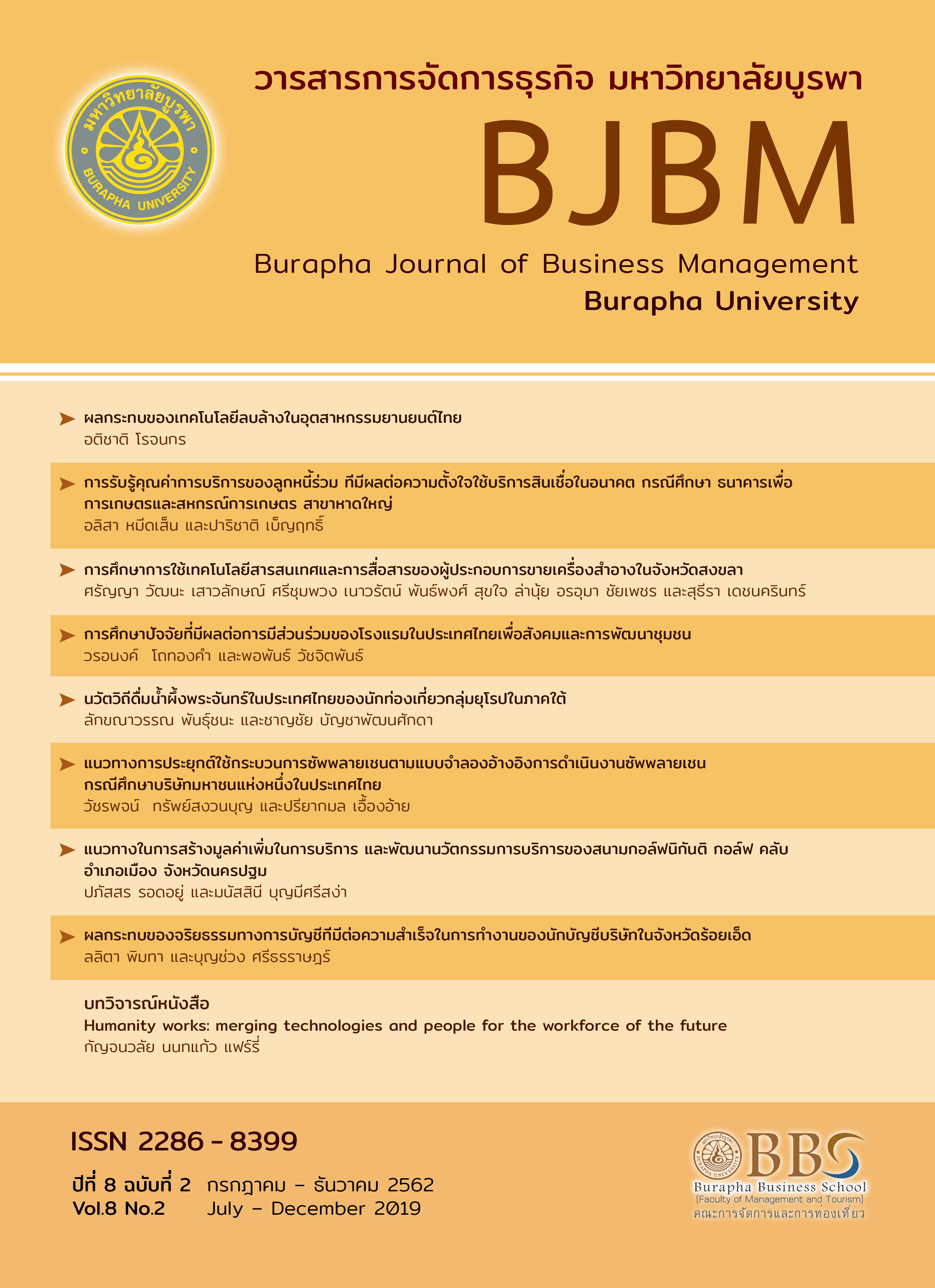
The Effect of Disruptive Technology in Thai Automotive Industry
Article Sidebar
Main Article Content
Abstract
The automotive industry is a major industry that has driven the economy of Thailand, which has been supported by the government since the Second National Economic and Social Development Plan. Make Thailand become one of the world's major automotive car maker and automotive parts manufacturers. Due to the rapidly changing air pollution and natural environment, worldwide are looking for vehicles that are more energy-efficient and environmentally friendly. For this reason, the demand for vehicle in the world market has changed from the internal combustion engine vehicles, in which Thailand has expertise in both assembly and production of the change to new demand for electric vehicle in Thailand is still in the period of development plan only. Electric vehicles are seen as a disruptive technology that will make a difference and affect the automotive industry worldwide. The supply chain of Thai automotive industry has to face modern technology that comes with electric vehicles. The Resources Base View and Operation Capability that the organization has under normal conditions may not be sufficient under the environmental turbulence situation. Dynamic capability is therefore an important role in managing the organization's strategy to be suitable for the competitive and highly dynamic situations. This article would like to presents guidelines for development of dynamic capability in Thai automotive industry, in terms of sensing, seizing and transforming to be a guideline for preparing the adaptation of the Thai automotive industry to keep up with the changes that will occur in the future.
Article Details
The article to be published in the Burapha Journal of Business Management must not have been previously published in any journal and must not be under consideration by other journals. If copyright infringement is found, or the comments in the articles are contrary to ethics, it is deemed to be the opinion and direct responsibility of the article’s authors, not the opinion or responsibility of the Burapha Business School, Burapha University. Wanting to publicize any content in the Burapha Journal of Business Management, permission must be obtained from the editorial team of the Burapha Journal of Business Management according to the copyright laws.
References
กระทรวงอุตสาหกรรม. (2560). มาตรการสนับสนุนการผลิตรถยนต์ที่ขับเคลื่อนด้วยพลังงานไฟฟ้าในประเทศไทย. สืบค้นเมื่อ 1 กันยายน 2562, สืบค้นจาก https://www.industry.go.th/industry/index.php/en/news -center/item/39299-2017-03-29-09-27-45
โชติกา ใจทิพย์. (2561). ศักยภาพของผู้นำองค์กรธุรกิจในสถานการณ์โลกที่มีความผันผวน. วารสารการจัดการธุรกิจ มหาวิทยาลัยบูรพา, 7(1), 1-14.
วรรณา ยงพิศาลภพ. (2560). ประเทศไทยกับการพัฒนาเทคโนโลยีรถยนต์ไฟฟ้า. Research Intelligence.
ศรีบวร เอี่ยมวัฒน์. (2561). แนวโน้มของ Disruptive Technology และความเป็นไปได้ของรูปแบบธุรกิจในอนาคตของเครื่องถ่ายเอกสารในประเทศไทย. วิทยานิพนธ์วิทยาศาสตร์มหาบัณฑิต, สาขาวิชาการบริหารเทคโนโลยี, วิทยาลัยนวัตกรรม, มหาวิทยาลัยธรรมศาสตร์.
ศูนย์วิจัยกสิกรไทย. (2560ก). SME ไทยก้าวทันกระแสยานยนต์ยุค 4.0 แล้วหรือยัง. K SME Analysis.
ศูนย์วิจัยกสิกรไทย. (2560ข). ยุคยานยนต์ไฟฟ้ามาแรง หนุนSMEไทยรุ่ง. K SME Analysis.
ศูนย์วิจัยกสิกรไทย. (2562). ยอดขายรถยนต์ไฟฟ้ายอดขายรถยนต์ไฟฟ้าปี 62 . สืบค้นเมื่อ 1 กันยายน 2562, สืบค้นจาก https://kasikornresearch.com/th/analysis/k-econ/business/Pages/z3018.aspx.
ศูนย์วิจัยเศรษฐกิจ ธุรกิจ และเศรษฐกิจฐานราก. (2561). รถยนต์ไฟฟ้ากับผลกระทบต่ออุตสาหกรรมยานยนต์ไทย. สืบค้นเมื่อ 1 กันยายน 2562, สืบค้นจาก https://www.gsb.or.th/getattachment/07c2aa6e- 9bc2-4682-8a9e-90b057178223/motor_61_62.aspx.
สถาบันทรัพย์สินทางปัญญาแห่งจุฬาลงกรณ์มหาวิทยาลัย. (2560). อุตสาหกรรมยานยนต์ใหม่. สืบค้นเมื่อ 1 กันยายน 2562, สืบค้นจาก https://www.ipthailand.go.th/images/3534/web_01052018/Report_ CHU/9_Next-Generation_Automotive_19-12-60_CHU.pdf.
สถาบันยานยนต์. (2560). ครม.ไฟเขียว 6 มาตรการ สนับสนุนรถยนต์พลังงานไฟฟ้า. สืบค้นเมื่อ 1 กันยายน 2562 , สืบค้นจาก https://www.thaiauto.or.th/2012/th/news/news-detail.asp? news_id=3684.
สายใจ วิทยาอนุมาส. (2560). ทิศทางยานยนต์ยุคใหม่ในประเทศไทย. รายงานทีดีอาร์ไอ, 129.
สำนักงานพัฒนาวิทยาศาสตร์และเทคโนโลยีแห่งชาติ. (2560). รายงานการศึกษาเรื่อง “อุตสาหกรรมยานยนต์ไฟฟ้า”. สืบค้นเมื่อ 1 กันยายน 2562, สืบค้นจาก https://waa.inter.nstda.or.th/prs/pub/EV.pdf.
อานันท์ เกียรติสารพิภพ. (2562). Disruptive Technology การดำรงชีวิตจะเปลี่ยนแปลง. สืบค้นเมื่อ 1 กันยายน 2562, สืบค้นจาก https://dl.parliament.go.th/handle/lirt/60249/browse?value=อานันท์+เกียรติสารพิภพ&type=author.
Drnevich, P., & Kriauciunas, A. (2011). Clarifying the conditions and limits of the contributions of ordinary and dynamic capabilities to relative firm performance. Strategic Management Journal, 32(3), 254-279.
Eisenhardt, K. M., & Martin, J. A. (2000). Dynamic Capabilities: What Are They? Strategic Management Journal, 21(11), 1105-1121.
International Energy Agency. (2017). Two million and Counting. Global EV Outlook 2017, 5-7.
International Energy Agency. (2018). Towards cross-modal electrification. Global EV Outlook.
International Energy Agency. (2019). Scaling-up the transition to electric mobility. Global EV Outlook 2019.
Jantunen, A., Ellonen, H.-K., & Johansson, A. (2012). Beyond appearances – Do dynamic capabilities of innovative firms actually differ? European Management Journal, 30(2), 141-155.
McKelvie, A., & Davidsson, P. (2009). From Resource Base to Dynamic Capabilities: an Investigation of New Firms. British Journal of Management, 20(1), S63-S80.
Teece, D. (2007). Explicating dynamic capabilities: The nature and microfoundations of (sustainable) enterprise performance. Strategic Management Journal, 28(13), 1319-1350.
Teece, D. (2012). Dynamic Capabilities: Routines versus Entrepreneurial Action. Journal of Management Studies, 49(8), 1395-1401.
Teece, D., Pisano, G., & Shuen, A. (1997). Dynamic capabilities and strategic management. Strategic management journal, 18(7), 509-533.
Teece, D., & Leih, S. (2016). Uncertainty, Innovation, and Dynamic Capabilities: An Introduction. California Management Review, 58(4), 5-12.
Winter, S. G. (2003). Understanding dynamic capabilities. Strategic Management Journal, 24(10), 991-995.
