
Influence of Service Convenience Affecting Toward Satisfaction of U-Tapao International Airport Rayong Province
Article Sidebar
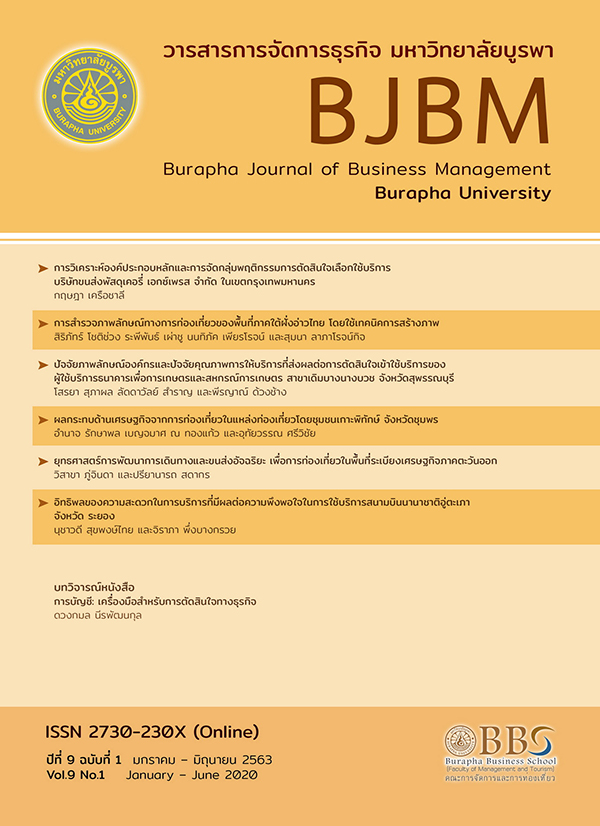
Main Article Content
Abstract
The objectives of this research were to: 1) study the level of service convenience of each dimension; and 2) study influence of service convenience to satisfaction with services provided by U-Tapao International Airport, Rayong Province. The sample size was calculated based on unknown population size. The reliability was determined at 95 percent. The questionnaire was used to gather data from the sample group of 400 cases. The statistics applied for data analysis included frequency, mean, standard deviation and multiple regression was employed for hypothesis test.
The results found that the majority of respondents were male; aged between 21-30 years; marital status was single; education was Bachelor’s degree; occupation was company employee; and monthly income was between 10,001 and 20,000 Baht Perception level of service convenience were in high level, ranking from the highest to the lowest were benefit convenience, followed by decision convenience, transaction convenience, access convenience, and post-benefit convenience, respectively. Besides, the overall level of satisfaction was high.
In the meantime, the hypothesis test results revealed that all access convenience, benefit convenience and post-benefit convenience had positive influence to satisfaction with statistical significance at level of .05.
Article Details
The article to be published in the Burapha Journal of Business Management must not have been previously published in any journal and must not be under consideration by other journals. If copyright infringement is found, or the comments in the articles are contrary to ethics, it is deemed to be the opinion and direct responsibility of the article’s authors, not the opinion or responsibility of the Burapha Business School, Burapha University. Wanting to publicize any content in the Burapha Journal of Business Management, permission must be obtained from the editorial team of the Burapha Journal of Business Management according to the copyright laws.
References
สำนักงานคณะกรรมการนโยบายเขตพัฒนาพิเศษภาคตะวันออก. (2561). โครงการเขตพัฒนาพิเศษภาคตะวันออก (อีอีซี) เป็นแผนยุทธศาสตร์ภายใต้ ไทยแลนด์ 4.0. สืบค้นเมื่อ 20 มีนาคม 2562 สืบค้นจาก https://www.eeco.or.th/เกี่ยวกับองค์กร/ความเป็นมา.
สำนักงานปลัดกระทรวงการท่องเที่ยวและกีฬา. (2559). รายงานภาวะเศรฯฐกิจท่องเที่ยว ฉบับที่ 6. สืบค้นเมื่อ 20 มีนาคม 2562 สืบค้นจาก https://www.mots.go.th/ewt_dl_link.php?nid=8265.
Berry, L. L., Seiders, K., & Grewal, D. (2002). Understanding Service Convenience. Journal of Marketing, 66 (1), 1-17.
Brown, L. G.(1990). Convenience in Services Marketing. Journal of Services Marketing, 4(1), 53- 59.
Brown, Lew. G., & M.R. McEnally. (1992). Convenience: Definition, Structure, and Application. Journal of Marketing Management, 2(3), 47-57.
Chang, Y.W., & Polonsky, M.J. (2012). The influence of multiple types of service convenience on behavioral intentions: The mediating role of consumer satisfaction in a Taiwanese leisure setting, International Journal of Hospitality Management, 31, 107-118.
Colwell, S.R., Aung, M., Kanetkar, V., & Holden, A.L. (2008). Toward a measure of service convenience: multiple-item scale development and empirical test. Journal of Services Marketing, 22(2), 160-169.
Cronin, J. J., Brady, M. K., & Hult, G. Thomas, M. (2000). Assessing the Effects of Quality, Value, and Customer Satisfaction on Consumer Behavioral Intentions in Service Environments. Journal of Retailing, 76(2), 193-218.
Geissler, G. L., Rucks, C. T., & Edison, S.W. (2006). Understanding the Role of Service Convenience in Art Museum Marketing: An Exploratory Study. Journal of Hospitality Marketing and Management, 14(4), 69-87.
Hair, J. F., Black, W. C., Babin, B.J., & Anderson, R. E. (2010). Multivariate Data Analysis. (7th ed.). Upper Saddle River, New Jersey: Prentice Hall.
Kaura, V., Durga Prasad, C. & Sharma, S. (2015). Service quality, service convenience, price and fairness, customer loyalty, and the mediating role of customer satisfaction. International Journal of Bank Marketing, 33(4), 404-422.
Kelley, E. J. (1958). The Importance of Convenience in Consumer Purchasing, Journal of Marketing, 23, 32-38.
Kotler, P. (1994). Marketing management analysis, planning, implementation, and control (8th ed.). Englewood Cliffs: Prentice-Hall.
Nunnally, J. C. (1978). Psychometric theory. (2nd ed.). New York: McGraw-Hill.
Ryu, K., Han, H., & Kim, T. H. (2008). The relationships among overall quick-casual restaurant image, perceived value, customer satisfaction, and behavioral intentions. International Journal of Hospitality Management, 27(3), 459-469.
Seiders, K., Voss, G. B., & Godfrey, A. L. (2006). Measuring Service Convenience and Assessing Its Influence on Retail Customers. American Marketing Association, (Winter2006), 116-117.
Seiders, Kathleen, G. B. V., Andarea L. Godfrey. (2006). Measuring Service Convenience and Assessing Its Influence on Retail Customers. American Marketing Association, (Winter2006), 116-117.
Seiders, K., Voss, G. B., Godfrey, A. L., & Grewal, D. (2007). SERVCON: development and validation of a multidimensional service convenience scale. Journal of the Academic Marketing Science, 35, 144-156.
Xie, L., Peng, J., & Shen, W. (2010). Customer’s Service Convenience and Customer’s Service Evaluation of the Bank’s Outlets, Proceeding Service System and Service Management (ICSSSM), 2010 7th International Conference on Service System and Service Management, 1-6.
Yamane, T. (1973). Statistics: An Introductory Analysis. (3rd ed). New York. Harper and Row Publications.
