
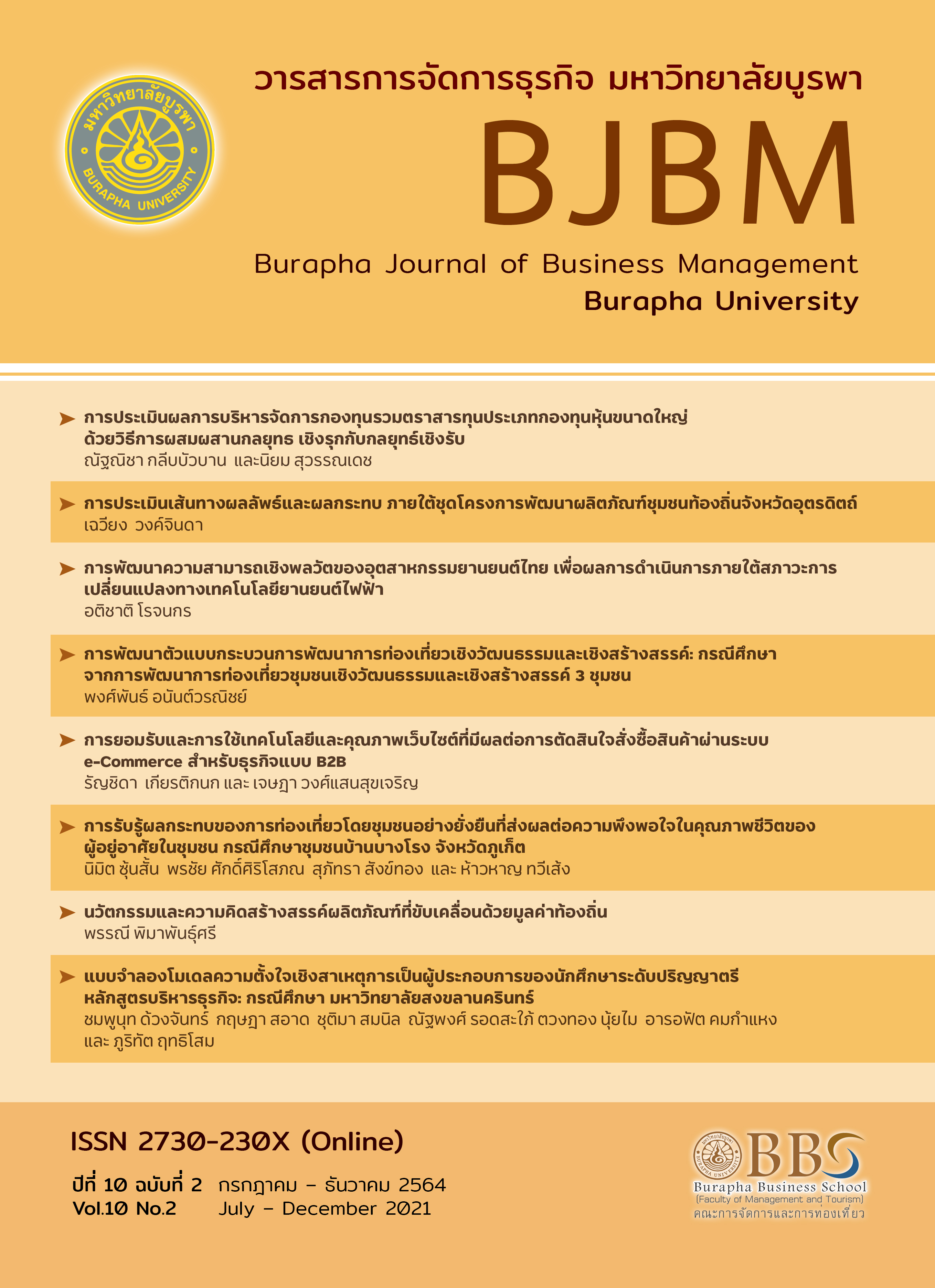
Assessment of Equity Large Cap Fund Management in Equity Large Cap by using a Mix Active Portfolio with Passive Portfolio
Article Sidebar
Main Article Content
Abstract
Mutual fund management must be managed professionally by using the active portfolio in order to earn a higher return than the market for the small investors. This research aimed to assess management by using the security selection under the Treynor-Black, and the mix of active portfolio and passive portfolio under the Sharp ratio and Treynor-Black ratio. This research was quantitative research and the sample group was 105 equity large-cap funds in equity large cap during 60 months (2014-2018) by using the stratified sampling method and the data was analyzed by using the regression analysis method. The findings revealed that; 1) the mutual fund manager madean effort to diversify all risks efficiently for higher return than the market, the higher the appraisal ratio, the higher the efficiency, and 2) the mutual fund manager who applied the active portfolio would gain more success in management compared with the passive portfolio, even the capital market was efficient under the Efficient Market Hypothesis (EMH). However, most of the equity large cap fund in equity large cap was applied by the active portfolio successfully. In addition, the findings of the research provide an advantage for retail investors in Thailand. The investors will have to choose mutual funds that are proactive rather than passive in order to earn a higher return than the market.
Article Details
The article to be published in the Burapha Journal of Business Management must not have been previously published in any journal and must not be under consideration by other journals. If copyright infringement is found, or the comments in the articles are contrary to ethics, it is deemed to be the opinion and direct responsibility of the article’s authors, not the opinion or responsibility of the Burapha Business School, Burapha University. Wanting to publicize any content in the Burapha Journal of Business Management, permission must be obtained from the editorial team of the Burapha Journal of Business Management according to the copyright laws.
References
ตลาดหลักทรัพย์แห่งประเทศไทย. (2561). ดัชนีตลาดหลักทรัพย์. สืบค้นเมื่อ 10 พฤษภาคม 2563 สืบค้นจาก https://www.set.or.th/static/mktstat/Table_Index.xls?001.
ธนาคารแห่งประเทศไทย. (2563). FM_RT_001_S2 อัตราดอกเบี้ยในตลาดเงิน (2548-ปัจจุบัน). สืบค้นเมื่อ 10 พฤษภาคม 2563 สืบค้นจาก https://www.bot.or.th/App/BTWS_STAT/statistics/BOTWEBSTAT. aspx?reportID=223&language=TH
มอร์นิ่งสตาร์ไดเร็ค. (2561). สรุปภาพรวมกองทุนรวมปี 2018. สืบค้นเมื่อ 10 พฤษภาคม 2563 สืบค้นจากhttps://1th.co/go4Nq4Nq4Nq.
Basu, S. (1977). Investment performance of common stocks in relation to their price‐earnings ratios: A test of the efficient market hypothesis. The Journal of Finance, 32(3), 663-682.
Bodie, Z., Kane, A., & Marcus, J. A. (2002). Investments. New York: McGraw-Hill Irwin.
Bodie, Z., Kane, A., & Marcus, J. A. (2011). Investments and Portfolio Management. (9th ed.). New York: McGraw–Hill Irwin.
Brown, K. C. & Reilly, F. (2009), Analysis of Investments and Management of Portfolios. (9th ed.). South Western Cengage Learning, Stamford, CT.
Brown, S. J., Goetzmann, W., Ibbotson, R. G., & Ross, S. A. (1992). Survivorship bias in performance studies. The Review of Financial Studies, 5(4), 553-580.
Fama, F.E. (1972), “Components of Investment Performance”, Journal of Finance. 27(3), 551-567
Jordan, D. J., Miller, W. T. & Dolvin, D. S. (2012). Fundamentals of Investments: Valuation and management (6th ed). New York: McGraw-Hill Irwin.
Roscoe. (1996). Cited in Kansiri Chancharoen (2013). Medical Research: Concept, Principle and Practic. Nonthaburi: Pimpaluk.
Sharpe, F. W. (1964), “Capital Asset Price: A Theory of Market Equilibrium under Conditions of Risk.”, Journal of Business, 19(3), 119-138.
Thai Mutualfund. (2561). Net Asset Value: NAV. Retrieved May 10, 2020, from http://www.thaimutualfund.com/ AIMC/aimc_navCenterDownload.jsp.
Treynor, J. L. & Black, F. (1973). How to Use Security Analysis to Improve Security Selection. Journal of Business. 46(1), 233-265.
Wermers, R. (2000). Mutual Fund Performance: An Empirical Decomposition into Stock-Picking Talent, Style, Transaction Costs, and Expenses. Journal of Finance. 55(4), 1655-1703.
