
The Moderating Effects of Self-efficacy on Motivation Factors, Hygiene Factors and Work Efficiency of Furukawa Metal (Thailand) Public Company Limited
Article Sidebar
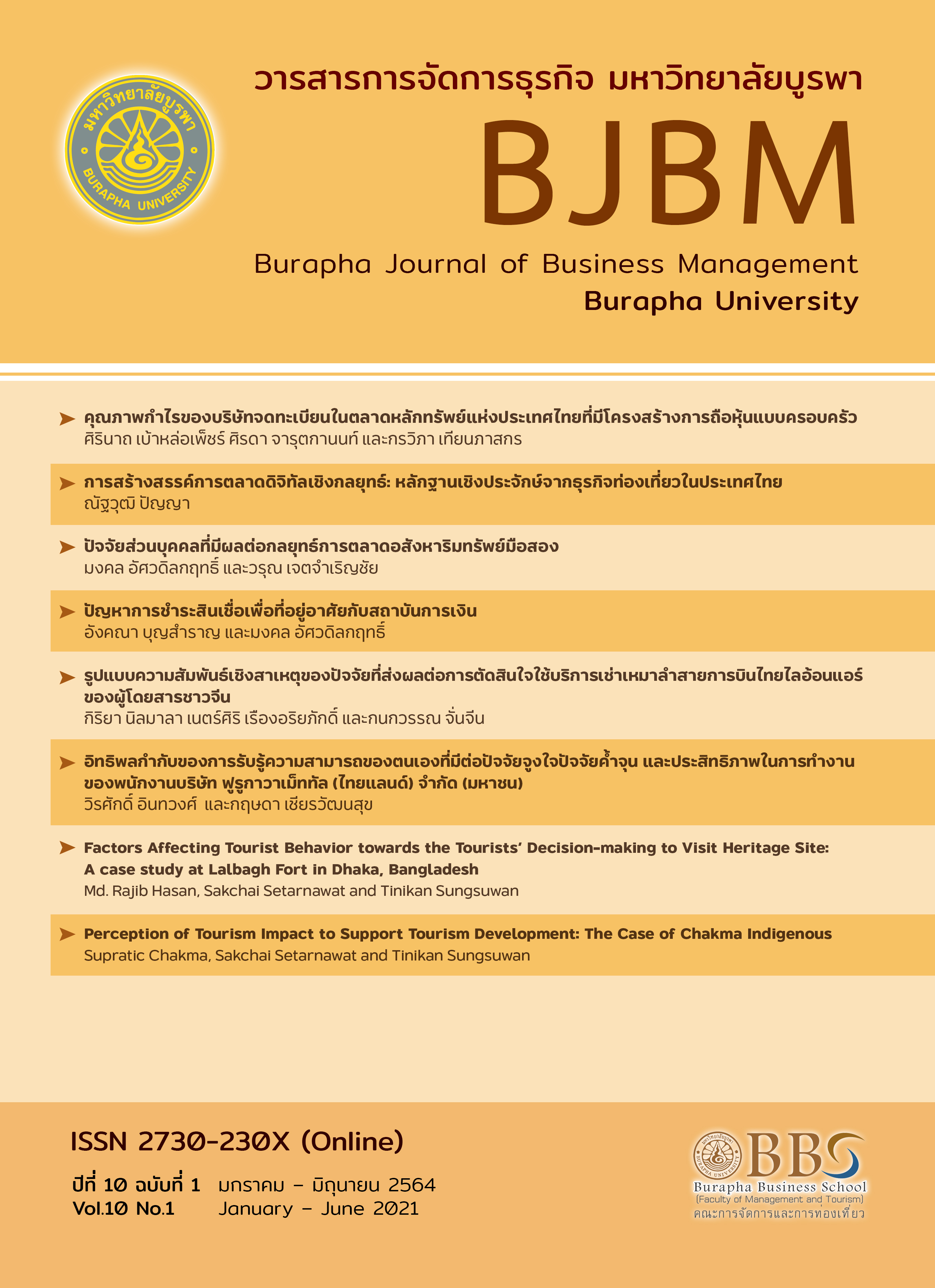
Main Article Content
Abstract
This research aimed to study the level of motivation factors, hygiene factors and work efficiency of employees and to study the moderating effects of self-efficacy towards motivation factors, hygiene factors and work efficiency of employees of Furukawa Metal (Thailand) Public Company Limited. The samples were 296 operational staffs of Furukawa Metal (Thailand) Public Company Limited. Sampling was carried out by convenient method and used questionnaires for data collection. The questions are closed-ended, that were developed from concepts and theories. Data were analyzed using descriptive statistics such as frequency, percentage, mean and standard deviation, while using partial least squares structural equation modeling (PLS-SEM) to test the hypotheses. There was a response rate of 296 complete questionnaires, representing 54.11% of the population studied.
The results found that employees had levels of motivation factors, hygiene factors and work efficiency at the low level. Results from hypotheses testing found that self-efficacy had a moderating effect on relationship between the hygiene factors and work efficiency with statistical level of significance at 0.001. However, self-efficacy did not have moderating effect on relationship between the motivation factors and work efficiency with 69% forecasting power.
Article Details
The article to be published in the Burapha Journal of Business Management must not have been previously published in any journal and must not be under consideration by other journals. If copyright infringement is found, or the comments in the articles are contrary to ethics, it is deemed to be the opinion and direct responsibility of the article’s authors, not the opinion or responsibility of the Burapha Business School, Burapha University. Wanting to publicize any content in the Burapha Journal of Business Management, permission must be obtained from the editorial team of the Burapha Journal of Business Management according to the copyright laws.
References
กมลพร กัลยาณมิตร. (2559). แรงจูงใจ 2 ปัจจัย พลังสู่ความสำเร็จ. วารสารวไลยอลงกรณ์ปริทัศน์, 6(3), 175-183.
กมลวรรณ ปานประดิษฐ์ และอดิศร ภู่สาระ. (2563). แรงจูงใจในการปฏิบัติงานของพนักงานองค์การบริหารส่วนตำบลในเขตอำเภอป่าโมก จังหวัดอ่างทอง. วารสารวิทยาการจัดการปริทัศน์, 22(1), 113-122.
กฤษดา เชียรวัฒนสุข และทัดทรวง บุญญาธิการ. (2560). แรงจูงใจที่มีอิทธิพลต่อผลการปฏิบัติงานของพนักงานกรณีศึกษา บริษัท ทีโอที จำกัด (มหาชน) สำนักงานใหญ่แจ้งวัฒนะ. วารสารวิจัยมหาวิทยาลัยเวสเทิร์น มนุษยศาสตร์และสังคมศาสตร์, 3(2), 29-43.
กฤษดา เชียรวัฒนสุข, รัชนี แก้วมณี, นีรนุช สายยุยา, และสุภัสสรา กิริกา. (2561). แรงจูงใจที่มีอิทธิพลต่อผลการปฏิบัติงานของพนักงาน กรณีศึกษา อายิโนะโมะโต๊ะ เบทาโกรสเปเชียลฟู้ดส์ จำกัด. วารสารการตลาดและการจัดการ, 5(2), 55-69.
กฤษดา เชียรวัฒนสุข. (2563). หลักการจัดการและองค์การ. กรุงเทพฯ: ทริปเพิ้ล เอ็ดดูเคชั่น.
กัลยา วานิชย์บัญชา และฐิตา วานิชย์บัญชา. (2558). การใช้ SPSS for Windows ในการวิเคราะห์ข้อมูล. กรุงเทพฯ: โรงพิมพ์สามลดา.
ณัฏฐ์พัชร์ ลาภบำรุงวงศ์. (2562). การประยุกต์ทฤษฎีแรงจูงในในการปฏิบัติงาน. วารสารวไลยอลงณ์ปริทัศน์, 9(2), 161-171.
ธนาคารแห่งประเทศไทย. (2562). สรุปประมาณการเศรษฐกิจและเงินเฟ้อ. สืบค้นเมื่อ 27 มีนาคม 2563, สืบค้นจาก https://www.bot.or.th/Thai/MonetaryPolicy/MonetPolicyComittee/MPR/Pages/default.aspx
นิศาชล รัตนมณี และประสพชัย พสุนนท์. (2562). อัตราการตอบกลับของแบบสอบถามในงานวิจัยเชิงปริมาณ. วารสารมนุษยศาสตร์และสังคมศาสตร์ มหาวิทยาลัยธนบุรี, 13(3), 181-188.
พีรญา ชื่นวงศ์. (2560). ประสิทธิภาพในการปฏิบัติงานของพนักงาน: กรณีศึกษา ธุรกิจการขนส่งในจังหวัดเชียงราย. วารสารเศรษฐศาสตร์และกลยุทธ์การจัดการ, 4(2), 92-100.
ภิญโญ มนูศิลป์. (2558). ปัจจัยที่ส่งผลต่อความมีประสิทธิผลของทีม. วารสารมนุษยศาสตร์และสังคมศาสตร์ บัณฑิตวิทยาลัย มหาวิทยาลัยราชภัฏพิบูลสงคราม, 9(2), 1-28.
ศรีเรือน แก้วกังวาล. (2558). จิตวิทยาบุคลิกภาพร่วมสมัยและจิตบำบัด. กรุงเทพฯ: หมอชาวบ้าน.
สถาบันไฟฟ้าและอิเล็กทรอนิกส์. (2563). รายงานสถานการณ์อุตสาหกรรมเครื่องใช้ไฟฟ้าและอิเล็กทรอนิกส์. สืบค้นเมื่อ 27 มีนาคม 2563, สืบค้นจาก https://ipidecenter.ipthailand.go.th/wp-content /uploads/2020/07/24-idg.pdf.
อภิสิทธิ์ ฉัตรทนานนท์. (2552). กลยุทธ์การบริหารภาวะวิกฤตสำหรับผู้นำองค์การ. วารสารบริหารธุรกิจ คณะพาณิชยศาสตร์และการบัญชี มหาวิทยาลัยธรรมศาสตร์, 32(122), 8-18.
อรอุมา บัวทอง (2558). ความสัมพันธ์ระหว่างการรับรู้ความสามารถตนเอง การกำหนดเป้าหมาย บุคลิกภาพเชิงรุก กับประสิทธิผลในการทำงานของพนักงาน สถานบันการเงินแห่งหนึ่งในกรุงเทพมหานคร. วิทยานิพนธ์ศิลปศาสตรมหาบัณฑิต, สาขาวิชาจิตวิทยาอุตสาหกรรมและองค์การ, คณะศิลปะศาสตร์, มหาวิทยาลัยธรรมศาสตร์
Bandura, A. (1977). Social learning theory. New Jersey: Prentice-Hall.
Bandura, A. (1994). Social cognitive theory and exercise of control over HIV infection. In Preventing AIDS (pp. 25-59). Springer, Boston, MA.
Cherian, J., & Jacob, J. (2013). Impact of self-efficacy on motivation and performance of employees. International Journal of Business and Management, 8(14), 80-88.
Hair, J., Black, W., Babin, B., & Anderson, E. (2010). Multivariate data analysis. (7th ed.). London: Pearson Education Limited.
Herzberg, F., Mausner, B., & Snyderman, B. B. (1959). The motivation to work. (2nd ed.). New York: John Wiley & Sons.
Lundberg, C., Gudmundson, A., & Andersson, T. D. (2009). Herzberg's Two-Factor Theory of work motivation tested empirically on seasonal workers in hospitality and tourism. Tourism management, 30(6), 890-899.
Newstrom, J. W. (2005). Organizational behavior: Human behavior at work. (12th ed.). New York: McGraw-Hill.
Peterson, E., & Plowman, G. E. (1953). Business organization and management. (3rd ed.). Ill: Irwin.
Vancouver, J. B., & Kendall, L. N. (2006). When self-efficacy negatively relates to motivation and performance in a learning context. Journal of applied psychology, 91(5), 1146.
Yamane. T. (1973). Statistics: An introductory analysis. (3rd ed.). New York: Harper and Row Publication.
