
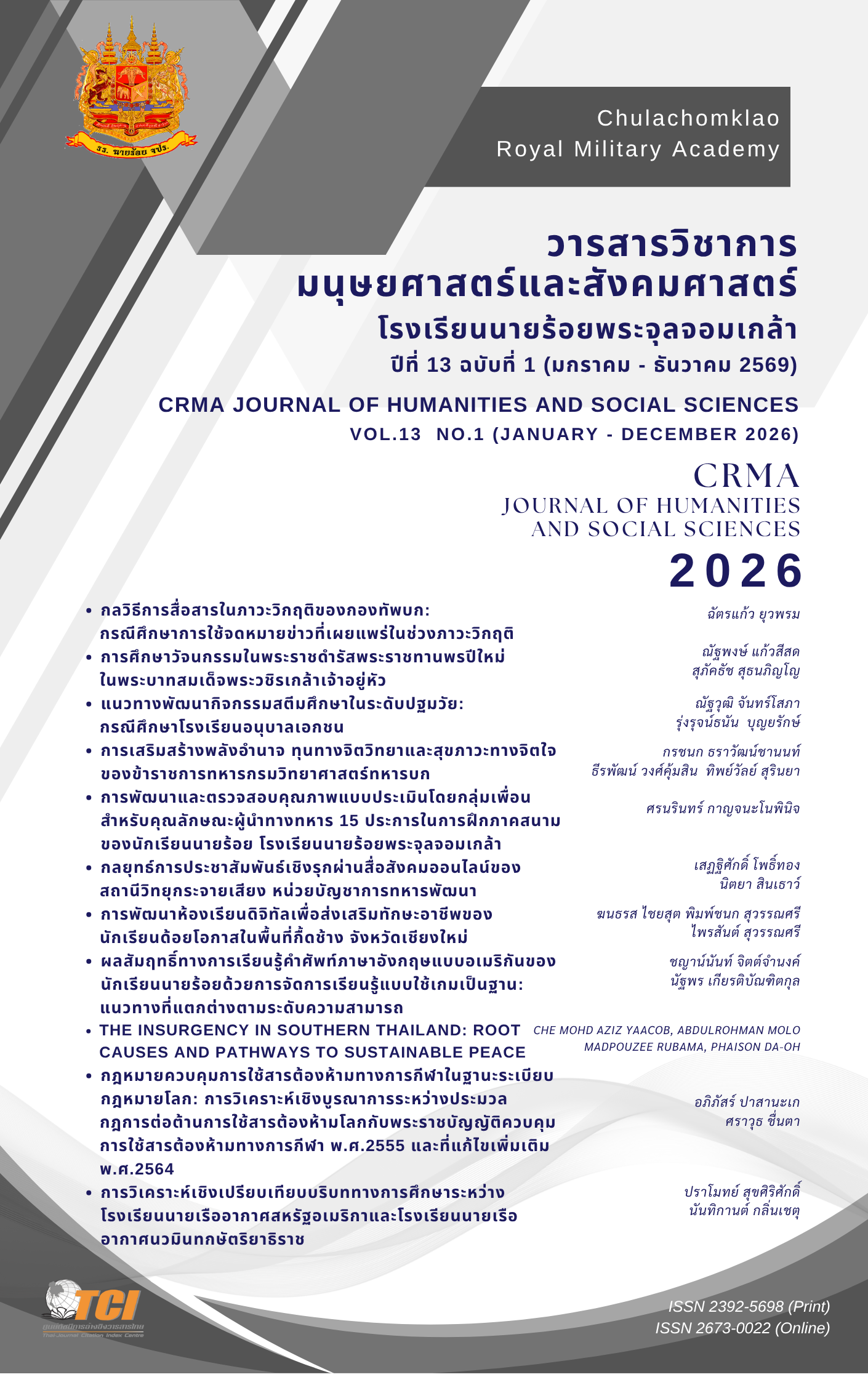
Anti-Doping Law in Sports as a Global Legal Order: An Integrated Analysis of the World Anti-Doping Code and the Anti-Doping in Sports Act B.E. 2555 (2012) as amended B.E. 2564 (2021)
Keywords:
Sports Law, Doping in Sports, Global Legal Order, Rule of Law, ProportionalityAbstract
The regulation of doping in sport has evolved into a global legal regime characterized by a transnational legal framework that intricately integrates the roles of sporting organizations and states, particularly under the World Anti-Doping Code and the UNESCO’s International Convention against Doping in Sport. This article aims to analyze the international legal framework, examine the legal structure of Thailand under the Anti-Doping Act B.E. 2555 (2012) and its amendment B.E. 2564 (2021), and evaluate the integration between Thai law and the global anti-doping legal order. The study employs a document analysis of relevant legal texts and academic literature using comparative and public law approaches to understand the development, mechanisms, and legal challenges arising from such integration. The findings reveal that the anti-doping legal system constitutes a hybrid regime combining elements of soft law and hard law, wherein the World Anti-Doping Code establishes normative standards while the UNESCO Convention imposes binding obligations on states. Thai law has adapted by adopting an open-ended legislative framework and relying primarily on subordinate legislation as a regulatory mechanism. Nevertheless, the main structural challenge is the tension between state sovereignty and pressures from the global legal order, along with issues of legal certainty, proportionality of measures, and the legitimacy of global governance mechanisms. Accordingly, this study recommends legal reforms to clarify essential principles at the statutory level, strengthen oversight mechanisms in the exercise of administrative powers, and enhance institutional capacity, in order to achieve a sustainable balance between international standards and the rule of law within the domestic legal system.
References
กานต์ เก่งสกุล. (2565). สถานะทางกฎหมายของซอฟลอว์ภายใต้กฎหมายระหว่างประเทศ : กรณีศึกษาประมวลกฎต่อต้านการใช้สารต้องห้าม 2021 [วิทยานิพนธ์นิติศาสตรมหาบัณฑิต, จุฬาลงกรณ์มหาวิทยาลัย]. Chulalongkorn University Theses and Dissertations (Chula ETD). https://doi.org/10.58837/CHULA.THE.2022.639
ธนวุฒิ แสงบุญ และ แสวง วัชระธนกิจ. (2565). ความเสี่ยงการได้รับสารต้องห้ามทางการกีฬาจากผู้มีส่วนได้ส่วนเสียในนักกีฬาทีมชาติไทย. วารสารราชวิทยาลัยจุฬาภรณ์, 4(3), 121-132.
ปีดิเทพ อยู่ยืนยง. (2565). มุมมองของสิทธิมนุษยชนต่อหลักความรับผิดโดยเด็ดขาดในกฎการใช้สารต้องห้ามสำหรับนักกีฬา. วารสารวิชาการนิติศาสตร์ มหาวิทยาลัยทักษิณ, 10(12), 110-130.
พระราชกำหนดแก้ไขเพิ่มเติมพระราชบัญญัติควบคุมการใช้สารต้องห้ามทางการกีฬา พ.ศ. 2555 พ.ศ. 2564. (2564, 30 ธันวาคม). ราชกิจจานุเบกษา. เล่ม 138 ตอนที่ 89 ก. หน้า 1–9.
พระราชบัญญัติควบคุมการใช้สารต้องห้ามทางการกีฬา พ.ศ. 2555. (2556, 9 มกราคม). ราชกิจจานุเบกษา. เล่ม 130 ตอนที่ 2 ก. หน้า 10–19.
ฤทัยรัตน์ คงมา, ปภาศรี บัวสวรรค์, และ พรพล เทศทอง. (2567). ปัญหากระบวนการลงโทษนักกีฬาและบุคคลซึ่งสนับสนุนการกีฬา ตามพระราชบัญญัติควบคุมการใช้สารต้องห้ามทางการกีฬา พ.ศ. 2555. วารสารวิชาการสถาบันวิทยาการจัดการแห่งแปซิฟิค, 10(2), 339–355.
Spring news. (2564, 8 ตุลาคม). ไทย ไม่ปฏิบัติตาม วาด้า WADA ถูกแบนจัดแข่งขันกีฬานานาชาติ และห้ามใช้ธงชาติ. https://www.springnews.co.th/news/816849
Akpobome, O. (2024). The impact of emerging technologies on legal frameworks: A model for adaptive regulation. International Journal of Research Publication and Reviews, 5(7), 5046–5060.
Borry, P., Caulfield, T., Estivill, X., Loland, S., McNamee, M., & Knoppers, B. M. (2018). Geolocalisation of athletes for out-of-competition drug testing: Ethical considerations. Position statement by the WADA Ethics Panel. British Journal of Sports Medicine, 52(7), 456–459. https://doi.org/10.1136/bjsports-2017-098299
European Olympic Committees. (2024). The principle of strict liability. https://www.eurolympic.org/clean-sport/the-principle-of-strick-liability
Ljungqvist, A. (2017). Brief history of anti-doping. Medicine and Sport Science, 62, 1–10. https://doi.org/10.1159/000460680
McLaren, R. H. (2001). Sports law arbitration by CAS: Is it the same as international arbitration? Pepperdine Law Review, 29(1), 101–114.
Olympics and International Sports Law Research Guide. (2026, January 30). Georgetown Law Library. https://guides.ll.georgetown.edu/lawolympics/antidoping
Pavot, D. (2023). Pathways to greater government accountability for breaches of their obligations in relation to doping in sport: A legal analysis. Frontiers in Sports and Active Living, 5, Article 1129390. https://doi.org/10.3389/fspor.2023.1129390
Somya, S. (2024). Quasi judicial bodies: Law and processes. International Journal for Legal Research and Analysis, 2(7), 5-15.
U.S. Department of Justice. (2022, January 12). First Olympic anti-doping charges filed in Manhattan federal court.
https://www.justice.gov/usao-sdny/pr/first-olympic-anti-doping-charges-filed-manhattan-federal-court
United Nations Educational, Scientific and Cultural Organization. (2025). International Convention against Doping in Sport. https://www.unesco.org/en/convention-against-doping-sport
World Anti-Doping Agency. (2021). World Anti-Doping Code 2021. https://www.wada-ama.org/sites/default/files/resources/files/2021_wada_code.pdf
World Anti-Doping Agency. (2021, October 7). WADA confirms non-compliance of five anti-doping organizations. https://www.wada-ama.org/en/news/wada-confirms-non-compliance-five-anti-doping-organizations
Downloads
Published
How to Cite
Issue
Section
Categories
License
Copyright (c) 2026 CRMA Journal of Humanities and Social Sciences

This work is licensed under a Creative Commons Attribution-NonCommercial-NoDerivatives 4.0 International License.
The content and information in this journal shall be considered as the individual opinions of the authors. In all cases, the editorial board may not necessarily agree with these opinions or be responsible for them.
The articles and information that are published in the journal are considered to be the copyright of the journal. Any party who wishes to re-publish the journal’s articles must seek permission from the journal’s editor. Articles that receive the agreement for publications must not appear in any other publications prior to their appearance in this journal. The editorial board will send one copy of the journal to each author whose submission was accepted and published.