
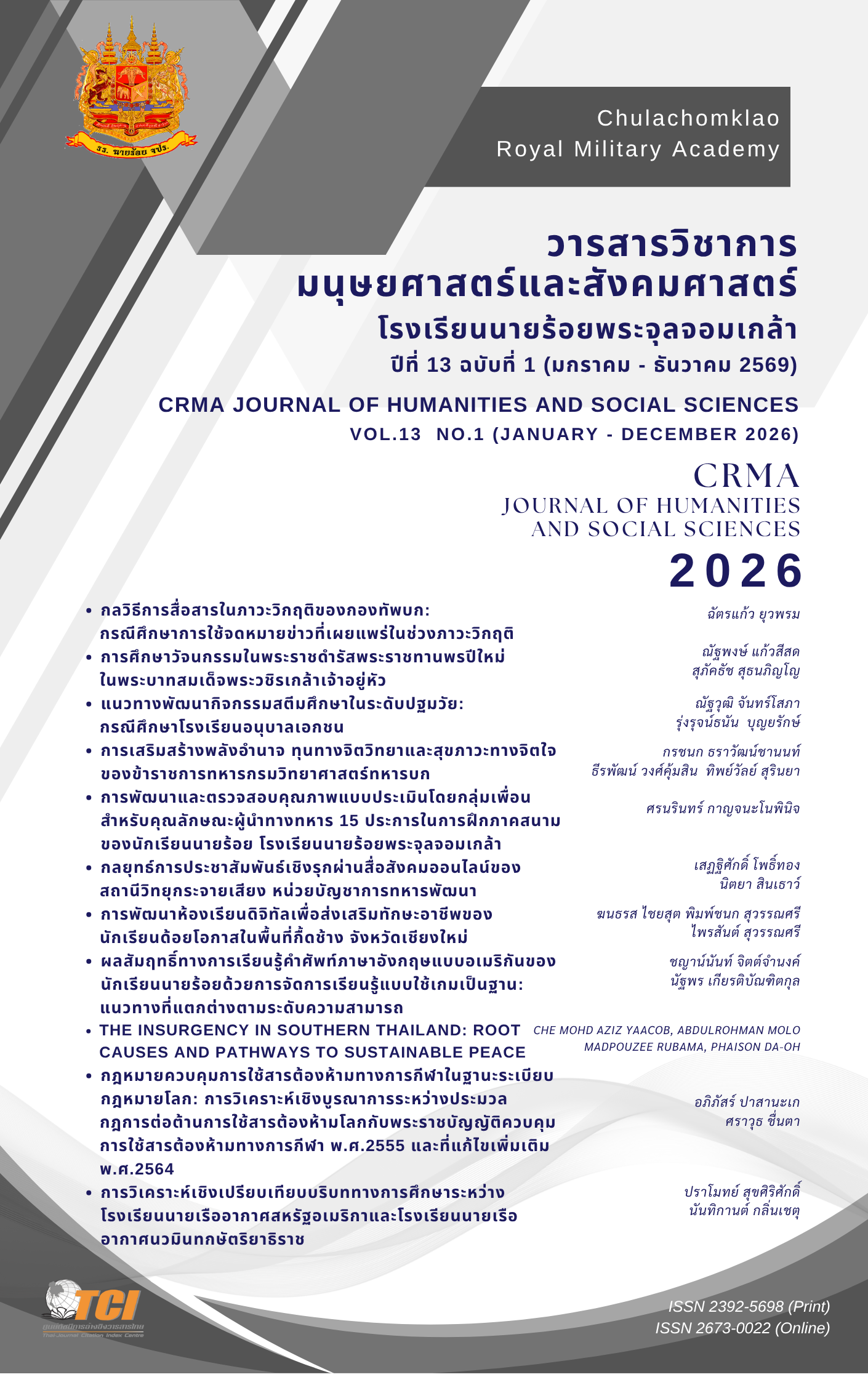
Proactive Public Relations Strategies via Social Media for Armed Forces Development Command Radio Broadcasting Stations
Keywords:
Proactive Public Relations, Social Media, Radio Broadcasting StationAbstract
This study, titled Proactive Public Relations Strategies through Social Media for the Radio Station of the Armed Forces Development Command, aimed to (1) examine the challenges of public relations through social media and (2) to formulate strategies for enhancing proactive public relations through social media for the radio station of the Armed Forces Development Command. A qualitative research design was employed, using in-depth interviews with 25 key informants. The data were analyzed through content analysis and thematic analysis. The findings revealed several major challenges, including policy ambiguity from higher authorities, a complex chain of command that hindered timely responses to the digital media environment, a digital skills gap among personnel over 50 years of age, inadequate basic equipment, and limited community engagement over the past 7–10 years. Although leaders expressed a vision for transitioning to online media, they lacked the practical skills necessary to drive this transformation effectively. Based on these findings, four urgent strategies are proposed. First, platforms and content should be redesigned according to a mobile-first approach, shifting from audio-based communication to multimedia content, particularly 1–3 minute short-form videos on TikTok and Facebook Reels, with social media content accounting for at least 50% of total output. Second, in-house influencers should be developed by positioning radio hosts as trusted intermediaries between the military and the public through approachable personalities and the use of local or ethnic languages. Third, two-way communication and rapid response mechanisms should be strengthened through a small Digital Command Center for social listening and real-time engagement, especially during crises. Fourth, a coaching-based development strategy should be adopted, enabling younger personnel to transfer digital skills to senior staff through one-on-one mentoring.
References
กรมประชาสัมพันธ์. (2566). แผนปฏิบัติการด้านการประชาสัมพันธ์แห่งชาติ (พ.ศ.2566-2570). https://drive.google.com/file/d/1aCarzPAeN39nVnAVmJzB4C3dpNI1TPwu/view
กาญจนา แก้วเทพ, นิคม ชัยขุนพล, และคณะ. (2555). สื่อเก่า–สื่อใหม่: สัญญะ อัตลักษณ์ อุดมการณ์. โครงการเมธีวิจัยอาวุโส ฝ่ายวิชาการ สำนักงานกองทุนสนับสนุนการวิจัย.
คณะกรรมการประชาสัมพันธ์แห่งชาติ. (2563). นโยบายและแผนการประชาสัมพันธ์แห่งชาติ ฉบับที่ 5 พ.ศ. 2563-2565 (ฉบับปรับปรุงให้สอดคล้องกับยุทธศาสตร์ชาติ 20 ปี). กรมประชาสัมพันธ์.https://plan.prd.go.th/th/content/category/detail/id/1263/iid/46641
คณะกรรมการยุทธศาสตร์ชาติ. (2561). ยุทธศาสตร์ชาติ (พ.ศ. 2561–2580). สำนักงานเลขานุการคณะกรรมการยุทธศาสตร์ชาติ สำนักงานสภาพัฒนาการเศรษฐกิจและสังคมแห่งชาติ. https://www.nesdc.go.th/wordpress/wp-content/uploads/2025/06/Masterplan-66-80.pdf
จอห์นนพดล วศินสุนทร. (2558, 18 ตุลาคม). เทคนิคการประชาสัมพันธ์เชิงรุก และการประชาสัมพันธ์ในภาวะวิกฤต.
E-JohnNopadon. http://johnnopadon.blogspot.com/2015/10/blog-post_18.html
ชัชญา สกุณา. (2560). กลยุทธ์การประชาสัมพันธ์ผ่านสื่อใหม่ของฝ่ายสื่อสารองค์กร มหาวิทยาลัยรังสิตประจำปี 2560 (น. 620–630). มหาวิทยาลัยรังสิต.
ฐิตินันท์ นันทะศรี, วาโร เพ็งสวัสดิ์, วัลนิกา ฉลากบาง, และ พรเทพ เสถียรนพเก้า. (2562). การพัฒนาตัวบ่งชี้ภาวะผู้นำเชิงนวัตกรรมของผู้บริหารสถานศึกษา สังกัดสำนักงานเขตพื้นที่การศึกษาประถมศึกษาในภาคตะวันออกเฉียงเหนือ. วารสารวิชาการและวิจัยสังคมศาสตร์, 14(3), 93-106. https://so05.tci-thaijo.org/index.php/JSSRA/article/view/203176
ณัฎฐา ชาวกงจักร์. (2562). รูปแบบการประชาสัมพันธ์เชิงรุกผ่านสื่อสังคมออนไลน์เพื่อส่งเสริมภาพลักษณ์ของคณะพยาบาลศาสตร์ มหาวิทยาลัยมหิดล [วิทยานิพนธ์ปริญญามหาบัณฑิต มหาวิทยาลัยศิลปากร]. ThaiLIS Digital Collection. https://www.thailis.or.th/tdc/browse.php?browse_type=title&option=show&titleid=690744&utm_source=chatgpt.com
ณัฎฐา รัตตกุล. (2555). การสื่อสารเพื่อป้องกันวิกฤตองค์กร. ใน รายงานการประชุมเสนอผลงานวิจัยระดับบัณฑิตศึกษา.
ณัฐพล ใยไพโรจน์. (2565). Digital Marketing 8th Edition Concept, Case & Tools (2022) (พิมพ์ครั้งที่ 2). ไอดีซี พรีเมียร์.
ธีระพงษ์ โสดาศรี. (2559). การบริหารภาพลักษณ์องค์กร. กรมประชาสัมพันธ์.
ประภาศรี สวัสดิ์อำไพรักษ์. (2560). การประชาสัมพันธ์เชิงกลยุทธ์. มหาวิทยาลัยสุโขทัยธรรมาธิราช.
พัฒนศักดิ์ อภัยสม, ณัฐรดา คณารักษ์, ดนุดา ณ กาฬสินธุ์, อดินันท์ แก้วนิล, ชวนคิด มะเสนะ, และ นิรมิต ชาวระนอง. (2565). แบบภาวะผู้นำทางการศึกษายุคใหม่. วารสารวิชาการมหาวิทยาลัยราชภัฏศรีสะเกษ, 16(2), 1-12. https://so05.tci-thaijo.org/index.php/sskrujournal/article/view/255133/175608
มัทนา วังถนอมศักดิ์. (2566). ภาวะผู้นำทางการศึกษา ทฤษฎีและการปฏิบัติ. มหาวิทยาลัยศิลปากร. https://digital.lib.ru.ac.th/m/c12036079.PDF
มาลี บุญศิริพันธ์. (2556). วารสารศาสตร์เบื้องต้น: ปรัชญาและแนวคิด (พิมพ์ครั้งที่ 2). สำนักพิมพ์มหาวิทยาลัยธรรมศาสตร์.
วิกานดา พรสกุลวานิช. (2561). สื่อใหม่และการจัดการการสื่อสาร. สำนักพิมพ์มหาวิทยาลัยธรรมศาสตร์.
ศิริวรรณ จุลทับ และ จินตนา ตันสุวรรณนนท์. (2558). กลยุทธ์การประชาสัมพันธ์เชิงรุกของสถาบันอุดมศึกษาเขตภูมิศาสตร์ภาคใต้. วารสารราชภัฏสุราษฎร์ธานี, 2(2), 157-174.
สถานีวิทยุกระจายเสียง 914 สำนักงานพัฒนาภาค 3 หน่วยบัญชาการทหารพัฒนา. (2567). การตรวจเยี่ยมของกรมกิจการพลเรือน [เอกสารประกอบการบรรยายสรุป].
สุพจน์ ประไพเพชร, สราวุฒิ กุลแดง, ราตรี เลิศหว้าทอง, และ สุดสวาสดิ์ ประไพเพชร. (2566). ภาวะผู้นำ: แนวคิด ทฤษฎี และองค์ประกอบ. วารสารครุศาสตร์ปัญญา, 2(1), 59–73. https://so06.tci-thaijo.org/index.php/IEJ/article/view/263131
สำนักงานสถิติแห่งชาติ. (2567). การสำรวจการรับฟัง/รับชมรายการของสถานีวิทยุกระจายเสียงแห่งประเทศไทยและสถานีวิทยุโทรทัศน์แห่งประเทศไทย พ.ศ. 2567. https://www.nso.go.th/nsoweb/storage/survey_detail/2024/20240607131259_81773.pdf
สำนักงานสภาพัฒนาการเศรษฐกิจและสังคมแห่งชาติ. (2565). แผนพัฒนาเศรษฐกิจและสังคมแห่งชาติ ฉบับที่สิบสาม (พ.ศ. 2566-2570).
อรวรรณ ภัทรดำเนินสุข. (2564). ภาวะผู้นำการเปลี่ยนแปลงของผู้บริหารกับแรงจูงใจในการปฏิบัติงานของครูในสถานศึกษา สังกัดสำนักงานเขตพื้นที่การศึกษาประถมศึกษาสมุทรสงคราม [วิทยานิพนธ์ปริญญามหาบัณฑิต, มหาวิทยาลัยศิลปากร].
อริญญา เถลิงศรี. (2563, 24 มีนาคม). ศูนย์พัฒนาและส่งเสริมการเรียนรู้ตลอดชีวิตแห่งภูมิภาคอาเซียน Work From Home. กรุงเทพธุรกิจออนไลน์. https://www.bangkokbiznews.com
Braun, V., & Clarke, V. (2006). Using thematic analysis in psychology. Qualitative Research in Psychology, 3(2), 77-101. https://doi.org/10.1191/1478088706qp063oa
Dataxet. (2567). ภาพรวมภูมิทัศน์สื่อไทยปี 2567-2568. https://www.dataxet.co/media-landscape/2025-th
Olayinka, O., & Ewuola, T. (2019). Factors responsible for career switch to non-communication related jobs by the graduates of mass communication and journalism. IJRDO - Journal of Social Science and Humanities Research, 4(5), 86-117. https://doi.org/10.53555/sshr.v4i5.2880
Oyebiyi, O., Misra, S., Maskeliunas, R., & Damasevicius, R. (2018). Application of ICT by small and medium enterprises in Ogun State, Nigeria. In Communications in Computer and Information Science (Vol. 799, pp. 459–471). Springer. https://doi.org/10.1007/978-981-10-8527-7_39
Downloads
Published
How to Cite
Issue
Section
Categories
License
Copyright (c) 2026 CRMA Journal of Humanities and Social Sciences

This work is licensed under a Creative Commons Attribution-NonCommercial-NoDerivatives 4.0 International License.
The content and information in this journal shall be considered as the individual opinions of the authors. In all cases, the editorial board may not necessarily agree with these opinions or be responsible for them.
The articles and information that are published in the journal are considered to be the copyright of the journal. Any party who wishes to re-publish the journal’s articles must seek permission from the journal’s editor. Articles that receive the agreement for publications must not appear in any other publications prior to their appearance in this journal. The editorial board will send one copy of the journal to each author whose submission was accepted and published.