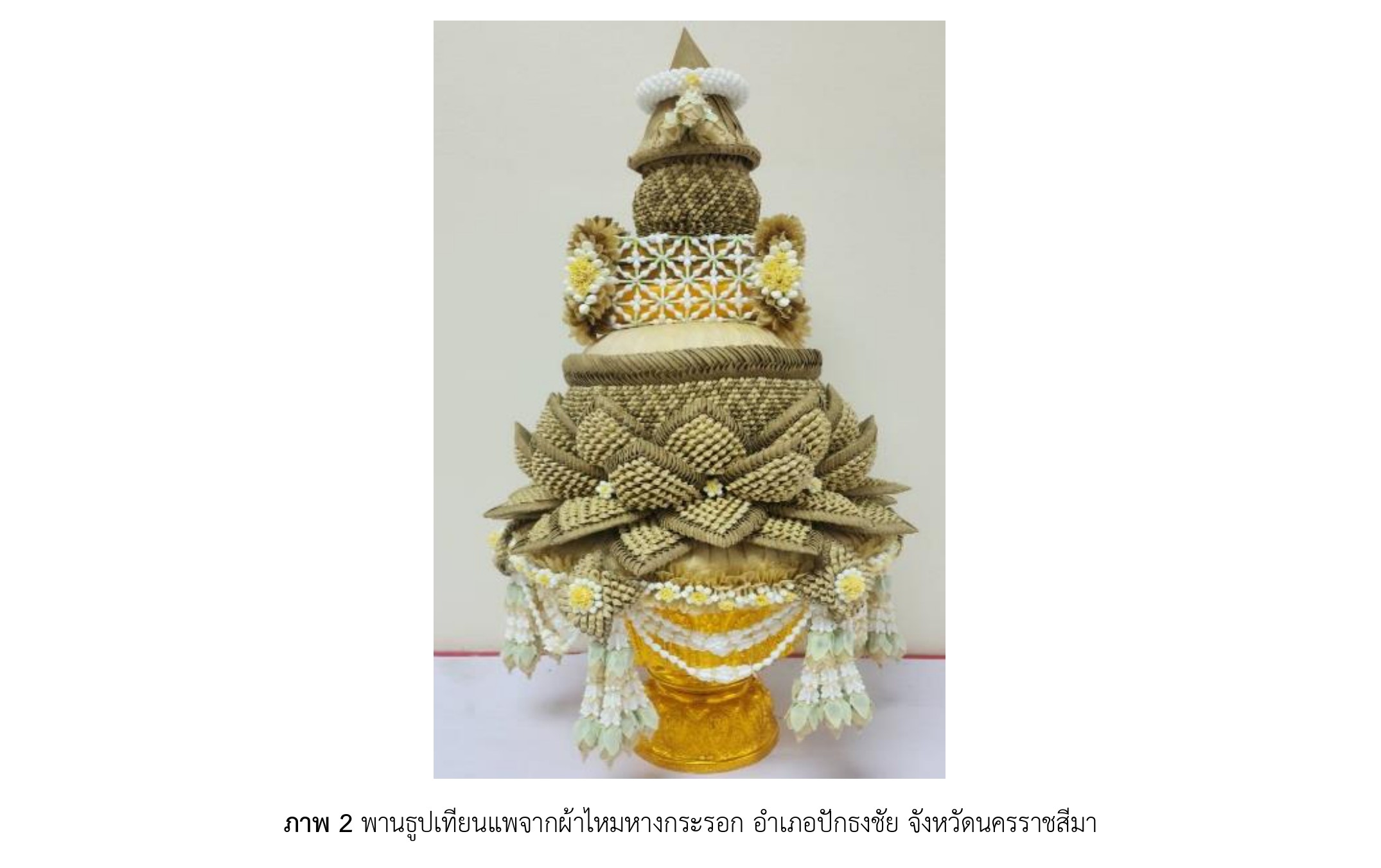
Development of incense tray and candle tray products from squirrel tail silk, Pak Thong Chai District, Nakhon Ratchasima Province
DOI:
https://doi.org/10.14456/psruhss.2025.11Keywords:
Silk, Incense tray with candles, HandicraftsAbstract
The development of the incense and candle tray product from squirrel tail silk, Pak Thong Chai District, Nakhon Ratchasima Province, aims to study the creation of the incense and candle tray from squirrel tail silk and to survey the satisfaction of consumers towards the incense and candle tray from squirrel tail silk and to analyze the data using statistics and to add value to squirrel tail silk. The creation of the incense and candle tray from squirrel tail silk through the process of applying the techniques of making in the form of hammering, cutting, attaching, stringing, tying and surveying the satisfaction of 100 consumers. The research results found that the product satisfaction survey found that in terms of creativity and design, the highest satisfaction score was creativity, at the highest level with an average of 4.62 ± 0.56, the form was at a high level with an average of 4.24 ± 0.74 and the proportion was at a high level with an average of 4.13 ± 0.80, respectively. In terms of material selection, the strength and durability were at a high level with an average of 4.09 ± 0.77, the suitability of the form was at a high level with an average of 4.20 ± 0.79 and the suitability for use was at a high level with an average of 4.21 ± 0.77, respectively. In terms of beauty and refinement The most exquisite beauty was at the highest level with a mean of 4.95 ± 0.23. The product color was most appropriate at the highest level with a mean of 4.79 ± 0.66. The product detail was at the highest level with a mean of 4.85 ± 0.41. In terms of product value and usefulness, it was at the highest level with a mean of 4.14 ± 0.75. The work expressed community identity and culture at the highest level with a mean of 4.55 ± 0.67. The usefulness and use were at the highest level with a mean of 4.18 ± 0.74. And overall satisfaction was at the highest level with a mean of 4.44 ± 0.61, respectively. It was found that the most satisfied consumers were in terms of exquisite beauty at the highest level with a mean of 4.86 ± 1.39. Creativity and design were at the highest level with a mean of 4.33 ± 1.44. Product value was at the highest level with a mean of 4.29 ± 1.43. The selection of materials was at the highest level with a mean of 4.16 ± 1.39. And overall satisfaction was at the highest level with a mean of 4.44 ± 0.61, respectively.
References
ศีมาศ ประทีปะวณิช. (2561). การศึกษากระบวนการผลิตผ้าไหมมัดหมี่ กรณีศึกษา พื้นที่อำเภอปักธงชัย จังหวัดนครราชสีมา. วารสารสถาบันวัฒนธรรมและศิลปะ มหาวิทยาลัยศรีนครินทรวิโรฒ, 20(1), 146–159. retrieved from https://so02.tci-thaijo.org/index.php/jica/article/view/163420
บุญชม ศรีสะอาด. (2545). หลักการวิจัยเบื้องต้น (พิมพ์ครั้งที่ 3). กรุงเทพฯ: สุวีริยาสาสน.
ประทับใจ สุวรรณธาดา, และศักดิ์ชาย สิกขา. (2561). การออกแบบและ พัฒนาผลิตภัณฑ์ชุมชนโดยใช้ทุนทางวัฒนธรรมและภูมิปัญญา: ในเขตพื้นที่ภาคอีสาน ตอนบน. วารสารวิชาการ ศิลปะสถาปัตยกรรมศาสตร์ มหาวิทยาลัยนเรศวร, 9(2), 137- 155. retrieved from https://so01.tci-thaijo.org/index.php/ajnu/article/view/163918
ประเสริฐ พิชยะสุนทร. (2557). ศิลปะและการออกแบบเบื้องต้น (พิมพ์ครั้งที่ 2). กรุงเทพฯ: จุฬาลงกรณ์มหาวิทยาลัย.
มณีรัตน์ จันทนะผะลิน. (2525). มรดกไทย เล่มที่ 3 งานใบตอง. กรุงเทพฯ: คณะวิชาวิทยาศาสตร์ วิทยาลัยครูสวนดุสิต.
วิจิตร สนหอม, วินัย ตาระเวช, จุฬาภรณ์ ศรีเมืองไหม, วรรณภา โรน์สุวณิชกร, และพิมพ์วิภา เงาไพร. (2565). การพัฒนาผลิตภัณฑ์พานธูปเทียนแพจากกระดาษฟางข้าว. วารสารศิลปกรรมศาสตร์วิชาการ วิจัย และงานสร้างสรรค์, 9(1), 100–110. retrieved from https://so05.tci-thaijo.org/index.php/arts/article/download/259932/174779/969347
Downloads
Published
How to Cite
Issue
Section
License
Copyright (c) 2025 Humanities and Social Sciences Journal of Pibulsongkram Rajabhat University

This work is licensed under a Creative Commons Attribution-NonCommercial-NoDerivatives 4.0 International License.
Any articles or comments appearing in the Journal of Humanities and Social Sciences, Rajabhat Phibulsongkram University, are the intellectual property of the authors, and do not necessarily reflect the views of the editorial board. Published articles are copyrighted by the Journal of Humanities and Social Sciences, Rajabhat Phibulsongkram University.