Hybrid Japanese Language Learning for Skill Development Among Hospital Staff: A Case Study of a Private Hospital in Chiang Mai Province
DOI:
https://doi.org/10.14456/psruhss.2025.30Keywords:
Japanese teaching, Hybrid learning system, Japanese language for work, HospitalAbstract
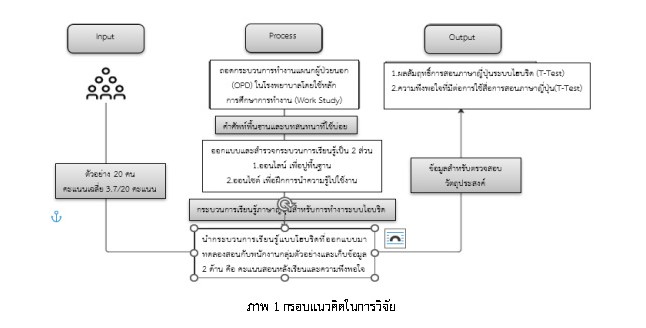
This research aimed to develop a hybrid Japanese language learning process for the OPD staff at a private hospital in Chiang Mai Province. The learning process is divided into two parts: the first part involves online learning to establish a foundational knowledge base. In contrast, the second part focuses on onsite learning that emphasizes the practical application of the Japanese language in real-world work scenarios. This is achieved through role-playing simulations and on-the-job training with Japanese patients who avail of the hospital's services. Preliminary research results indicate that this learning process effectively enhances learners' knowledge as expected, with post-learning test scores increasing by an average of more than 10 points out of a total of 20 points. Additionally, learners expressed a satisfaction level averaging above 4 out of 10 points at the significant level of 0.05, as confirmed statistically through a t-test. This research not only provides a new approach for developing Japanese language skills among hospital staff but also addresses the needs of the medical industry in the era of the New S-Curve. It also responds to the needs of the medical industry in the New S-Curve era, particularly in the area of customer service for Japanese patients receiving treatment in Thai hospitals.
References
ชัยวัฒน์ สุภัควรกุล, สุทธิพงศ์ หกสุวรรณ และนิคม ชมภูหลง. (2560). การพัฒนาระบบการเรียนการสอนแบบไฮบริด สำหรับนักศึกษาระดับปริญญาตรี มหาวิทยาลัยราชภัฏ. วารสารการวัดผลการศึกษา มหาวิทยาลัยมหาสารคาม, 23 (1), 66–77.
ณภัทร แสนโภชน์, อภิศักดิ์ วิทยประภากร และ Isao Yamaki. (2564). การสร้างหลักสูตรภาษาญี่ปุ่นเพื่อการทำงานบุคลากรทางการแพทย์โดยโมเดลซิปปา: กรณีศึกษาโรงพยาบาลเชียงใหม่. ใน การประชุมวิชาการระดับชาตินเรศวรวิจัยและนวัตกรรม ครั้งที่ 17 (น. 1174-1189). พิษณุโลก: มหาวิทยาลัยนเรศวร. สืบค้นจาก https://www.mis.research.nu.ac.th/dri/pdf_file/nrc/nrc17.pdf
ณัฐกร สงคราม. (2557). ผลของการใช้การเรียนรู้แบบปัญหากระตุ้นการเรียนรู้ในรูปแบบผสมผสานต่อผลสัมฤทธิ์ทางการเรียนของนักศึกษาระดับปริญญาตรี คณะเทคโนโลยีการเกษตร มหาวิทยาลัยเทคโนโลยีพระจอมเกล้าลาดกระบัง. วารสารศึกษาศาสตร์ มหาวิทยาลัยศิลปากร, 12(12), 81-86. https://so02.tci-thaijo.org/index.php/suedujournal/article/view/94947
ปราณี คำจันทร์, ทัชมาศ ไทยเล็ก และศมนนันท์ ทัศนีย์สุวรรณ .(2562). ผลลัพธ์การเรียนรู้ตามกรอบมาตรฐานคุณวุฒิระดับอุดมศึกษาในมุมมองของนักศึกษาพยาบาลเกี่ยวกับการเรียนรู้แบบผสมผสานในรายวิชาวิจัยทางการพยาบาลพื้นฐาน. วารสารสงขลานครินทร์, 42(3), 63-73. สืบค้นจาก https://he02.tci-thaijo.org/index.php/nur-psu/article/view/257379.
ปิยวรรณ ปิยะกาญจน์, สุจิตรา ประวงษ์ และณัฎฐพงษ์ กาญจนฉายา. (2563). การพัฒนาบทเรียนมัลติมีเดียภาษาจีนสำหรับผู้เรียนระดับต้น. Journal of Information and Learning, 33(3), 10-12. สืบค้นจาก https://so04.tci-thaijo.org/index.php/jil/article/view/258444.
พรพิศ งามพงษ์. (2564). การพัฒนาความสามารถทางภาษาอังกฤษโดยใช้การเรียนรู้แบบเชิงรุกโดยการจัดการเรียนการสอนแบบออนไลน์ของนักศึกษาชั้นปีที่ 1 มหาวิทยาลัยสวนดุสิต. ใน การประชุมวิชาการนำเสนอผลงานวิจัยระดับชาติและนานาชาติ ครั้งที่ 14 (น. 429-432). กรุงเทพฯ: มหาวิทยาลัยสวนดุสิต. สืบค้น จาก http://journalgrad.ssru.ac.th/index.php/8thconference/article/view/2466
รัชติวรรณ กาญจนปัญญาคม. (2562). การศึกษางานอุตสาหกรรม. กรุงเทพฯ: จุฬาลงกรณ์มหาวิทยาลัย.
วารีรัตน์ แก้วอุไร. (2564). การพัฒนาหลักสูตร: ทฤษฎีสู่การปฏิบัติในการออกแบบและพัฒนา. พิษณุโลก: มหาวิทยาลัยนเรศวร.
Aik, C. T. (2005). The synergies of the learning organization, visual factory management, and on-the-job training. Performance Improvement, 44 (7), 15–20. https://doi.org/10.1002/pfi.4140440705
Bloom, B. S., Engelhart, M. D., Furst, E. J., Hill, W. H., & Krathwohl, D. R. (1956). Taxonomy of educational objectives, handbook I: The cognitive domain. David McKay.
Eakpim, S. (2017). Curriculum development: Theory into practice of design and development. Takkasila. MacMillan Publishing Company.
Johnson, S. D., & Aragon, S. R. (2003). An instructional strategy framework for online learning environments. New directions for adult and continuing education, 2003(100), 31-43. https://doi.org/10.1002/ace.117
Kaladee, A., & Chankong, W. (2022). Hybrid learning design in statistics and research in health management for graduate students during the COVID-19 outbreak. Public Health Policy and Laws Journal, 8 (2), 295-311. สืบค้นจาก https://so05.tci-thaijo.org/index.php/journal_law/article/view/258569
Matsuo, M. (2014). Instructional skills for on-the-job training and experiential learning: An empirical study of Japanese firms. International Journal of Training and Development, 18(4), 225-240. https://doi.org/10.1111/ijtd.12035
Moreno, J. L. (1953). Who shall survive?: A new approach to the problem of human interrelations. Publication of Beacon House.
Nichikito, E. (2017). An analysis of the teamwork between doctors and medical interpreters: derived from simulated consultations mediated by Japanese Thai interpreters. The JSN Journal (Special Edition),187-203. https://so04.tci-thaijo.org/index.php/jsn/article/view/75068.
Nichiko, E. (2018). Medical interpreters' knowledge and communication skills for effective teamwork with doctors and nurses: Based on a study of Japanese Thai interpreters at three private hospitals in Chiangmai. The Japanese Studies Journal, 35(2), 42-67. https://so02.tci-thaijo.org/index.php/japanese/article/view/165181
Print, M. (1993). Curriculum development and design (2nd ed.). Allen & Unwin.
Rodrigo, R. T., & Platon, L. H. (2022). Hybrid learning for the digital natives: Impacts on academic performance and learning approaches. Kasetsart Journal of Social Sciences, 43(1),201–208. https://doi.org/10.34044/j.kjss.2022.43.1.27
Yukinori, W. (2012). Japanese interpreters in Bangkok's international hospitals: Implications for intercultural communication between Japanese patients and Thai medical providers. 多言語多文化研究= Japan journal of multilingualism and multiculturalism, 18(1), 19-38.
Downloads
Published
How to Cite
Issue
Section
License
Copyright (c) 2025 Humanities and Social Sciences Journal of Pibulsongkram Rajabhat University

This work is licensed under a Creative Commons Attribution-NonCommercial-NoDerivatives 4.0 International License.
Any articles or comments appearing in the Journal of Humanities and Social Sciences, Rajabhat Phibulsongkram University, are the intellectual property of the authors, and do not necessarily reflect the views of the editorial board. Published articles are copyrighted by the Journal of Humanities and Social Sciences, Rajabhat Phibulsongkram University.