Cross-Cultural Communication through Narrative in Anime Film Texts
DOI:
https://doi.org/10.14456/psruhss.2025.17Keywords:
Cross-cultural communication, Narrative, Anime filmAbstract
The purpose of the present study was to analyze anime film texts through the concepts of cross-cultural communication and film narrative. Qualitative research methodology was applied, and data collected from 9 anime films and related documents were presented in analytical description. The findings revealed 10 important issues that contribute to the successful transcendence of cultural boundaries by Japanese cultural elements embedded in anime and their influence on international audiences. Within the domain of cross-cultural communication, three principal issues were identified under general cross-cultural communication, four under time orientation, and five under Hofstede’s cultural dimensions theory. Regarding the elements of storytelling, the analysis uncovered four important issues related to character development, six related to setting, and seven pertaining to presentation style. Most of the significant findings are rooted in expressions of Japanese culture, wherein anime directors integrate Japanese traditions and domestic settings into character actions to reflect Japanese identity. Additionally, the elements of storytelling particularly characters, settings, and presentation style further enhance the distinctiveness and narrative richness of each anime film examined.
References
เบญจางค์ ใจใส แดร์ อาร์สลานิออง. (2565). ความรู้เบื้องต้นเกี่ยวกับโยไก. กรุงเทพฯ: ดีไซน์ปริ้นท์ มีเดีย.
ปัญญาพงค์ วาทิสุนทร. (2564). ปัจจัยที่มีผลต่อความชื่นชอบตัวละครในการ์ตูนญี่ปุ่นยุค 90s ของประชากรไทย (วิทยานิพนธ์ปริญญามหาบัณฑิต). กรุงเทพฯ: มหาวิทยาลัยมหิดล.
มติชนสุดสัปดาห์. (2564). สังคมผู้ชายเป็นใหญ่ในญี่ปุ่นกับยุคสมัยที่เปลี่ยนแปลง. สืบค้น 12 กรกฎาคม 2568, จาก https://www.matichonweekly.com/column/article_416951
มีเดียม. (2564). วัฒนธรรมกาแฟในญี่ปุ่น. สืบค้น 11 กรกฎาคม 2568, จาก https://g-crimson.medium.com/วัฒนธรรมกาแฟในญี่ปุ่น-f62227ba9040
ยุพา คลังสุวรรณ, และหทัยรัตน์ ทรรพวสุ. (2540). การอาบน้ำแบบญี่ปุ่น. วารสารญี่ปุ่นศึกษาธรรมศาสตร์, 14(2), 71-92. https://so02.tci-thaijo.org/index.php/japanese/article/view/52071
วาริชา วงศ์พยัต. (2563). พื้นที่ใน-ระหว่าง ในการอยู่อาศัยญี่ปุ่น. กรุงเทพฯ: ภาพพิมพ์.
อรสา ชูสกุล. (2555). การพัฒนาคุณภาพการศึกษาของประเทศญี่ปุ่น. สืบค้น 12 กรกฎาคม 2568, จาก http://biology.ipst.ac.th/?p=947
AKBAS, I. (2018). A “Cool’’ Approach to Japanese Foreign Policy: Linking Anime to International Relations. Journal of International Affairs, 23(1), 95-120. https://dergipark.org.tr/en/download/article-file/815454
Ayumu, W. (Director). (2019). Children of the Sea [Film]. Tokyo: STUDIO 4°C.
Bastida, R. (2019). Beyond Subcultural Community: A Sociological Analysis of Japanese Animation Fans and Fandoms (Doctoral dissertation). Calgary: University of Calgary.
Box Office Mojo. (n.d.). Genre Keyword: Anime. Retrieved July 10, 2025, from https://www.boxofficemojo.com/genre/sg4259246337/?ref_=bo_gs_table_226
Hosoda, M. (Director). (2012). Wolf Children [Film]. Tokyo: Studio Chizu.
Miyazaki, G. (Director). (2011). From Up on Poppy Hill [Film]. Tokyo: Studio Ghibli.
Mogi, K. (2022). The Little Book of Ikigai. Great Britain: Quercus Editions, Ltd.
Mollett, L. (2022). The Business of Capitalizing on Culture: Onsen Industry in Japan. Retrieved July 11, 2025, from https://wyoscholar.uwyo.edu/server/api/core/bitstreams/91294660-ef6e-4b03-963a-0690c2412a13/content
Monden, M. (2015). Shojo Manga Research: The Legacy of Women Critics and Their Gender-Based Approach. Retrieved March 1, 2025, from https://www.researchgate.net/publication/280083810_Shojo_Manga_Research_The_Legacy_of_Women_Critics_and_Their_Gender-Based_Approach
Okeke, D. (2024). Most Interesting Anime Statistics and Facts (NEW Report). Retrieved July 13, 2025, from https://passivesecrets-com.translate.goog/anime-statistics/?_x_tr_sl=en&_x_tr_tl=th&_x_tr_hl=th&_x_tr_pto=tc
Onemu, U. (n.d.). The Economies of Anime Anime as a soft power, a cultural product and a (trans)national medium (master’s thesis). Uxbridge: Brunel University.
Shen, Y. (2020). Traditional Festival as a Tourism Event: Stakeholders’ Influence on the Dynamics of the Sendai Tanabata Festival in Japan (master’s thesis). Oslo: University of Oslo.
Shinkai, M. (Director). (2016). Your Name [Film]. Tokyo: CoMix Wave Films.
Shinkai, M. (Director). (2019). Weathering with You [Film]. Tokyo: CoMix Wave Films.
Sotozaki, H. (Director). (2020). Demon Slayer : Kimetsu no Yaiba – The Movie: Mugen Train [Film]. Tokyo: Studio Ufotable.
Universotokyo. (2016). Macoto Takahashi: An Invitation into his Fairytale World. Retrieved July 10, 2025, from https://universotokyo.wordpress.com/2016/02/19/macoto-takahashi-an-invitation-into-his-fairytale-world-
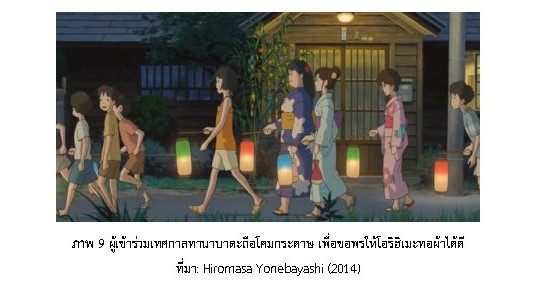
Yonebayashi, H. (Director). (2014). When Marnie Was There [Film]. Tokyo: Studio Ghibli.
Downloads
Published
How to Cite
Issue
Section
License
Copyright (c) 2025 Humanities and Social Sciences Journal of Pibulsongkram Rajabhat University

This work is licensed under a Creative Commons Attribution-NonCommercial-NoDerivatives 4.0 International License.
Any articles or comments appearing in the Journal of Humanities and Social Sciences, Rajabhat Phibulsongkram University, are the intellectual property of the authors, and do not necessarily reflect the views of the editorial board. Published articles are copyrighted by the Journal of Humanities and Social Sciences, Rajabhat Phibulsongkram University.