Guidelines for Muslim Community Participation in the Joint Issuance of Liquor Licensing
DOI:
https://doi.org/10.14456/psruhss.2026.4Keywords:
Participation, Muslim community, Joint issuance, Liquor licensingAbstract
This qualitative research aimed to: 1) develop a community participation model for liquor license issuance corresponding to the density of liquor retailers in each area; and 2) examine the feasibility of the model with Muslim communities in Bangkok as a prototype for community participation in liquor license issuance. The study was grounded in the theoretical framework of citizen participation, integrated with the Responsible Service of Alcohol (RSA) approach and the principles of the Community Health Charter. Data were collected through six focus group discussions with 30 key informants, comprising 15 government officials (Excise officers, police officers, public health officers, and city law enforcement officers) and 15 Muslim community representatives (religious leaders/Imams, community leaders, and community members), selected through purposive sampling. The research was conducted in three Bangkok districts—Watthana, Khlong Toei, and Nong Chok—representing high, medium, and low densities of liquor retailers, respectively. A semi-structured focus group guide, validated for content validity by experts, was used as the research instrument. Data were analyzed through structured content analysis, and credibility was established through triangulation.
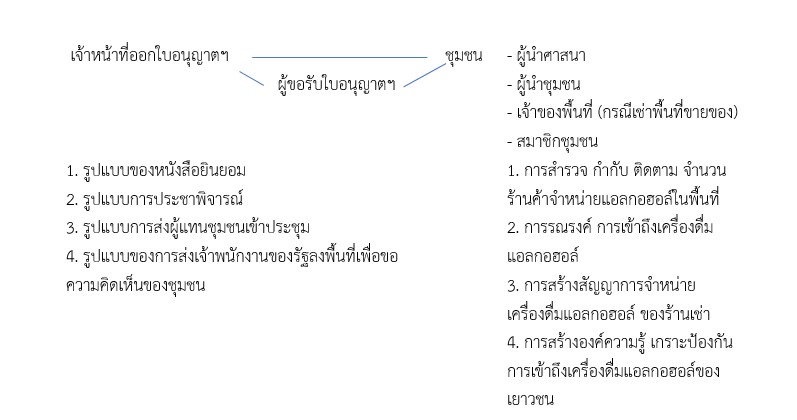
The findings revealed that Muslim community participation in liquor license issuance can be implemented through both direct and indirect mechanisms. The direct approach comprises four forms: community consent letters, public hearings, the delegation of community representatives to licensing meetings, and on-site consultations by licensing officers—though these remain unsupported by current legal provisions. The indirect approach involves awareness campaigns, religious guidance for community members, and lease agreements prohibiting alcohol sales on rented premises. The developed model encompasses the interrelationships among three key actors—government officials, retailers, and local residents—driven by community strength, religious and cultural principles, mutual agreements, and spatial information systems. When piloted in three communities, all selected the indirect approach grounded in religious principles, as they were unable to enforce restrictions on transient populations and non-Muslim residents, and the state lacks formal procedures supporting community resolutions. The research team therefore recommends amending Clauses 4 and 6 of the Ministerial Regulation on Liquor Licensing (No. 2) B.E. 2565, requiring license applicants to submit community committee consent documentation and mandating that competent officials consult community opinions prior to issuing liquor licenses.
References
กิจพิณิฐ อุสาโห, ปองสิน วิเศษศิริ, ฐิติกร หมายมั่น, มณฑา วิญญโสภิต, และ ยุพวรรณ นังคลาภิวัฒน์. (2564). การศึกษาบทบาทที่เป็นจริงของหน่วยงานรัฐและกลไกของรัฐในการบังคับใช้กฎหมาย เกี่ยวกับมาตรการควบคุมจุดจำหน่ายเครื่องดื่มแอลกอฮอล์รอบมหาวิทยาลัย. วารสารวิชาการมหาวิทยาลัยอีสเทิร์นเอเชีย ฉบับสังคมศาสตร์และมนุษยศาสตร์, 11(1), 208-218.
ผดุงศิษฏ์ ชำนาญบริรักษ์, ปรีขา ยะถา, บุญชอบ สิงห์คำ, กิตติศักดิ์ ไกรจันทร์, และ สุนีรัตน์ สิงห์คำ. (2564). การสร้างและการพัฒนามาตรการชุมชนเพื่อการควบคุมการบริโภคและการจำหน่ายเครื่องดื่มแอลกอฮอล์ในชุมชน ตำบลดงบัง อำเภอนาดูน จังหวัดมหาสารคาม. วารสารโรงพยาบาลมหาสารคาม, 18(2), 61-71.
พลเทพ วิจิตรคุณากร, สาวิตรี อัษณางค์กรชัย, กนิษฐา ไทยกล้า, สุพีชา รุ่งเรือง, ซูไฮมี บูยา, วรางคณา ด้วงแป้น, และวรินทร บุญญานุกูล. (2564). การศึกษาความสัมพันธ์ระหว่างความหนาแน่นของจุดจำหน่ายสุราและพฤติกรรมการ บริโภคสุราในวัยรุ่นไทย ปี พ.ศ. 2550-2560 โดยใช้ Spatiotemporal analysis. ศูนย์วิจัยปัญหาสุรา (ศวส.). กรุงเทพฯ, 64 น.
มัสยิดอัตตักวา. (2560). ธรรมนูญสุขภาพชุมชนมุสลิมมัสยิดอัตตักวา อำเภอเมือง จังหวัดเชียงใหม่ ฉบับที่ 1 พ.ศ. 2560. สืบค้น 20 มกราคม 2569 จาก, https://infocenter.nationalhealth.or.th/Ebook/massayitastakawa/book.html#p=2
วีรนุช ว่องวรรธนะกุล. (2553). การควบคุมการเข้าถึงเครื่องดื่มแอลกอฮอล์ : นโยบายสาธารณะที่มีประสิทธิผลและความคุ้มค่า. วารสารวิจัยสาธารณสุข, 4(4), 578-580.
สุรศักดิ์ ไชยสงค์, บุณฑริกา บุญไชยแสน, ศิริพร หงษ์ทะนี, ศิรินันท์ ปะนะภูเต และนันทนัช ตั้งจาตุรโสภณ. (2556). การรับรู้และการปฏิบัติตามกฎหมายควบคุมเครื่องดื่มแอลกอฮอล์ของผู้จำหน่ายเครื่องดื่มแอลกอฮอล์รอบเขตมหาวิทยาลัยมหาสารคาม วิทยาเขตขามเรียง. วารสารวิทยาศาสตร์และเทคโนโลยี มหาวิทยาลัยมหาสารคาม, 31(3), 237-244.
อวิการัตน์ นิยมไทย. (2552). “เครื่องดื่มแอลกอฮอล์” สินค้าที่ต้องได้รับการควบคุม. จุลนิติ. 133-139.
อุดมศักดิ์ แซ่โง้ว. (2561). ผลของความหนาแน่นของจุดจำหน่ายแอลกอฮอล์ต่อพฤติกรรมการดื่มและผลกระทบ. วารสารวิจัยทางวิทยาศาสตร์สุขภาพ วิทยาลัยพยาบาลบรมราชชนนี จังหวัดนนทบุรี, 12(1), 129–139. https://he01.tci-thaijo.org/index.php/JHR/article/view/131787
Al-Ansari, B., Thow, A. M., Mirzaie, M., Day, C. A., & Conigrave, K. M. (2019). Alcohol policy in Iran: Policy content analysis. International Journal of Drug Policy, 73, 185-198. https://doi.org/10.1016/j.drugpo.2019.07.032
Arnstein, S. R. (1969) A Ladder of Citizen Participation. Journal of the American Institute of Planners, 35, 216-224. https://doi.org/10.1080/01944366908977225
Arnstein, S. R. (1969). A Ladder Of Citizen Participation. Journal of the American Institute of Planners. 35(4), 216–224.
Hofstrand, D. (2009). Understanding Profitability. Ag Decisions Makers. 2, C3–24. https://www.extension.iastate.edu/agdm/wholefarm/pdf/c3-24.pdf
Kypri, K., & Maclennan, B. (2014). Public participation in local alcohol regulation: Findings from a survey of N ew Z ealand communities. Drug and Alcohol Review, 33(1), 59-63. https://doi.org/10.1111/dar.12094
Melton City Council. (2017). Melton Council and Community Alcohol (Liquor) Policy Framework: Background Paper.
Nicholls, J., O'Donnell, R., Mahon, L., & Fitzgerald, N. (2022). ‘Give us the real tools to do our jobs’: views of UK stakeholders on the role of a public health objective for alcohol licensing. Public Health, 211, 122-127.
Pliakas, T., Egan, M., Gibbons, J., Ashton, C., Hart, J., & Lock, K. (2018). Increasing powers to reject licences to sell alcohol: Impacts on availability, sales and behavioural outcomes from a novel natural experiment evaluation. Preventive Medicine. 116, 87–93.
Reynolds, J., Engen, J., McGrath, M., Pashmi, G., Andrews, M., Egan, M., Lim, J., & Lock, K. (2017). Influences on public health contributions to alcohol licensing processes in local government in England: a mixed-methods study. The Lancet. 390, S77.
The Institute of Public Health in Ireland. (2022). Review of Alcohol Licensing. Retrieved January 25, 2026 from https://instituteofpublichealth.org/sites/default/files/resources/20220121_Review-of-alcohol-licensing_IPH_FINAL-for-website.pdf
Ure, C., Burns, E. J., Hargreaves, S. C., Hidajat, M., Coffey, M., de Vocht, F., ... & Cook, P. A. (2021). How can communities influence alcohol licensing at a local level? Licensing officers’ perspectives of the barriers and facilitators to sustaining engagement in a volunteer-led alcohol harm reduction approach. International Journal of Drug Policy, 98, 103412. https://doi.org/10.1016/j.drugpo.2021.103412
Vengateshwaran, C., & Madasamy, V. (2017). Social and Economic Problems of Alcohol Addiction in Urban. International Journal of Innovative Knowledge Concepts, 5(7), 118-122.
Downloads
Published
How to Cite
Issue
Section
License
Copyright (c) 2026 Humanities and Social Sciences Journal of Pibulsongkram Rajabhat University

This work is licensed under a Creative Commons Attribution-NonCommercial-NoDerivatives 4.0 International License.
Any articles or comments appearing in the Journal of Humanities and Social Sciences, Rajabhat Phibulsongkram University, are the intellectual property of the authors, and do not necessarily reflect the views of the editorial board. Published articles are copyrighted by the Journal of Humanities and Social Sciences, Rajabhat Phibulsongkram University.