
The Social Welfare on The Third Way
DOI:
https://doi.org/10.14456/psruhss.2026.19Keywords:
The third way, Social welfare reform, Social investment stateAbstract
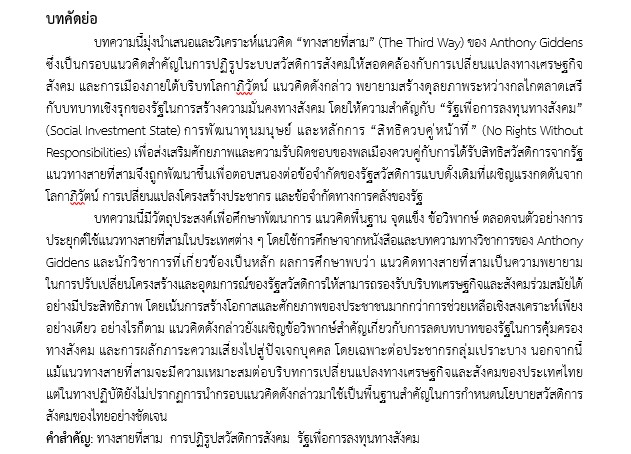
This article aims to present and critically analyze the concept of “The Third Way” proposed by Anthony Giddens, which constitutes a significant theoretical framework for reforming social welfare systems in response to economic, social, and political transformations under the conditions of globalization. The concept seeks to establish a balance between free-market mechanisms and the proactive role of the state in promoting social security and social cohesion. Central to this approach are the notions of the “Social Investment State,” human capital development, and the principle of “No Rights Without Responsibilities,” which emphasize the enhancement of citizens’ capacities and responsibilities alongside their entitlement to social welfare rights. The Third Way thus emerged as an attempt to address the limitations of the traditional welfare state, which has increasingly faced pressures arising from globalization, demographic transformation, and fiscal constraints.
This article seeks to examine the historical development, foundational principles, strengths, criticisms, and practical applications of the Third Way in various countries through an extensive review of the works of Anthony Giddens and related scholars. The findings indicate that the Third Way represents an effort to restructure both the institutional foundations and ideological orientation of the welfare state in order to accommodate contemporary economic and social conditions more effectively. Rather than emphasizing passive welfare assistance, the approach prioritizes the creation of opportunities, the enhancement of human capabilities, and active participation in economic and social life. Nevertheless, the concept has also been subject to substantial criticism, particularly regarding the reduction of the state’s role in social protection and the transfer of social risks and responsibilities to individuals, especially vulnerable populations. Furthermore, although the Third Way appears to be broadly compatible with Thailand’s contemporary socioeconomic transformations, there remains no clear adoption of this framework as a central foundation for social welfare policymaking in Thailand.
References
Beramendi, P., Häusermann, S., Kitschelt, H., & Kriesi, H. (Eds.). (2015). The politics of advanced capitalism. Cambridge University Press.
Callinicos, A. (2001). Against the third way: An anti-capitalist critique. Polity Press.
Castells, M. (1996). The rise of the network society. Oxford: Blackwell Publishers.
Esping-Andersen, G. (2002). Why We Need a New Welfare State. Oxford University.
Fairclough, N. (2002). New labour, new language?. Routledge.
Ferguson, I., Mooney, G., & Lavalette, M. (2002). Rethinking welfare: A critical perspective. https://doi.org/10.4135/9781446219324
Friedman, M., Friedman, R. D., & Gardner, G. (1962). Capitalism and freedom. Chicago: University of Chicago press.
Giddens, A. (1998). The Third Way: The Renewal of Social Democracy. Cambridge: Polity Press.
Giddens, A. (2013). The third way and its critics. John Wiley & Sons.
Hall, S. (2003). New Labour's double-shuffle. Soundings, 24(24), 10-24. https://doi.org/10.3898/136266203820467680
Hayek, F. A. (1944). The road to serfdom. Routledge, London: The University of Chicago Press.
Inglehart, R. (1997). Modernization and Postmodernization: Cultural, Economic, and Political Change in 43 Societies. Princeton, NJ: Princeton University.
Jenson, J. (2009). Lost in Translation: The Social Investment Perspective and Gender Equality. Social Politics, 16(4), 446–483.
Keman, H. (2003). Explaining miracles: Third ways and work and welfare. West European Politics, 26(2), 115-135.
Leggett, W. (2004). Criticism and the Future of the Third Way. The Third Way and Beyond: Criticisms, Futures, Alternatives. Manchester: Manchester UP, 186-200.
Lister, R. (1990). The Exclusive Society: Citizenship and the Poor. Child Poverty Action Group.
Morel, N., Palier, B., & Palme, J. (2012). Towards a Social Investment Welfare State? Ideas, Policies and Challenges. Policy Press.
Olsen, N. (2022). Jørn Henrik Petersen and the origins of the third way: The market turn in the Danish welfare state since the 1970s. Scandinavian Journal of History, 47(5), 650–672.
Panitch, L., & Leys, C. (1997). The end of parliamentary socialism: From New Left to New Labour. Verso.
Pierson, C. (2001). The modern state and social welfare: The third way revisited. Policy Press.
Powell, M. (2000). New Labour and the third way in the British welfare state: a new and distinctive approach?. Critical social policy, 20(1), 39-60.
Sheldrick, B. (2002). New labor and the third way: Democracy, accountability and social democratic politics. Studies in Political Economy, 67(1), 133-143.
Taylor-Gooby, P. (2004). New risks, new welfare: The transformation of the European welfare state. Oxford University Press.
Wetherly, P. (2001). The reform of welfare and the way we live now: A critique of Giddens and the Third Way. Contemporary Politics, 7(2), 149-170.
Yates, C. (2002). In Defence of Unions: A Critique of the Third Way. Studies in Political Economy, 67(1), 123-131.
Downloads
Published
How to Cite
Issue
Section
License
Copyright (c) 2026 Humanities and Social Sciences Journal of Pibulsongkram Rajabhat University

This work is licensed under a Creative Commons Attribution-NonCommercial-NoDerivatives 4.0 International License.
Any articles or comments appearing in the Journal of Humanities and Social Sciences, Rajabhat Phibulsongkram University, are the intellectual property of the authors, and do not necessarily reflect the views of the editorial board. Published articles are copyrighted by the Journal of Humanities and Social Sciences, Rajabhat Phibulsongkram University.