
สวัสดิการสังคมบนแนวทางสายที่สาม
DOI:
https://doi.org/10.14456/psruhss.2026.20คำสำคัญ:
ทางสายที่สาม , การปฏิรูปสวัสดิการสังคม , รัฐเพื่อการลงทุนทางสังคมบทคัดย่อ
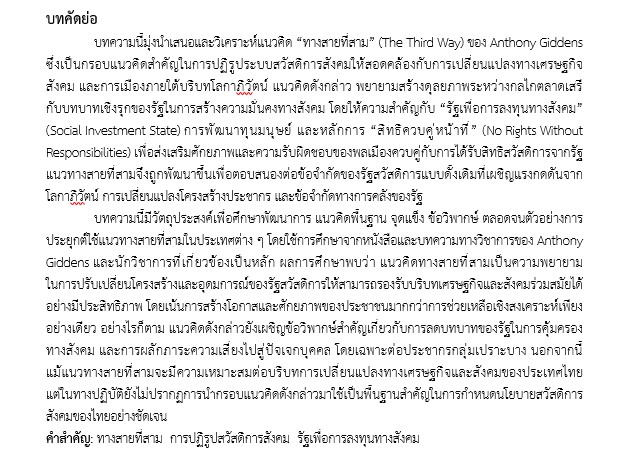
บทความนี้มุ่งนำเสนอและวิเคราะห์แนวคิด “ทางสายที่สาม” (The Third Way) ของ Anthony Giddens ซึ่งเป็นกรอบแนวคิดสำคัญในการปฏิรูประบบสวัสดิการสังคมให้สอดคล้องกับการเปลี่ยนแปลงทางเศรษฐกิจ สังคม และการเมืองภายใต้บริบทโลกาภิวัตน์ แนวคิดดังกล่าว พยายามสร้างดุลยภาพระหว่างกลไกตลาดเสรีกับบทบาทเชิงรุกของรัฐในการสร้างความมั่นคงทางสังคม โดยให้ความสำคัญกับ “รัฐเพื่อการลงทุนทางสังคม” (Social Investment State) การพัฒนาทุนมนุษย์ และหลักการ “สิทธิควบคู่หน้าที่” (No Rights Without Responsibilities) เพื่อส่งเสริมศักยภาพและความรับผิดชอบของพลเมืองควบคู่กับการได้รับสิทธิสวัสดิการจากรัฐ แนวทางสายที่สามจึงถูกพัฒนาขึ้นเพื่อตอบสนองต่อข้อจำกัดของรัฐสวัสดิการแบบดั้งเดิมที่เผชิญแรงกดดันจากโลกาภิวัตน์ การเปลี่ยนแปลงโครงสร้างประชากร และข้อจำกัดทางการคลังของรัฐ
บทความนี้มีวัตถุประสงค์เพื่อศึกษาพัฒนาการ แนวคิดพื้นฐาน จุดแข็ง ข้อวิพากษ์ ตลอดจนตัวอย่างการประยุกต์ใช้แนวทางสายที่สามในประเทศต่าง ๆ โดยใช้การศึกษาจากหนังสือและบทความทางวิชาการของ Anthony Giddens และนักวิชาการที่เกี่ยวข้องเป็นหลัก ผลการศึกษาพบว่า แนวคิดทางสายที่สามเป็นความพยายามในการปรับเปลี่ยนโครงสร้างและอุดมการณ์ของรัฐสวัสดิการให้สามารถรองรับบริบทเศรษฐกิจและสังคมร่วมสมัยได้อย่างมีประสิทธิภาพ โดยเน้นการสร้างโอกาสและศักยภาพของประชาชนมากกว่าการช่วยเหลือเชิงสงเคราะห์เพียงอย่างเดียว อย่างไรก็ตาม แนวคิดดังกล่าวยังเผชิญข้อวิพากษ์สำคัญเกี่ยวกับการลดบทบาทของรัฐในการคุ้มครองทางสังคม และการผลักภาระความเสี่ยงไปสู่ปัจเจกบุคคล โดยเฉพาะต่อประชากรกลุ่มเปราะบาง นอกจากนี้ แม้แนวทางสายที่สามจะมีความเหมาะสมต่อบริบทการเปลี่ยนแปลงทางเศรษฐกิจและสังคมของประเทศไทยแต่ในทางปฏิบัติยังไม่ปรากฏการนำกรอบแนวคิดดังกล่าวมาใช้เป็นพื้นฐานสำคัญในการกำหนดนโยบายสวัสดิการสังคมของไทยอย่างชัดเจน
เอกสารอ้างอิง
Beramendi, P., Häusermann, S., Kitschelt, H., & Kriesi, H. (Eds.). (2015). The politics of advanced capitalism. Cambridge University Press.
Callinicos, A. (2001). Against the third way: An anti-capitalist critique. Polity Press.
Castells, M. (1996). The rise of the network society. Oxford: Blackwell Publishers.
Esping-Andersen, G. (2002). Why We Need a New Welfare State. Oxford University.
Fairclough, N. (2002). New labour, new language?. Routledge.
Ferguson, I., Mooney, G., & Lavalette, M. (2002). Rethinking welfare: A critical perspective. https://doi.org/10.4135/9781446219324
Friedman, M., Friedman, R. D., & Gardner, G. (1962). Capitalism and freedom. Chicago: University of Chicago press.
Giddens, A. (1998). The Third Way: The Renewal of Social Democracy. Cambridge: Polity Press.
Giddens, A. (2013). The third way and its critics. John Wiley & Sons.
Hall, S. (2003). New Labour's double-shuffle. Soundings, 24(24), 10-24. https://doi.org/10.3898/136266203820467680
Hayek, F. A. (1944). The road to serfdom. Routledge, London: The University of Chicago Press.
Inglehart, R. (1997). Modernization and Postmodernization: Cultural, Economic, and Political Change in 43 Societies. Princeton, NJ: Princeton University.
Jenson, J. (2009). Lost in Translation: The Social Investment Perspective and Gender Equality. Social Politics, 16(4), 446–483.
Keman, H. (2003). Explaining miracles: Third ways and work and welfare. West European Politics, 26(2), 115-135.
Leggett, W. (2004). Criticism and the Future of the Third Way. The Third Way and Beyond: Criticisms, Futures, Alternatives. Manchester: Manchester UP, 186-200.
Lister, R. (1990). The Exclusive Society: Citizenship and the Poor. Child Poverty Action Group.
Morel, N., Palier, B., & Palme, J. (2012). Towards a Social Investment Welfare State? Ideas, Policies and Challenges. Policy Press.
Olsen, N. (2022). Jørn Henrik Petersen and the origins of the third way: The market turn in the Danish welfare state since the 1970s. Scandinavian Journal of History, 47(5), 650–672.
Panitch, L., & Leys, C. (1997). The end of parliamentary socialism: From New Left to New Labour. Verso.
Pierson, C. (2001). The modern state and social welfare: The third way revisited. Policy Press.
Powell, M. (2000). New Labour and the third way in the British welfare state: a new and distinctive approach?. Critical social policy, 20(1), 39-60.
Sheldrick, B. (2002). New labor and the third way: Democracy, accountability and social democratic politics. Studies in Political Economy, 67(1), 133-143.
Taylor-Gooby, P. (2004). New risks, new welfare: The transformation of the European welfare state. Oxford University Press.
Wetherly, P. (2001). The reform of welfare and the way we live now: A critique of Giddens and the Third Way. Contemporary Politics, 7(2), 149-170.
Yates, C. (2002). In Defence of Unions: A Critique of the Third Way. Studies in Political Economy, 67(1), 123-131.
ดาวน์โหลด
เผยแพร่แล้ว
รูปแบบการอ้างอิง
ฉบับ
ประเภทบทความ
สัญญาอนุญาต
ลิขสิทธิ์ (c) 2026 วารสารมนุษยศาสตร์และสังคมศาสตร์ มหาวิทยาลัยราชภัฏพิบูลสงคราม

อนุญาตภายใต้เงื่อนไข Creative Commons Attribution-NonCommercial-NoDerivatives 4.0 International License.
บทความหรือข้อคิดเห็นใดใดที่ปรากฏในวารสารมนุษยศาสตร์และสังคมศาสตร์ มหาวิทยาลัยราชภัฏพิบูลสงครามเป็นวรรณกรรมของผู้เขียน ซึ่งบรรณาธิการไม่จำเป็นต้องเห็นด้วย บทความที่ได้รับการตีพิมพ์เป็นลิขสิทธิ์ของวารสารมนุษยศาสตร์และสังคมศาสตร์ มหาวิทยาลัยราชภัฏพิบูลสงคราม