The Guidelines for Retirement Savings Motivation among Young Employees: A Case Study of Bangkok
DOI:
https://doi.org/10.14456/psruhss.2026.7Keywords:
Retirement saving, Motivation, Young employeesAbstract
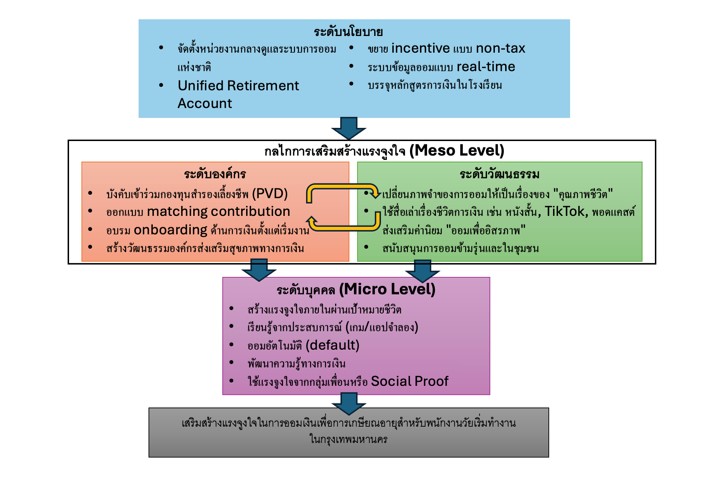
This study aims to investigate personal, financial literacy, and social factors influencing retirement saving behavior among young employees in Bangkok and proposes strategies to enhance saving motivation. A mixed-methods design was used, combining survey data from 400 employees aged 22–29 with in-depth interviews of 10 employees and 6 policymakers or experts. Results show that income, expenses, age, financial literacy, and social context significantly affect saving behavior, with income and financial literacy as the strongest predictors. These findings indicate that income security and financial capability are fundamental determinants of sustainable long-term saving behavior. Qualitative insights highlight that the barriers to saving are systemic rather than purely individual, including constraints at the individual level such as limited income and insufficient financial knowledge; at the organizational level, absence of provident funds and limited financial guidance; and at the policy level, fragmented and uncoordinated measures, especially for informal workers. To overcome these challenges, the study proposes a Whole-of-Society Approach across four dimensions (1) personal, including automatic payroll deductions and financial apps; (2) organizational, including employer matching and auto-enrollment; (3) policy, including a centralized savings agency and tax incentives for low-income groups; and (4) cultural, including campaigns that promote saving norms.
References
กรมกิจการผู้สูงอายุ. (2566). สถานการณ์ผู้สูงอายุไทย พ.ศ. 2565. กรุงเทพฯ: อมรินิทร์์ คอร์์เปอเรชั่นส์.
กระทรวงแรงงาน. (2566). รายงานสถิติจำนวนแรงงานแรกเข้าและผู้ประกันตนใหม่ในพื้นที่กรุงเทพมหานคร ประจำปีพุทธศักราช 2566. กรุงเทพฯ: ศูนย์เทคโนโลยีสารสนเทศและการสื่อสาร สำนักงานปลัดกระทรวงแรงงาน.
จิราภรณ์ มณีเนตร. (2567). ปัจจัยที่มีอิทธิพลต่อพฤติกรรมการออมและการวางแผนทางการเงินเพื่อการเกษียณอายุของประชากร Generation Y และ Generation Z ในเขตกรุงเทพมหานคร (สารนิพนธ์ปริญญามหาบัณฑิต). กรุงเทพฯ: มหาวิทยาลัยศรีนครินทรวิโรฒ.
ชมพูนุท พรหมภักดิ์. (2556). การเข้าสู่สังคมผู้สูงอายุของประเทศไทย. กรุงเทพฯ: สำนักงานเลขาธิการวุฒิสภา.
ธนาคารแห่งประเทศไทย. (2565). รายงานภาวะเศรษฐกิจและการเงิน. สืบค้น 25 ธันวาคม 2568, จาก https://www.bot.or.th/content/dam/bot/documents/th/thai-economy/state-of-thai-economy/annual-report/annual-econ-report-th-2565.pdf
นลินี วรวิทย์อนันต์. (2566). ช่องว่างระหว่างความรู้ทางการเงินและพฤติกรรมการออมเพื่อการเกษียณของกลุ่มแรงงานจบใหม่. วารสารการจัดการเชิงกลยุทธ์, 15(2), 45-62.
พงษ์ศักดิ์ เลิศวิจิตรศิลป์. (2566). บทบาทของสถาปัตยกรรมทางเลือกในองค์กรต่อการกระตุ้นการออมผ่านกองทุนสำรองเลี้ยงชีพ. วารสารพฤติกรรมศาสตร์เพื่อการพัฒนา, 11(1), 89-105.
วรัญญา ตั้งปัญญาเลิศ. (2567). อิทธิพลทางสังคมและบรรทัดฐานในที่ทำงานที่มีต่อพฤติกรรมการวางแผนทางการเงินระยะยาว. วารสารสังคมศาสตร์และมนุษยศาสตร์, 30(3), 112-128.
สถาบันคุ้มครองเงินฝาก. (2565). รายงานประจำปี 2565. สืบค้น 25 ธันวาคม 2568, จาก https://www.dpa.or.th/annual-report/annual-report-2565
สำนักงานเศรษฐกิจการคลัง. (2565). รายงานสถานการณ์การออมเพื่อวัยเกษียณ. กรุงเทพฯ: กระทรวงการคลัง.
สำนักงานสถิติแห่งชาติ. (2566). รายงานภาวะการทำงานของประชากรไทย พ.ศ. 2566. กรุงเทพฯ: สำนักงานสถิติแห่งชาติ.
Beshears, J., Choi, J. J., Laibson, D., & Madrian, B. C. (2009). The importance of default options For retirement saving outcomes: Evidence from the United States. In Social security policy in a changing environment (pp. 167-195). University of Chicago Press.
Cialdini, R. B., & Goldstein, N. J. (2004). Social influence: Compliance and conformity. Annu. Rev. Psychol., 55(1), 591-621. https://doi.org/10.1146/annurev.psych.55.090902.142015
Coleman, J. S. (1990). Foundations of Social Theory. Harvard University Press: Cambridge.
Hofstede, G. (1991). Cultures and Organizations: Software of the Mind. London: McGraw-Hill.
Laibson, D. (1997). Golden eggs and hyperbolic discounting. The Quarterly Journal of Economics, 112(2), 443-478. https://doi.org/10.1162/003355397555253
Lusardi, A., & Mitchell, O. S. (2014). The Economic Importance of Financial Literacy: Theory and Evidence. Journal of Economic Literature, 52(1), 5-44. https://doi.org/10.1257/jel.52.1.5
Lusardi, A., & Mitchell, O. S. (2019). How ordinary consumers make complex economic decisions: Financial literacy and retirement readiness. Quarterly Journal of Finance, 9(3), 1–30.
Madrian, B. C., & Shea, D. F. (2001). The power of suggestion: Inertia in 401(k) participation and Savings behavior. Quarterly Journal of Economics, 116(4), 1149–1187.
Modigliani, F., & Brumberg, R. (1954). Utility analysis and the consumption function: An interpretation of cross-section data. In K. K. Kurihara (Ed.), Post-Keynesian economics (pp. 388–436). Rutgers University Press.
OECD. (2020). OECD/INFE 2020 International Survey of Adult Financial Literacy. OECD Publishing: Paris. https://doi.org/10.1787/145f5607-en.
OECD. (2021). Pensions at a Glance 2021: OECD and G20 Indicators. OECD Publishing: Paris. https://doi.org/10.1787/ca401ebd-en
Thaler, R. H., & Sunstein, C. R. (2008). Nudge: Improving Decisions about Health, Wealth, and Happiness. Yale University Press: New Haven.
WealthMagik. (2565). 5 เคล็ดลับ ออมเงินแบบไหนดี? ตอบโจทย์ไลฟ์สไตล์คนรุ่นใหม่. สืบค้น 25 ธันวาคม 2568, จาก https://www.wealthmagik.com/articles/howto-saving
Willis Towers Watson (2016). ‘2015/2016 Global Benefits Attitudes Survey,’ Willis TowersWatson Issue Brief. London, UK: Willis Towers Watson.
Yamane, T. (1973). Statistics: An Introductory Analysis (3rd Ed.). Harper and Row: New York.
Downloads
Published
How to Cite
Issue
Section
License
Copyright (c) 2026 Humanities and Social Sciences Journal of Pibulsongkram Rajabhat University

This work is licensed under a Creative Commons Attribution-NonCommercial-NoDerivatives 4.0 International License.
Any articles or comments appearing in the Journal of Humanities and Social Sciences, Rajabhat Phibulsongkram University, are the intellectual property of the authors, and do not necessarily reflect the views of the editorial board. Published articles are copyrighted by the Journal of Humanities and Social Sciences, Rajabhat Phibulsongkram University.