Developing Participatory Waste Management Strategies to Promote the Circular Economy of Organizations Communities above Bhumibol Dam
DOI:
https://doi.org/10.14456/psruhss.2026.16Keywords:
Strategic, Waste management, Participatory, Circular economyAbstract
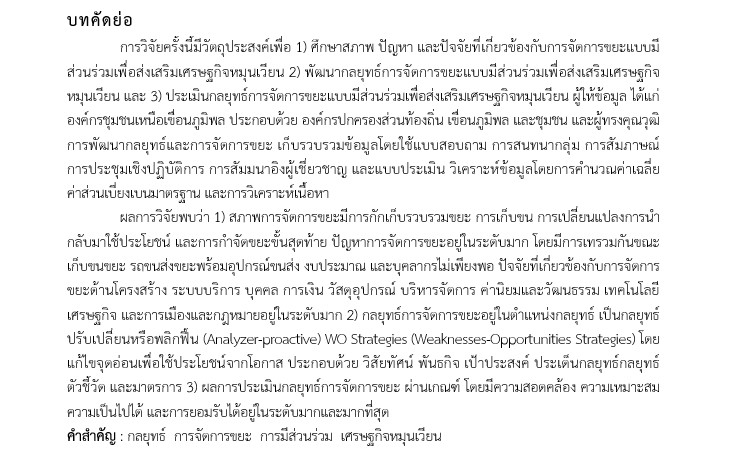
This research aimed to: 1) study the current state, problems, and related factors of participatory waste management to promote a circular economy 2) develop participatory waste management strategies to promote a circular economy, and 3) evaluate the developed participatory waste management strategies to promote a circular economy. The Informant are community organizations upstream of the Bhumibol Dam with consisting of local administrative organization, Bhumibol Dam, community leaders, community, and expert about strategy development or waste management. Data were collected through questionnaires, focus group discussion, interviews, workshops, connoisseurship, and evaluation forms. Data analysis involved mean, standard deviation and content analysis.
The findings revealed: 1) The current states of waste management consist of storage, collection, processing and recycling, and final disposal. The problems of waste management indicated high-levels that identified it was often mixed during transport, insufficient waste collection vehicles and equipment, budget constraints, and inadequate personnel. The factors which related waste management consist of structure, services, man, money, material, management, social – cultural, technology, economics and political-legal were indicated high-levels. 2) The waste management strategy status was analyzer – proactive (WO Strategies or Weaknesses-Opportunities Strategies) by addressing weaknesses to capitalize on opportunities. and it consist of vision, mission, goal, strategy issues, strategy, indicator and measure. 3) The developed waste management strategies were passed the evaluation criteria which they have consistency, appropriateness, feasibility, and acceptability indicated high-levels and very high-levels.
References
กรมควบคุมมลพิษ. (2566). รายงานจัดการขยะและของเสียอันตราย. สืบค้น 10 ตุลาคม 2566, จาก https://www.pcd.go.th/publication/10650/
กระทรวงมหาดไทย. (2567). การจัดการมูลฝอย. กรุงเทพฯ: กรมส่งเสริมการปกครองท้องถิ่นกองกฎหมายและระเบียบท้องถิ่น.
กองจัดการกากของเสียและสารอันตราย. (2565). รายงานประจำปีกากของเสียและขยะอันตราย. กรุงเทพฯ: กองจัดการกากของเสียและขยะอันตราย กรมควบคุมมลพิษ.
เก ประเสริฐสังข์. (2560). การวิจัยปฏิบัติการเชิงวิพากษ์เพื่อสร้างรูปแบบและกลไกการจัดการขยะอย่างครบวงจรบนฐานการมีส่วนร่วมของโรงเรียนและชุมชน (วิทยานิพนธ์ปรัชญาดุษฎีบัณฑิต). กรุงเทพฯ: มหาวิทยาลัยศรีนครินทรวิโรฒ.
คณาธิป ไกยชน. (2567). การบริหารจัดการขยะตามแนวคิดเศรษฐกิจหมุนเวียน (Circular economy). วิจัยปริทัศน์, 47, 1-20.
เดช อุณหะจิรังรักษ์. (2565). การสร้างสรรค์นวัตกรรมบริการสาธารณะโดยองค์การบริหารส่วนตำบล. สืบค้น 10 ตุลาคม 2566, จาก https://explore.nrct.go.th/search_detail/result/8752
นงนุช ศรีสุข และเบญญาดา กระจ่างแจ้ง. (2566). การจัดการขยะฐานศูนย์ของชุมชนภายใต้แนวคิดระบบเศรษฐกิจหมุนเวียน กรณีศึกษา องค์การบริหารส่วนตำบลปะตง อำเภอสอยดาว จังหวัดจันทบุรี. วารสารนวัตกรรมการจัดการศึกษาและการวิจัย, 5(4), 1011–1026. https://so02.tci-thaijo.org/index.php/jemri/article/view/263714
บุญชม ศรีสะอาด. (2545). การวิจัยเบื้องต้น (พิมพ์ครั้งที่ 7). กรุงเทพฯ: สุวีริยาสาส์น.
ประกาศยุทธศาสตร์ชาติ 20 ปี (พ.ศ. 2561-2580). (2566, 10 ตุลาคม). ราชกิจจานุเบกษา. เล่ม 135 ตอนที่ 82ก. หน้า 1-71.
พัทธ์ธีรา วงศราวิทย์. (2561). เศรษฐกิจหมุนเวียน. สืบค้น 16 กรกฎาคม 2564, จาก https://www.prachachat.net/columns/news-169313
ภัทรารัตน์ ตนนุกิจ, สุขสันต์ กิติศุภกร และปิติ ฉลองวิริยะเลิศ. (2564). การพัฒนาระบบบริหารจัดการขยะโดยใช้แนวคิดเศรษฐกิจหมุนเวียนและการแก้ปัญหาแบบมีส่วนร่วมในโรงพยาบาลสำนักการแพทย์ กรุงเทพมหานคร. กรุงเทพฯ: ศูนย์วิจัยและแพทยศาสตร์ศึกษา สำนักการแพทย์กรุงเทพมหานคร.
มลธิดา อุบลรัตน์. (2566). การวางแผนกลยุทธ์ เพื่อพัฒนาองค์กรที่มีประสิทธิภาพ. วารสารสหวิทยาการนวัตกรรมปริทรรศน์, 6(2), A100-A114. https://so04.tci-thaijo.org/index.php/jidir/article/view/259319
ลักษมี เกตุสกุล. (2558). การมีส่วนร่วมของประชาชนในการจัดการสิ่งแวดล้อม กรณีศึกษาชุมชนบ้านทุ่งศรี อำเภอร้องกวาง จังหวัดแพร่ (วิทยานิพนธ์วิทยาศาสตรมหาบัณฑิต). กรุงเทพฯ: สถาบันบัณฑิตพัฒนบริหารศาสตร์.
วิภาต อภิปาลกุลดำรง. (2566). การพัฒนาระบบการจัดการขยะมูลฝอยขององค์กรปกครองส่วนท้องถิ่นในจังหวัดปทุมธานี ด้วยระบบเศรษฐกิจหมุนเวียน. วารสาร มจร การพัฒนาสังคม, 8(2), 86-98.
สมคิด พรมจุ้ย. (2560). การเขียนรายงานการประเมินโครงการ. นนทบุรี: จตุพรดีไซน์.
สมชาย ภคภาสวิวัฒน์. (2564). การบริหารเชิงกลยุทธ์. กรุงเทพฯ: อมรินทร์.
สำนักงานประชาสัมพันธ์จังหวัดพะเยา. (2561). การบริหารจัดการขยะโดยเริ่มที่ผู้นำและสำนักงาน. พะเยา: สำนักงานประชาสัมพันธ์.
สำนักงานสิ่งแวดล้อมภาคและควบคุมมลพิษที่ 1. (2566). สถานการณ์การจัดการขยะมูลฝอยประจำปี. เชียงใหม่:สำนักงานสิ่งแวดล้อมและควบคุมมลพิษที่ 1 จังหวัดเชียงใหม่.
อรัญญา ลอลือเลิศ. (2561). ความร่วมมือระหว่างภาครัฐและเอกชนในการส่งเสริมขยะรีไซเคิลเพื่อการส่งออก (วิทยานิพนธ์ปรัชญาดุษฎีบัณฑิต). กรุงเทพฯ: มหาวิทยาลัยกรุงเทพธนบุรี.
อุทิศ ขาวเธียร. (2562). การวางแผนกลยุทธ์. กรุงเทพฯ: ด่านสุทธาการพิมพ์.
เอกชัย บุญยาทิษฐาน. (2563). คู่มือวิเคราะห์ SWOT อย่างมืออาชีพ. กรุงเทพฯ: ปัญญาชน.
Krejcie, R. V., & Morgan, D. W. (1970). Determining Sample Size for Research Activities. Educational and Psychological Measurement, 30, 607-610. https://doi.org/10.1177/001316447003000308
Downloads
Published
How to Cite
Issue
Section
License
Copyright (c) 2026 Humanities and Social Sciences Journal of Pibulsongkram Rajabhat University

This work is licensed under a Creative Commons Attribution-NonCommercial-NoDerivatives 4.0 International License.
Any articles or comments appearing in the Journal of Humanities and Social Sciences, Rajabhat Phibulsongkram University, are the intellectual property of the authors, and do not necessarily reflect the views of the editorial board. Published articles are copyrighted by the Journal of Humanities and Social Sciences, Rajabhat Phibulsongkram University.