The Development of an Assessment Model for 17 Teacher Competencies of Rajabhat University Pre-Service Teachers in the 21st Century
DOI:
https://doi.org/10.14456/psruhss.2026.8Keywords:
Pre-service teacher competencies, Competency assessment, 21st-century competenciesAbstract
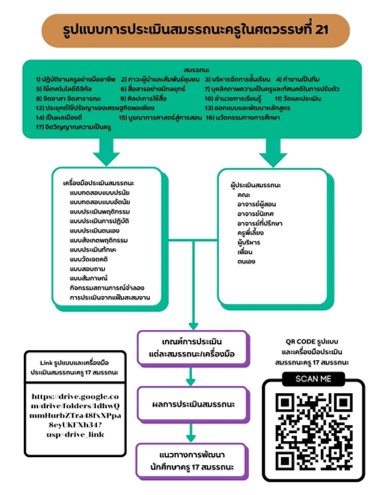
This research aimed to: (1) investigate the contextual foundations of developing 17 core Pre-Service teacher competencies; (2) design and develop a comprehensive assessment model and instruments for evaluating these competencies; and (3) evaluate and pilot the proposed assessment model for 21st-century Pre-Service teacher competencies. A multi-phase research design was employed. Phase 1 involved a contextual analysis conducted through in-depth interviews with 30 key stakeholders, including teacher educators, pre-service teachers, mentor teachers, and educational administrators. Phase 2 focused on the development of the assessment model and instruments through expert workshops with 34 specialists in educational measurement and evaluation, learning management, and subject-specific pedagogy. Phase 3 comprised expert focus group validation of the model, large-scale pilot implementation of the assessment with 803 pre-service teachers, and an evaluation of learner satisfaction using a structured questionnaire. Data were analyzed using descriptive statistics (means, percentages, and standard deviations) and qualitative content analysis.
The results indicated that: (1) Regarding the context of teacher competency development and assessment, teacher competencies are currently evaluated through coursework and professional teaching practicum experiences. However, there are still no standardized instruments specifically designed to assess each competency separately according to the operational definitions of the 17 competencies. Each competency should be assessed through a variety of assessment methods and instruments. Stakeholders involved in the teacher preparation process should participate in the assessment process.Furthermore, the assessment instruments should be practical for implementation and accompanied by clear procedures and explicit evaluation criteria. (2) The 21st-century Pre-Service teacher competency assessment model consisted of 17 Pre-Service teacher competencies and employed a variety of assessment instruments, including objective tests, subjective tests, behavioral rating scales, performance assessments, self-assessment forms, behavioral observation forms, skill assessment forms, attitude scales, questionnaires, interviews, simulation activities, and portfolio assessment. Multiple evaluators were involved in the assessment process, including faculty members, instructors, supervising lecturers, academic advisors, mentor teachers, administrators, peers, and the students themselves.The assessment model also incorporated evaluation criteria and competency assessment results, depending on the context and assessment instruments used for each competency. (3) The evaluation results of the assessment model and instruments for the 17 teacher competencies, as reviewed by experts, indicated that the overall quality was at a good level (M = 4.41, S.D. = 0.51). (4) The results of the partial implementation of the assessment of the 17 teacher competencies showed that the overall competency score was 75.92%. When considering each competency individually, the highest-rated competency was Media Utilization Skills, with a score of 88.13%, followed by Teacher Personality and Attitude: Adaptability, with a score of 87.07%, and Professional Teaching Practice, with a score of 86.53%, respectively. In contrast, the competencies with the lowest scores were Curriculum Design and Development, with a score of 61.28%, Leadership and Community Relations, with a score of 53.72% percent, and Classroom Management, with a score of 50.91%, respectively. (5) The results of the student satisfaction evaluation toward the 21st-century teacher competency assessment model revealed that the overall level of satisfaction was high (M = 4.46, S.D. = 0.64).
References
กรกมล ชูช่วย, สุดารัตน์ ศรีมา และนันทิยา น้อยจันทร์. (2565). การพัฒนาแบบประเมินสมรรถนะวิชาชีพครูของนักศึกษาคณะครุศาสตร์ มหาวิทยาลัยราชภัฏสวนสุนันทา. Journal of Roi Kaensarn Academi, 7(1), 138-148.
กฤษดา กฤตเมธกุล และคณะ. (2564). การประเมินสมรรถนะของบัณฑิตระดับปริญญาตรี มหาวิทยาลัยราชภัฏหมู่บ้านจอมบึง ประจำปีการศึกษา 2562. ราชบุรี : มหาวิทยาลัยราชภัฏหมู่บ้านจอมบึง.
เดลินิวส์. (2566). แถลงข่าวหลักสูตรผลิตครูฐานสมรรถนะ มหาวิทยาลัยราชภัฏ. สืบค้น 30 มิถุนายน 2566, จาก https://www.dailynews.co.th/news/1996231/
นริศรา เสือคล้าย. (2566). แนวทางการประเมินสมรรถนะนิสิตนักศึกษาครูตามมาตรฐานวิชาชีพครู. วารสารปัญญา, 30(3), 1-17.
บุญชม ศรีสะอาด. (2553). การวิจัยเบื้องต้น (พิมพ์ครั้งที่ 8). กรุงเทพฯ: สุวีริยาสาส์น.
ประชาชาติธุรกิจ. (2566). แถลงข่าวหลักสูตรผลิตครูฐานสมรรถนะ มหาวิทยาลัยราชภัฏ. สืบค้น 30 มิถุนายน 2566, จาก https://www.prachachat.net/education/news-1205194
วิภาวรรณ เอกวรรณัง, พิกุล เอกวรางกรู และบุญเรียง ขจรศิลป์. (2560). การพัฒนาแบบประเมินสมรรถนะวิชาชีพครูสำหรับนักศึกษาฝึกประสบการณ์วิชาชีพครู มหาวิทยาลัยราชภัฏ. วารสารวิจัยและพัฒนา มหาวิทยาลัยราชภัฏสวนสุนันทา, 9(2), 119-131.
สำนักงานคณะกรรมการข้าราชการพลเรือน. (2548). คู่มือสมรรถนะราชการพลเรือนไทย. กรุงเทพฯ: สำนักงานคณะกรรมการข้าราชการพลเรือน.
สุกัญญา บุญศรี ,กมลวรรณ ตังธนกานนท์ และศิริชัย กาญจนวาสี. (2563). การประเมินสมรรถนะความรู้วิชาชีพครูช่างอุตสาหกรรมแบบพหุมิติของนักศึกษา หลักสูตรครุศาสตรอุตสาหกรรมบัณฑิต. วารสารครุศาสตร์ จุฬาลงกรณ์มหาวิทยาลัย, 48(3), 349-369.
Boyatzis, R. E. (1982). The Competent Manager: A Model for Effective Performance. John Wiley & Sons, New York.
Dales, M., & Hes, K. (1995). Creating Training Miracles. Sydney: Prentice Hall.
Good, C. V. (1973). Dictionary of Education (3rd ed.). New York: McGraw-Hill.
McLagan, P. A. (1997). Competencies: The next generation. Training and Development, 51(5), 40-47.
Parry, Scott B. (1996). The Quest for Competencies. Training, 33(7), 48-54.
Downloads
Published
How to Cite
Issue
Section
License
Copyright (c) 2026 Humanities and Social Sciences Journal of Pibulsongkram Rajabhat University

This work is licensed under a Creative Commons Attribution-NonCommercial-NoDerivatives 4.0 International License.
Any articles or comments appearing in the Journal of Humanities and Social Sciences, Rajabhat Phibulsongkram University, are the intellectual property of the authors, and do not necessarily reflect the views of the editorial board. Published articles are copyrighted by the Journal of Humanities and Social Sciences, Rajabhat Phibulsongkram University.