The Development of a Training Curriculum on Pruning and Canopy Management of Cashew for Cashew Farmers in Uttaradit Province
DOI:
https://doi.org/10.14456/psruhss.2026.12Keywords:
Training curriculum development, Pruning, cashew, Uttaradit provinceAbstract
The objectives of this research were 1) to develop a training curriculum on pruning and canopy management for cashew farmers in Uttaradit Province, and 2) to study the effects of implementing the training curriculum in terms of knowledge, practical skills, and satisfaction with the curriculum. The sample consisted of 30 cashew farmers from Tha Pla and Nam Pat Districts, Uttaradit Province, selected through purposive sampling. The research instruments included the training curriculum, a knowledge achievement test, a practical skill evaluation form, and a satisfaction questionnaire. Data were analyzed using Mean (), Standard Deviation (S.D.), and dependent samples t-test. The research findings were as follows
- 1. The training curriculum was developed based on Taba’s model, initiating with a diagnostic study of problems and needs from both farmers and academic experts. This led to the design of a curriculum comprising six core components: principles, objectives, structures and contents, learning activities, media and materials, and evaluation, encompassing both theoretical and practical dimensions. The expert evaluation revealed that the curriculum’s overall appropriateness was at the highest level (
= 57, S.D.= 0.12), with an Index of Item-Objective Congruence (IOC) of 1.00 for all items.
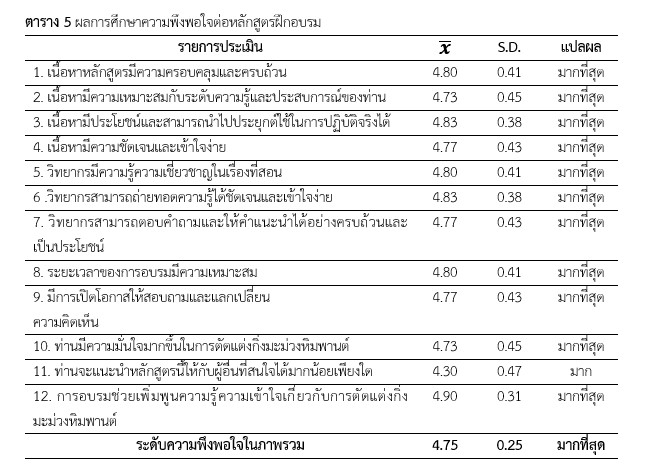
- The curriculum implementation results indicated that: 1) the farmers’ average post-training knowledge and understanding scores were significantly higher than their pre-training scores at the .05 level; 2) the evaluation of practical skills passed the established criteria at the highest level; and 3) the farmers’ overall satisfaction with the training curriculum was at the highest level
(
References
กรมส่งเสริมการเกษตร. (2567). ระบบสารสนเทศการผลิตทางด้านการเกษตร. สืบค้น 10 มกราคม 2569, จาก https://production.doea.go.th/service/site/inde
กานต์ชัญญา แก้วแดง. (2559). การพัฒนาหลักสูตรการฝึกอบรมการผลิตผักพื้นบ้านด้วยระบบพืชปลอดภัยร่วมกับภูมิปัญญาท้องถิ่นด้านการเกษตรสำหรับผู้สูงอายุ. วารสารวิจัยราชภัฏเชียงใหม่, 17(1), 47-56.
ชวลิต ชูกำแพง. (2559). การวิจัยและพัฒนาหลักสูตร: แนวคิดและกระบวนการ. กรุงเทพฯ: จุฬาลงกรณ์มหาวิทยาลัย.
ชัยวัฒน์ สุทธิรัตน์. (2560). การพัฒนาหลักสูตร: ทฤษฎีสู่การปฏิบัติ (พิมพ์ครั้งที่ 6). กรุงเทพฯ: วี พรินท์.
ธำรง บัวศรี. (2563). หลักสูตรและการสอน (พิมพ์ครั้งที่ 5). กรุงเทพฯ: มหาวิทยาลัยรามคำแหง.
ปรมะ แก้วพวง. (2567). การพัฒนาหลักสูตรฝึกอบรมระยะสั้นสำหรับเกษตรกร เพื่อเพิ่มขีดความสามารถด้านมาตรฐานการเพาะปลูกและการจัดการตลาดมะขามหวาน. วารสารครุพิบูล คณะครุศาสตร์ มหาวิทยาลัยราชภัฏพิบูลสงคราม, 11(2), 54–64.
ประวุฒิ ทัศมาลี และดวงกมล ปานรศทิพ ธรรมาธิวัฒน์. (2562). ความพึงพอใจของเกษตรกรรุ่นใหม่ต่อการฝึกอบรมหลักสูตรเตรียมความพร้อมสู่การเป็นผู้ประกอบการเกษตรรุ่นใหม่ ในกรุงเทพมหานคร. วารสารเกษตรพระจอมเกล้า, 37(4), 627-634.
พจนีย์ แสงมณี. (2563). ผลของการตัดแต่งกิ่งและจัดการธาตุอาหารที่มีต่อการเจริญเติบโตและผลผลิตของมะม่วงหิมพานต์. วารสารเกษตร, 36(3), 313–319.
แพรทอง ละมุล, ณัฏฐชัย จันทชุม และทิพาพร สุจารี. (2568). การพัฒนาหลักสูตรฝึกอบรมเพื่อเสริมสร้างสมรรถนะการผลิตผักอินทรีย์สำหรับเกษตรกรตามกรอบมาตรฐาน. วารสารมหาวิทยาลัยราชภัฏมหาสารคาม, 19(1), 185-199.
ยุทธ ไกยวรรณ์. (2559). การวิจัยและพัฒนาหลักสูตรฝึกอบรม. กรุงเทพฯ: จุฬาลงกรณ์มหาวิทยาลัย.
รัฐบาลไทย. (2567, 18 ธันวาคม). “อนุกูล” เผยตัวเลขส่งออกสินค้าเกษตรช่วง 10 เดือนปี 67 มูลค่ารวมกว่า 2.1ล้านล้านบาทขยายตัวเพิ่มขึ้น 6.49 “ข้าว” ครองแชมป์สินค้าเกษตรส่งออก. สืบค้น 10 มกราคม 2569, จาก https://www.thaigov.go.th/news/contents/details/91479
วิชัย วงษ์ใหญ่. (2560). แนวทางการพัฒนาหลักสูตรและการเรียนรู้. กรุงเทพฯ: โรงพิมพ์ชุมนุมสหกรณ์การเกษตรแห่งประเทศไทย.
วิชัย วงษ์ใหญ่. (2561). กระบวนทัศน์ใหม่ในการพัฒนาหลักสูตรและกระบวนการเรียนรู้. กรุงเทพฯ: ศูนย์ตำราและเอกสารทางวิชาการ คณะครุศาสตร์ จุฬาลงกรณ์มหาวิทยาลัย.
สำนักงานปลัดกระทรวงเกษตรและสหกรณ์. (2567). ข้อมูลพื้นฐานของจังหวัดอุตรดิตถ์. สืบค้น 10 มกราคม 2569, จาก https://www.opsmoac.go.th/uttaradit-dwl-files-471991791070
Johnson, W. T., & Miller, H. C. (2011). Diseases and insects of ornamental plants. John Wiley & Sons.
Sangmanee, P., Chaikla, P., Palas, P., Sirirojjanasraporn, T., & Uppapong, K. (2026). Participatory Management of Cashew Nut Production for Strengthening the Grassroots Economy in Uttaradit Province, Thailand. Area Based Development Research Journal, 18(1), 256903. https://doi.org/10.48048/abcj.2026.256903
Taba, H. (1962). Curriculum development: Theory and practice. Harcourt, Brace & World.
Downloads
Published
How to Cite
Issue
Section
License
Copyright (c) 2026 Humanities and Social Sciences Journal of Pibulsongkram Rajabhat University

This work is licensed under a Creative Commons Attribution-NonCommercial-NoDerivatives 4.0 International License.
Any articles or comments appearing in the Journal of Humanities and Social Sciences, Rajabhat Phibulsongkram University, are the intellectual property of the authors, and do not necessarily reflect the views of the editorial board. Published articles are copyrighted by the Journal of Humanities and Social Sciences, Rajabhat Phibulsongkram University.