A Lifestyles, Belief, Culture Practices and Power Negotiation of Thai Hair Beauty Entrepreneurs: Sustainable Competitive Advantage through Critical Autoethnography
DOI:
https://doi.org/10.14456/psruhss.2026.13Keywords:
Lifestyle, Belief, Culture practices, Power negotiation, Thai hair beauty industry, Sustainable competitive advantageAbstract
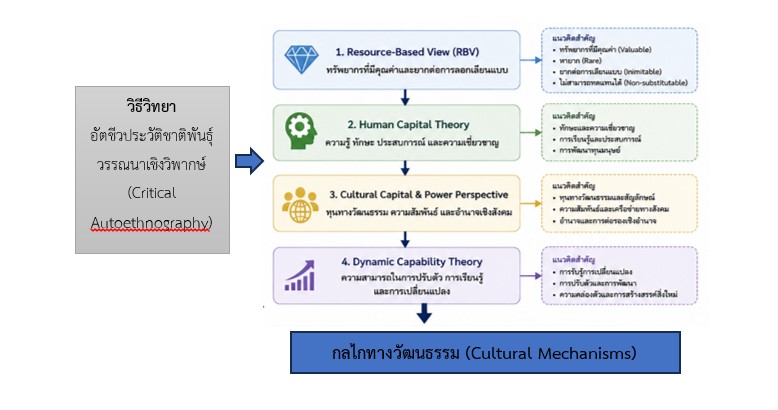
This study is a qualitative research employing Critical Autoethnography as its methodology. The objective is to investigate the lifestyles, belief systems, cultural practices, and power negotiations of entrepreneurs within the Thai hair beauty industry that contribute to the creation of sustainable competitive advantage. Data were collected through critical autoethnographic accounts integrated with insights from key informants amount fifteen key informants who are experts in the Thai hair industry. The findings reveal the cultural dynamics and power structures within the industry that dictate the existence, professional conduct, and sustainable competitiveness of the Thai hair beauty sector. The researchers used triangulation to verify the reliability of the data, checked the completeness of the data, and interpreted. The results of the study indicate that 1) The entrepreneurs' lifestyle is an integrated way of life that fosters long-term social engagement 2) The belief system serves as a framework that instills discipline, motivation, and professional identity 3) Cultural practices provide Thai services with a unique identity, creating experiential value that is difficult to replicate and 4) Power negotiation acts as a mechanism that determines patterns of survival, continuous adaptation, and the establishment of sustainability.
References
Al frijat, Y. S., & Elamer, A. A. (2025). Human capital efficiency, corporate sustainability, and performance: Evidence from emerging economies. Corporate Social Responsibility and Environmental Management, 32(2), 1457–1472. https://doi.org/10.1002/csr.3013
Alakkas, A. A., Alhumoudi, H., Al-Matari, E. M., Omer, A. M., Alhebri, A., & Khan, I. A. (2023). An Empirical Analysis of the Impact of Human Capital as an Intangible Asset on Environmental Performance. International Journal of Sustainable Development & Planning, 18(12), 3831-3844. https://doi.org/10.18280/ijsdp.181215
Alvino, F., Di Vaio, A., Hassan, R., & Palladino, R. (2021). Intellectual capital and sustainable development: a systematic literature review. Journal of Intellectual Capital, 22(1), 76-94. https://doi.org/10.1108/jic-11-2019-0259
Amoakoh, E. O., & Naong, M. N. (2017). The relevance of relationship marketing model for hair salon’s competitiveness: a theoretical perspective. Problems and perspectives in management, 15(1), 132-139. http://dx.doi.org/10.21511/ppm.15(1).2017.14
Banmairuroy, W., Kritjaroen, T., & Homsombat, W. (2022). The Effect of Knowledge-Oriented Leadership and Human Resource Development on Sustainable Competitive Advantage through Organizational Innovation’s Component Factors: Evidence from Thailand’s New S-Curve Industries. Asia Pacific Management Review, 27(3), 200-209. https://doi.org/10.1016/j.apmrv.2021.09.001
Barney, J. B. (1991). Firm Resources and Sustained Competitive Advantage. Journal of Management, 17(1), 99-120. https://doi.org/10.1177/014920639101700108
Bochner, A., & Ellis, C. (2016). Evocative Autoethnography: Writing Lives and Telling Stories. Routledge. https://doi.org/10.4324/9781315545417
Braun, V., & Clarke, V. (2006). Using thematic analysis in psychology. Qualitative research in psychology, 3(2), 77-101. https://doi.org/10.1191/1478088706qp063oa
El Nemar, S., El-Chaarani, H., Dandachi, I., & Castellano, S. (2025). Resource-based view and sustainable advantage: a framework for SMEs. Journal of Strategic Marketing, 33(6), 798–821. https://doi.org/10.1080/0965254X.2022.2160486
Ellis, C., & Bochner, A.P. (2000). Autoethnography, Personal Narrative, Reflexivity: Researcher as Subject. Sage Publications.
Field, L. C., & Mkrtchyan, A. (2017). The effect of director experience on acquisition performance. Journal of financial economics, 123(3), 488-511. https://doi.org/10.1016/j.jfineco.2016.12.001
Gordon, C. (1980). Power/knowledge. Pantheon: New York.
Gordon, R. D. (2005). An empirical investigation into the power behind empowerment. Organization Management Journal, 2(3), 144-165. https://doi.org/10.1057/omj.2005.24
Grzymkiewicz, M. (2024). Influence of quality management on the image of beauty, cosmetology and hairdressing salons. Aesthetic cosmetology and medicine Учредители: Indygo Zahir Media, 13(4), 145-152. https://doi.org/10.52336/acm.2024.022
Hale, J., Irish, A., Carolan, M., Clark, J. K., Inwood, S., Jablonski, B. B., & Johnson, T. (2023). A systematic review of cultural capital in US community development research. Journal of Rural Studies, 103, 103113.
Hardy, C., & Leiba-O'Sullivan, S. (1998). The power behind empowerment: Implications for research and practice. Human relations, 51(4), 451-483.
Hongsirikarn, K., Vongvanichtawee, C., & Santisan, B. (2019).Characteristic of team in successful startup entrepreneur in Thailand. RMUTT Global Business and Economics Review, 14(2), 47-60.
Kampani, N., & Jhamb, D. (2021). Examining the relationship among servicescape, perceived overall image and customer behavioural intentions in beauty salons: the moderating role of pleasure-arousal-dominance emotional state model. International Journal of Services, Economics and Management, 12(2), 164-184.
Karami, M., Eyüboğlu, Ş., & Ertugan, A. (2024). Sustainable Consumer Behavior: the Influence of Habit on Relational Benefits and Behavioral Intentions in Personal Service Businesses. Journal of Management Marketing and Logistics, 11(2), 66-79.
Lamaison, P., & Bourdieu, P. (1986). From rules to strategies: An interview with Pierre Bourdieu. Cultural anthropology, 1(1), 110-120.
Lee, S. H. (2023). Theory of cultural capital: Productive use of an unproductive activity. Journal of Public Economic Theory, 25(2), 359-375.
Lim, M.-J., & Park, E.-J. (2022). Effect of hair salon service quality and perceived value on purchasing behavior. Journal of the Korean Society of Cosmetology, 28(6), 1157-1166.
Lubis, N. W. (2022). Resource based view (RBV) in improving company strategic capacity. Research Horizon, 2(6), 587-596.
Madison, D. S. (2011). Critical ethnography: Method, ethics, and performance. Sage.
Mailani, D., Hulu, M. Z. T., Simamora, M. R., & Kesuma, S. A. (2024). Resource-Based View Theory to achieve a sustainable competitive advantage of the firm: Systematic literature review. International Journal of Entrepreneurship and Sustainability Studies, 4(1), 1-15. https://doi.org/10.31098/ijeass.v4i1.2002
Marlina, L., Senen, S. H., Yuniarsih, T., & Ahman, E. (2023). Human capital competitiveness model in the digital era of craft creative industry entrepreneurs. Journal of Competitiveness, 15(2), 1-23.
Moon, D.-B., & Jung, Y. (2022). The effect of positive psychological capital of hair beauty service workers on job satisfaction and customer orientation. Journal of the Korean Society of Cosmetology, 28(6), 1318-1329.
Muwanga, R., Mwiru, D. P., & Watundu, S. (2023). Influence of social-cultural practices on the adoption of Renewable Energy Technologies (RETs) in Uganda. Renewable Energy Focus, 45, 201-209.
Ofori, D., & Appiah-Nimo, C. (2022). Relationship management, competitive advantage and performance of hotels: a resource-based view. Journal of African Business, 23(3), 712-730.
Palácios, H., Almeida, H. d., & Sousa, M. J. (2021). A bibliometric analysis of service climate as a sustainable competitive advantage in hospitality. Sustainability, 13(21), 12214.
Park, K.-H., & Yang, S.-Y. (2025). The Impact of Hair Salon Customer Acceptance Attitude on Service Environment Perception. Journal of the Korean Society of Cosmetology, 31, 947-955. https://doi.org/10.52660/JKSC.2025.31.4.947
Park, S.-J. (2023). The Effect of Location Characteristics and Service Quality of Beauty Salon on Customer Satisfaction and Intention to Revisit-Focusing on the Gender Control effect of University Students. Journal of the Korea Fashion and Costume Design Association, 25(3), 143-155.
Porter, M. E. (2008). The Competitive Advantage: Creating and Sustaining Superior Performance. NY: Free Press.
Pratono, A. H. (2022). Reinterpreting excellence for sustainable competitive advantage: the role of entrepreneurial culture under information technological turbulence. Measuring Business Excellence, 26(2), 180-196.
Qandah, R., Suifan, T. S., Masa'deh, R. e., & Obeidat, B. Y. (2021). The impact of knowledge management capabilities on innovation in entrepreneurial companies in Jordan. International. Journal of Organizational Analysis, 29(4), 989-1014.
Rahi, A. F., Johansson, J., Blomkvist, M., & Hartwig, F. (2024). Corporate sustainability and financial performance: A hybrid literature review. Corporate Social Responsibility and Environmental Management, 31(2), 801-815.
Schultz, T. W. (1961). Investment in human capital. The American Economic Review, 51(1), 1-17.
Teece, D. J., Pisano, G., & Shuen, A. (1997). Dynamic capabilities and strategic management. Strategic management journal, 18(7), 509-533.
Teixeira, A. A., Moraes, T. E. d. C., Stefanelli, N. O., de Oliveira, J. H. C., Teixeira, T. B., & de Souza Freitas, W. R. (2020). Green supply chain management in Latin America: Systematic literature review and future directions. Environmental Quality Management, 30(2), 47-73.
UnitedNations. (2025). THE 17 GOALS. Department of Economic and Social Affairs Sustainable Development. https://sdgs.un.org/goals
Ward, A. F. (2020). The Aesthetic Society and Its Gatekeepers. Japanese Society and Culture, 2(1), 005-022.
Yuan, H., & Ferreira, F. A. (2025). Sustainable competitive advantage in maternal and child health institutions: a dynamic capability approach. Annals of Operations Research, 346(2), 1869-1895.
Zhang, L., Van Iddekinge, C. H., Ployhart, R. E., Arnold, J. D., & Jordan, S. L. (2023). The definition and measurement of human capital resources: A content and meta-analytic review. Journal of Applied Psychology, 108(9), 1486–1514. https://doi.org/10.1037/apl0001088
Downloads
Published
How to Cite
Issue
Section
License
Copyright (c) 2026 Humanities and Social Sciences Journal of Pibulsongkram Rajabhat University

This work is licensed under a Creative Commons Attribution-NonCommercial-NoDerivatives 4.0 International License.
Any articles or comments appearing in the Journal of Humanities and Social Sciences, Rajabhat Phibulsongkram University, are the intellectual property of the authors, and do not necessarily reflect the views of the editorial board. Published articles are copyrighted by the Journal of Humanities and Social Sciences, Rajabhat Phibulsongkram University.