
Development of Desirable Competency Indicators for Nursing Graduates of Rajabhat University
DOI:
https://doi.org/10.14456/psruhss.2026.3Keywords:
Desirable competencies, Nursing graduatesAbstract
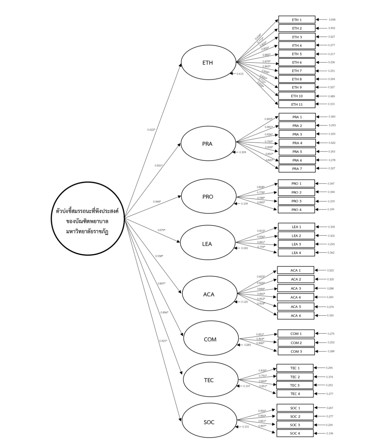
This research aimed to: 1) develop the components and indicators of desirable competencies for nursing graduates of Rajabhat Universities, and 2) examine the construct validity of the components and indicators of desirable competencies for nursing graduates of Rajabhat Universities. The sample consisted of 252 nursing graduates from Rajabhat Universities, obtained through multi-stage random sampling. The data collection instrument was a rating scale questionnaire with 5 levels of assessment, comprising a total of 43 items. Data analysis was conducted using means, standard deviations, correlation coefficients, and confirmatory factor analysis. The research findings revealed that: 1) The components and indicators of desirable competencies for nursing graduates of Rajabhat Universities consisted of 8 competency domains with 43 indicators, namely: 1) Ethics, professional conduct, and law 11 indicators; 2) Nursing and midwifery practice 7 indicators; 3) Professional attributes 4 indicators; 4) Leadership, management, and quality development 4 indicators; 5) Academic knowledge and research 6 indicators; 6) Communication and interpersonal relationships 3 indicators; 7) Technology and information 4 indicators; and 8) Society 4 indicators. The suitability assessment by 11 experts indicated that all competencies were rated at the highest level of appropriateness. 2) The results of the second-order confirmatory factor analysis of the desirable competency indicator model for nursing graduates of Rajabhat Universities showed that the model demonstrated construct validity and goodness of fit with the empirical data (X2 (576, N = 252) = 632.283, X2/df = 1.098, p – value = 0.0519, CFI = 0.995, TLI = 0.993, RMSEA = 0.020, SRMR = 0.049).
References
กระทรวงมหาดไทย. (2568). สถิติผู้สูงอายุในประเทศไทย. สืบค้น 17 พฤษภาคม 2569, จาก https://www.dop.go.th/th/statistics_page?cat=1&id=2578
ปาริชาต รัตนราช. (2563). คุณลักษณะที่พึงประสงค์ของบัณฑิตพยาบาล มหาวิทยาลัยราชภัฏอุบลราชธานี. วารสารวิจัยและประเมินผลอุบลราชธานี, 9(1), 20-30.
พระราชบัญญัติมหาวิทยาลัยราชภัฏ พ.ศ. 2547. (2547, 14 มิถุนายน). ราชกิจจานุเบกษา. เล่ม 121 ตอนพิเศษ 23 ก. หน้า 1-25.
ฟาอิส วาเลาะแต, สาวิณี ชาญสินธพ, สุภาวดี อดิศัยศักดา และมูฮัมหมัดไซด์ ซาและ. (2566). สมรรถนะวิชาชีพการพยาบาลยุคไทยแลนด์ 4.0 ของนักศึกษาหลักสูตรพยาบาลศาสตรบัณฑิต คณะพยาบาลศาสตร์ มหาวิทยาลัยนราธิวาสราชนครินทร์. วารสารมหาวิทยาลัยนราธิวาสราชนครินทร์, 15(3), 235-250. https://li01.tci-thaijo.org/index.php/pnujr/article/view/259147
วิจิตร ศรีสุพรรณ และกฤษดา แสวงดี. (2555). ข้อเสนอเชิงนโยบายในการแก้ไขปัญหาการขาดแคลนพยาบาลวิชาชีพในประเทศไทย. วารสารสภาการพยาบาล, 27(1), 5–12.
ศิรินทิพย์ ฝักฝ่าย. (2566). สมรรถนะที่พึงประสงค์ของพยาบาลวิชาชีพในยุควิถีใหม่ หน่วยบริหารสาธารณสุข สังกัดกระทรวงสาธารณสุข เขตสุขภาพที่ 2. สืบค้น 20 กรกฎาคม 2567, จาก https://nuir.lib.nu.ac.th/dspace/handle/123456789/5779
ศุภาพิชญ์ โฟน โบร์แมนน์, ทองสวย สีทานนท์, ศุกร์ใจ เจริญสุข, กมลรัตน์ เทอร์เนอร์ และกฤษดา แสวงดี. (2564). สมรรถนะที่พึงประสงค์ของบัณฑิตพยาบาลไทย: มุมมองของผู้มีส่วนได้ส่วนเสียทางการพยาบาล. วารสารสถาบันบำราศนราดูร, 15(2), 71-81. https://he01.tci-thaijo.org/index.php/bamrasjournal/article/view/238930
สภาการพยาบาล. (2561). ประกาศสภาการพยาบาล เรื่อง สมรรถนะหลักของผู้สำเร็จการศึกษาระดับปริญญาตรี ปริญญาโท ปริญญาเอก สาขาพยาบาลศาสตร์ หลักสูตรฝึกอบรมการพยาบาลขั้นสูงระดับวุฒิบัตรและได้รับวุฒิบัตร/หนังสืออนุมัติแสดงความรู้ความชำนาญเฉพาะทางการพยาบาลและการผดุงครรภ์และการพยาบาลเฉพาะทางสาขาพยาบาลศาสตร์. สืบค้น 4 ตุลาคม 2567, จาก https://www.tnmc.or.th/images/userfiles/files/004.pdf
สภาการพยาบาล. (2567). สภาการพยาบาลเสนอแนวทางแก้ไขปัญหาการขาดแคลนพยาบาลในประเทศไทยอย่างเป็นระบบต่อกระทรวงสาธารณสุข. สืบค้น 25 ธันวาคม 2567, จาก https://www.tnmc.or.th/news/1155
สำนักงานปลัดกระทรวงสาธารณสุข. (2566). รายงานบุคลากรด้านสาธารณสุข ประจำปี 2566. สืบค้น 24 เมษายน 2567, จาก https://dmsic.moph.go.th/index/detail/9421
อารีรัตน์ ขำอยู่, สิริพิมพ์ ชูปาน, ลัดดาวัลย์ พุทธรักษา, สหัทยา รัตนจรณะ, ดำรงศักดิ์ สงเอียด และฉวีรัตน์ ชื่นชมกุล. (2564). ปัจจัยที่เกี่ยวข้องกับสมรรถนะพยาบาลวิชาชีพของนิสิตคณะพยาบาลศาสตร์ มหาวิทยาลัยในภาคตะวันออก. วารสารคณะพยาบาลศาสตร์ มหาวิทยาลัยบูรพา, 29(1), 1-12. https://nurse.buu.ac.th/rsh/file/journal/0000001176.pdf
Fukada, M. (2018). Nursing competency: Definition, structure and development. Yonago acta medica, 61(1), 001-007. https://doi.org/10.33160/yam.2018.03.001
Nilsson, J., Mischo-Kelling, M., Thiekoetter, A., Deufert, D., Mendes, A. C., Fernandes, A., ... & Lepp, M. (2019). Nurse professional competence (NPC) assessed among newly graduated nurses in higher educational institutions in Europe. Nordic journal of nursing research, 39(3), 159-167. https://doi.org/10.1177/2057158519845321
Serafin, L., Danilewicz, D., Chyla, P., & Czarkowska-Pączek, B. (2020). What is the most needed competence for newly graduated generation z nurses? Focus groups study. Nurse Education Today, 94, 104583. https://doi.org/10.1016/j.nedt.2020.104583
Soper, D. S. (2024). A-priori sample size calculator for structural equation models [Software]. https://www.danielsoper.com/statcalc
Downloads
Published
How to Cite
Issue
Section
License
Copyright (c) 2026 Humanities and Social Sciences Journal of Pibulsongkram Rajabhat University

This work is licensed under a Creative Commons Attribution-NonCommercial-NoDerivatives 4.0 International License.
Any articles or comments appearing in the Journal of Humanities and Social Sciences, Rajabhat Phibulsongkram University, are the intellectual property of the authors, and do not necessarily reflect the views of the editorial board. Published articles are copyrighted by the Journal of Humanities and Social Sciences, Rajabhat Phibulsongkram University.