Analysis of the Relationship Between Computer Laboratory Usage Behavior and Academic Achievement Among Undergraduate Students
DOI:
https://doi.org/10.14456/psruhss.2026.9Keywords:
Computer laboratory usage behavior, Academic achievement, Learning analytics, At-risk students, Higher education, Logistic regressionAbstract
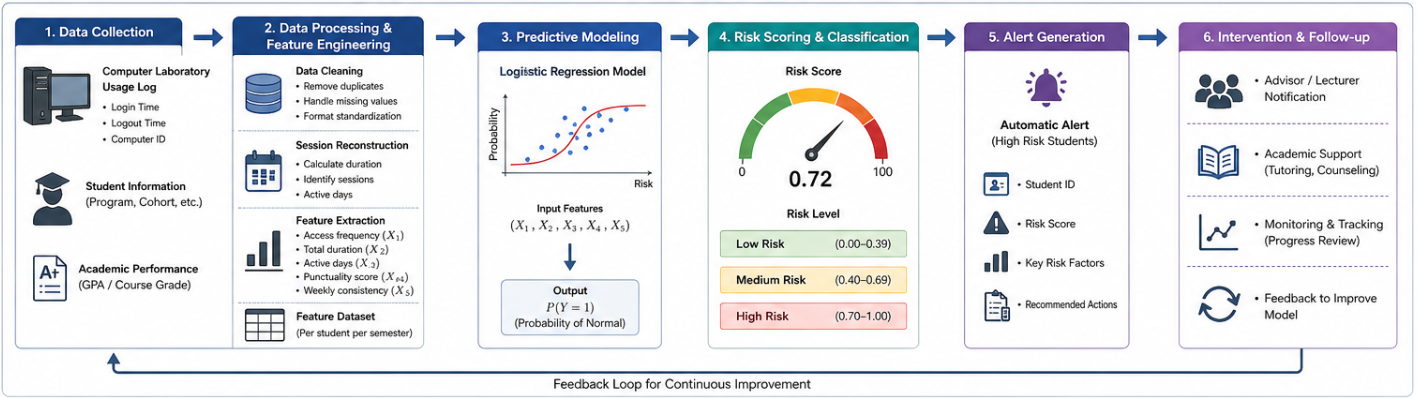
This study aimed to: 1) examine students’ computer laboratory usage behavior, 2) analyze the relationship between laboratory usage behavior and academic achievement, and 3) propose guidelines for monitoring and supporting at-risk students based on the concept of Learning Analytics. This quantitative research employed secondary data obtained from the computer laboratory usage log system and students’ academic records from the second semester of academic year 2024 and the first semester of academic year 2025. The sample consisted of 105 students selected through purposive sampling based on the completeness of data from both sources. The data were prepared, validated, transformed into individual-level variables, and analyzed using descriptive statistics, Pearson’s correlation coefficient, and Logistic Regression.
The findings revealed that students demonstrated a moderate to high level of computer laboratory usage behavior. Laboratory usage behavior was related to academic achievement, particularly the number of usage days, number of visits, and total usage duration. In addition, the Logistic Regression model was able to support the classification of at-risk students at an acceptable level, with an AUC of 0.722, accuracy of 81.30%, precision of 79.60%, recall of 77.80%, and F1-score of 78.70%. The results indicate that log data from the computer laboratory usage system can serve as a useful database for developing a monitoring and early warning system for at-risk students, thereby supporting proactive student assistance in higher education effectively.
References
จิราวรรณ พาชอบ. (2569). พฤติกรรมและความพึงพอใจการใช้บริการห้องปฏิบัติการคอมพิวเตอร์ของนักศึกษา คณะศึกษาศาสตร์ มหาวิทยาลัยการกีฬาแห่งชาติ วิทยาเขตอุดรธานี. Journal of Pitchaya Education and Research, 2(1), 40-47.
เจนจิรา ปาทาน, จรัญ แสนราช. (2568). การวิเคราะห์ปัจจัยการเลือกศึกษาต่อคณะครุศาสตร์ด้วยเทคนิคเหมืองข้อมูล. Journal of Spatial Development and Policy, 3(2), 1-28.
ผกามาศ บุตรสาลี, รัตนาภรณ์ บุญถม, เรณุกา นะรัยรัมย์, ลดาวัลย์ กันรัมย์ และกฤษณา จีนโน. (2567). ผลกระทบของพฤติกรรมการเรียนและกระบวนการจัดการเรียนการสอนที่ส่งผลต่อผลสัมฤทธิ์ทางการเรียนของนักศึกษาสาขาวิชาการบัญชี ชั้นปีที่ 4 คณะวิทยาการจัดการ มหาวิทยาลัยราชภัฏบุรีรัมย์. วารสารสหวิทยาการจัดการ มหาวิทยาลัยราชภัฏบุรีรัมย์, 8(1), 95-112.
เพ็ชร พงษ์เฉย และนรินธน์ นนทมาลย์. (2569). การพัฒนาระบบวิเคราะห์การเรียนออนไลน์ มหาวิทยาลัยพะเยา. The Journal of Spatial Innovation Development, 7(1), 61-90.
ภูมิภควัธจ์ ภูมพงศ์คชศร, พลภัทร บริรักษ์ธนกุล, ณัฏฐ์ ตังปรีชาพาณิชย์, ไกร บุญบันดาล, ณรงค์ ศรีชัยบุญสูง, อธิสิทธิ์ นุชเนตร, และขวัญชนก อายุยืน. (2568). ความสัมพันธ์ระหว่างระบบการจัดการเทคโนโลยี สารสนเทศทางการศึกษากับประสิทธิภาพการเรียนการสอนแบบผสมผสานในสถานศึกษา. วารสาร ส่งเสริมและพัฒนาวิชาการสมัยใหม่, 3(2), 767-786.
สมิตา จุลเขตร. (2568). ปัจจัยที่ส่งผลต่อผลสัมฤทธิ์การบริหารการศึกษาในโรงเรียนวิถีพุทธ จังหวัดบุรีรัมย์. Journal of Social Science and Cultural, 9(10), 265-281.
สาธกา ตาลชัย, สุวัฒนพงษ์ ร่มศรี และสัญญา เคณาภูมิ. (2567). กลยุทธ์การจัดการเรียนรู้เชิงรุกเพื่อยกระดับ คุณภาพการศึกษาขั้นพื้นฐาน. วารสารวิทยาการจัดการมหาวิทยาลัยราชภัฏสกลนคร, 4(2), 673-688.
อนิวัช แก้วจำนงค์ และวาสนา มรรคคงคา. (2567). การวิจัยผสานวิธีแบบแผนขั้นตอนเชิงสำรวจผลทักษะบุคลากรที่สามารถใช้เทคโนโลยีสารสนเทศเพื่อการปฏิบัติงานในสถาบันการศึกษาใน 4 จังหวัดชายแดนภาคใต้ของประเทศไทย. JOURNAL OF SOUTHERN TECHNOLOGY, 17(2), 75-88.
Bringula, R. P. (2026). Logistic regression model of the perceived academic performance of college students in an online learning setting. Discover Education, 5, Article 299. https://doi.org/10.1007/s44217-026-01301-7
Conijn, R., Snijders, C., Kleingeld, A., & Matzat, U. (2017). Predicting student performance from LMS data: A comparison of 17 blended courses using Moodle LMS. IEEE Transactions on Learning Technologies, 10(1), 17–29.
Jokhan, A., Sharma, B., & Singh, S. (2019). Early warning system as a predictor for student performance in higher education. Studies in Higher Education, 44(9), 1500–1511.
Lim, W. M. (2025). What is quantitative research? An overview and guidelines. Australasian Marketing Journal, 33(3), 325-348.
Romero, C., & Ventura, S. (2020). Educational data mining and learning analytics: An updated survey. WIREs Data Mining and Knowledge Discovery, 10(3), e1355. https://doi.org/10.1002/widm.1355
Tannoubi, A., Bonsaksen, T., Mørk, G., Ahmedov, F., Setiawan, E., & Azaiez, F. (2025). Engagement factors affect academic success through study approaches among physical education and sport university students: A mediation analysis. Frontiers in Education, https://doi.org/10.3389/feduc.2025.1512557
Downloads
Published
How to Cite
Issue
Section
License
Copyright (c) 2026 Humanities and Social Sciences Journal of Pibulsongkram Rajabhat University

This work is licensed under a Creative Commons Attribution-NonCommercial-NoDerivatives 4.0 International License.
Any articles or comments appearing in the Journal of Humanities and Social Sciences, Rajabhat Phibulsongkram University, are the intellectual property of the authors, and do not necessarily reflect the views of the editorial board. Published articles are copyrighted by the Journal of Humanities and Social Sciences, Rajabhat Phibulsongkram University.