ผลกระทบเชิงลบของการรับรู้การสนับสนุนองค์การจากมุมมองของ TMT: กรณีศึกษา สายการบินในประเทศไทย
DOI:
https://doi.org/10.14456/psruhss.2024.3คำสำคัญ:
การแบ่งปันความรู้ , การรับรู้การสนับสนุนองค์กร , บุคลิกภาพเชิงรุก , การจัดการทรัพยากรมนุษย์ , การบินบทคัดย่อ
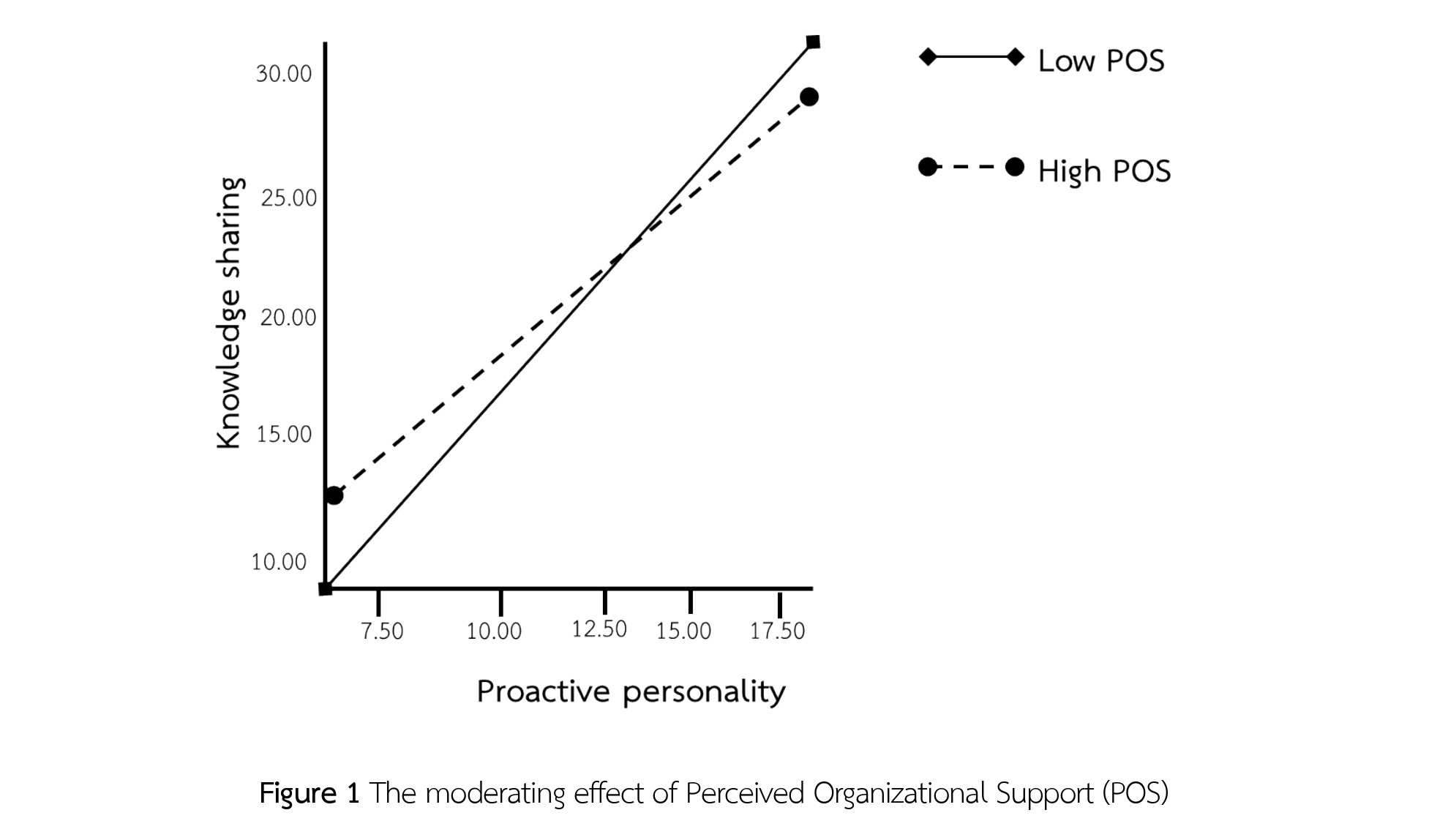
งานวิจัยนี้มีวัตถุประสงค์เพื่อตรวจสอบบทบาทเชิงลบของการรับรู้การสนับสนุนองค์การที่ส่งผลต่อความสัมพันธ์ระหว่างอิทธิพลของบุคลิกภาพเชิงรุกกับการแบ่งปันความรู้ โดยการรวบรวมข้อมูลจากผู้ตอบแบบสอบถาม 620 คน ที่ทำงานในองค์การการบินในประเทศไทยผ่านการตอบแบบสอบถามด้วยตนเอง ทดสอบสมมติฐานด้วยสถิติวิเคราะห์สมการทดถอยเชิงเส้นพหุคูณ ผลการวิจัยพบว่าพนักงานที่มีบุคลิกภาพเชิงรุกมีอิทธิพลต่อการแบ่งปันความรู้ในองค์การอย่างมีนัยยะสำคัญ การรับรู้การสนับสนุนขององค์กรแสดงผลเชิงลบต่อความสัมพันธ์ระหว่างพนักงานที่มีบุคลิกภาพเชิงรุกและการแบ่งปันความรู้ แสดงให้เห็นว่าหากพนักงานรับรู้การสนับสนุนขององค์การในระดับที่สูงขี่นมีแนวโน้มจะแบ่งปันความรู้น้อยลง ผลการศึกษานี้สร้างองค์ความรู้ต่อยอดจากการวิจัยก่อนหน้านี้ที่ศึกษาการรับรู้การสนับสนุนขององค์การจากมุมมองของ TMT อีกทั้งผลการวิจัยยังสามารถช่วยเพิ่มมุมมองของผู้ปฏิบัติงาน HR ในองค์การให้เห็นความสำคัญของการปรับความสมดุลระหว่างนโยบายการสนับสนุนขององค์การให้เหมาะสมกับความต้องการของพนักงานเพื่อสร้างให้เกิดผลลัพธ์ที่องค์การต้องการ
เอกสารอ้างอิง
Affum-Osei, E., Asante, E. A., Forkouh, S. K., & Absul-Nasiru, I. (2020). Career adaptability and ambidextrous behavior among customer-service representatives: The role of perceived organizational support. Journal of Personal Selling and Sales Management, 40(1), 4 – 18. https://doi.org/10.1080/08853134.2019.1594241
Afsar, B., & Badir, Y. (2017). Workplace spirituality, perceived organizational support and innovative work behavior: The mediating effects of person-organization fit. Journal of Workplace Learning, 29(2), 95-109. https://doi.org/10.1108/JWL-11-2015-0086
Aiken, L. S., & West, S. G. (1991). Multiple regression: Testing and interpreting interactions. Newbury Park, CA: Sage Publications.
Akram, T., Lei, S., Haider, M. J., & Hussain, S. T. (2020). The impact of organizational justice on employee innovative work behavior: Mediating role of knowledge sharing. Journal of Innovation & Knowledge, 5(1), 117 – 129. https://doi.org/10.1016/j.jik.2019.10.001
Average Salary in Thailand in 2023. (2023). Retrieved from http://www.salaryexplorer.com/salary-survey.php?loc=215&loctype=1
Bateman, T. S., & Crant, M. (1993). The proactive components of organizational behavior: A measure and correlates. Journal of Organizational Behavior, 14(2), 103-118. https://doi.org/10.1002/job.4030140202
Bryman, A. (2016). Social research methods (5th ed.). New York, NY: Oxford University Press.
Burnett, M. F., Chiaburu, D. S., Shapiro, D. L., & Li, N. (2015). Revisiting how and when perceived organizational support enhances taking charge: An inverted U-Shaped perspective. Journal of Management, 41(7), 1805-1826. https://doi.org/10.1177/0149206313493324
Cabrera, A., Collins, W. C., & Salgado, J. F. (2007). Determinants of individual engagement in knowledge sharing. The International Journal of Human Resource Management, 17(2), 245-264. https://doi.org/10.1080/09585190500404614
Caesens, G., & Stinglhamber, F. (2020). Toward a more nuanced view on organizational support theory, Frontiers in Psychology, 11, 1- 3. https://doi.org/10.3389/fpsyg.2020.00476
Caesens, G., Stinglhamber, F., Demoulin, S., De Wilde, M., & Mierop, A. (2019). Perceived organizational support and workplace conflict: The mediating role of failure-related trust. Frontiers in Psychology, 9, 1-13. https://doi.org/10.3389/fpsyg.2018.02704
Chong, S., Dyne, L. V., Kim, Y. J., & Oh, J. K. (2021). Drive and direction: Empathy with intended targets moderates the proactive personality-job performance relationship via work engagement. Journal of Applied Psychology, 70(2), 575 – 605. https://doi.org/10.1111/apps.12240
Cohen, J., Cohen, P., West, S. G., & Aiken, L. S. (2003). Applied multiple regression/correlation analysis for the behavioral sciences (3rd ed.). Mahwah, NJ: Lawrence Erlbaum.
Cropanzano, R., & Mitchell, M. S. (2005). Social exchange theory: An interdisciplinary review. Journal of management, 31(6), 874-900. https://doi.org/10.1177/0149206305279602
Duke, A. B., Goodman, J. M., Treadway, D. C., & Breland, J. W. (2009). Perceived organizational support as a moderator of emotional labor/outcomes relationships. Journal of Applied Social Psychology, 39(5), 1013-1034. https://doi.org/10.1111/j.1559-1816.2009.00470.x
Eisenberger, R., Huntington, R., Hutchison, S., & Sowa, D. (1986). Perceived organizational support. Journal of Applied Psychology, 71(3), 500–507. https://doi.org/10.1037/0021-9010.71.3.500
Eisenberger, R., Shanock, L. R., & Wen, X. (2020). Perceived organizational support: Why caring about employees counts. Annual Review of Organizational Psychology and Organizational Behavior, 7(1), 101 – 124. https://doi.org/10.1146/annurev-orgpsych-012119-044917
Gerpott, F. H., Fasbender, U., & Burmeister, A. (2020). Respectful leadership and followers’ knowledge sharing: A social mindfulness lens. Human Relations, 73(6), 789-810. https://doi.org/10.1177/0018726719844813
Giao, H. N. K., Vuong, B. N., Huan, D. D., Tushar, H., & Quan, T. N. (2020). The effect of emotional intelligence on turnover intention and the moderating role of perceived organizational support: Evidence from the Banking Industry of Vietnam, Sustainability, 12, 1857. https://doi.org/10.3390/su12051857
Grant, R. M. (1996a). Toward a knowledge-based theory of the firm. Strategic Management Journal, 17(S2), 109-122. https://doi.org/10.1002/smj.4250171110
Hair, J., Anderson, R., Black, B., & Babin, B. (2016). Multivariate data analysis. New York, NY: Pearson Higher Education.
Hon, A. H. Y., Fung, C. P. Y., & Senbeto, D. L. (2021). Willingness to share or not to share? Understanding the motivation mechanism of knowledge sharing for hospitality workforce. Journal of Hospitality Marketing & Management, 31(1), 77-96. https://doi.org/10.1080/19368623.2021.1935384
Jain, A. K., Giga, S. I., & Cooper, C. L. (2013). Perceived organizational support as a moderator in the relationship between organizational stressors and organizational citizenship behaviors". International Journal of Organizational Analysis, 21(3), 313-334. https://doi.org/10.1108/IJOA-Mar-2012-0574
Jin, M. H., & McDonald, B. (2017). Understanding employee engagement in the public sector: The role of immediate supervisor, perceived organizational support, and learning opportunities. The American Review of Public Administration, 47(8), 881-897. https://doi.org/10.1177/0275074016643817
Kim, T. Y., Hon, A. H. Y., & Lee, D. R. (2010). Proactive personality and employee personality: The effects of job creativity requirement and supervisor support for creativity. Creativity Research Journal, 22(1), 37-45. https://doi.org/10.1080//10400410903579536
Kline, R. B. (2011). Principles and practice of structural equation modeling. New York, NY: Guilford Press.
Kurtessis, J. N., Eisenberger, R., & Ford, M. T. (2017). Perceived organizational support: A meta-analytic evaluation of organizational support theory. Journal of Management, 43(6), 1854-1884. https://doi.org/10.1177/0149206315575554
Li, F., Chen, T., Chen, N. Y., Bai, Y., & Crant, M. (2020). Proactive yet reflective? Materializing proactive personality into creativity through job reflective learning and activated positive affective states. Personnel Psychology, 73(3), 459-489. https://doi.org/10.1111/peps.12370
Pierce, J. R., & Aguinis, H. (2013). The too-much-of-a-good-thing effect in management. Journal of Management, 39(2), 313-338. https://doi.org/10.1177//0149206311410060
Rovinelli, R. J., & Hambleton, R. K. (1976). On the use of content specialists in the assessment of criterion-referenced test item validity. Paper presented at the 60th Annual Meeting of the American Educational Research Association. Retrieved from https://eric.ed.gov/?id=ED121845
Sober, D. S. (2020). A-priori Sample Size Calculator for Structural Equation Models [Software]. Available from http://www.danielsoper.com/statcalc.
The Civil Aviation Authority of Thailand, State of Thai Aviation Industry. (2020). Retrieved from https://www.caat.or.th/wp-content/uploads/2020/06/STATE-OF-THAI-AVIATION-INDUSTRY-2019.pdf.
Turner, R. C., & Carlson, L. (2003). Indexes of item-objective congruence for multidimensional Items. International Journal of Testing, 3(2), 163-171. https://doi.org/10.1207/S15327574IJT0302_5
Wang, H., & Lei, L. (2021). Proactive personality and job satisfaction: Social support and hope as mediators. Current Psychology. https://doi.org.10.1007/s12144-021-01379-2
Witherspoon, C. L., Bergner, J., Cockrell, C., & Stone, D. N. (2012). Antecedents of organizational knowledge sharing: A meta-analysis and critique. Journal of Knowledge Management, 17(2), 250-277.
Yang, H., van Rijn, M. B., & Sanders, K. (2020). Perceived organizational support and knowledge sharing: employee’s self-construal matters. The International Journal of Human Resource Management, 31(17), 2217 – 2237. https://doi.org.10.1080/09585192.2018.1443956
Yang, H., van Rijn, M. B., & Sanders, K. (2020). Perceived organizational support and knowledge sharing: employee’s self-construal matters. The International Journal of Human Resource Management, 31(17), 2217 – 2237. https://doi.org.10.1080/09585192.2018.1443956
Zhao, Z., Yu, K., Liu, C., & Yan, Y. (2022). High-performance human resource practices and employee well-being: The role of networking and proactive personality. Asia Pacific Journal of Human Resources, 60(4), 721-738. https://doi.org/10.1111/1744-7941.12339
ดาวน์โหลด
เผยแพร่แล้ว
รูปแบบการอ้างอิง
ฉบับ
ประเภทบทความ
สัญญาอนุญาต
ลิขสิทธิ์ (c) 2024 วารสารมนุษยศาสตร์และสังคมศาสตร์ มหาวิทยาลัยราชภัฏพิบูลสงคราม

อนุญาตภายใต้เงื่อนไข Creative Commons Attribution-NonCommercial-NoDerivatives 4.0 International License.
บทความหรือข้อคิดเห็นใดใดที่ปรากฏในวารสารมนุษยศาสตร์และสังคมศาสตร์ มหาวิทยาลัยราชภัฏพิบูลสงครามเป็นวรรณกรรมของผู้เขียน ซึ่งบรรณาธิการไม่จำเป็นต้องเห็นด้วย บทความที่ได้รับการตีพิมพ์เป็นลิขสิทธิ์ของวารสารมนุษยศาสตร์และสังคมศาสตร์ มหาวิทยาลัยราชภัฏพิบูลสงคราม