การวิเคราะห์กลุ่มพฤติกรรมความรับผิดชอบต่อสิ่งแวดล้อมของเยาวชนไทย
DOI:
https://doi.org/10.14456/psruhss.2024.12คำสำคัญ:
พฤติกรรมความรับผิดชอบต่อสิ่งแวดล้อม , เยาวชนไทย , การวิเคราะห์จำแนกกลุ่มบทคัดย่อ
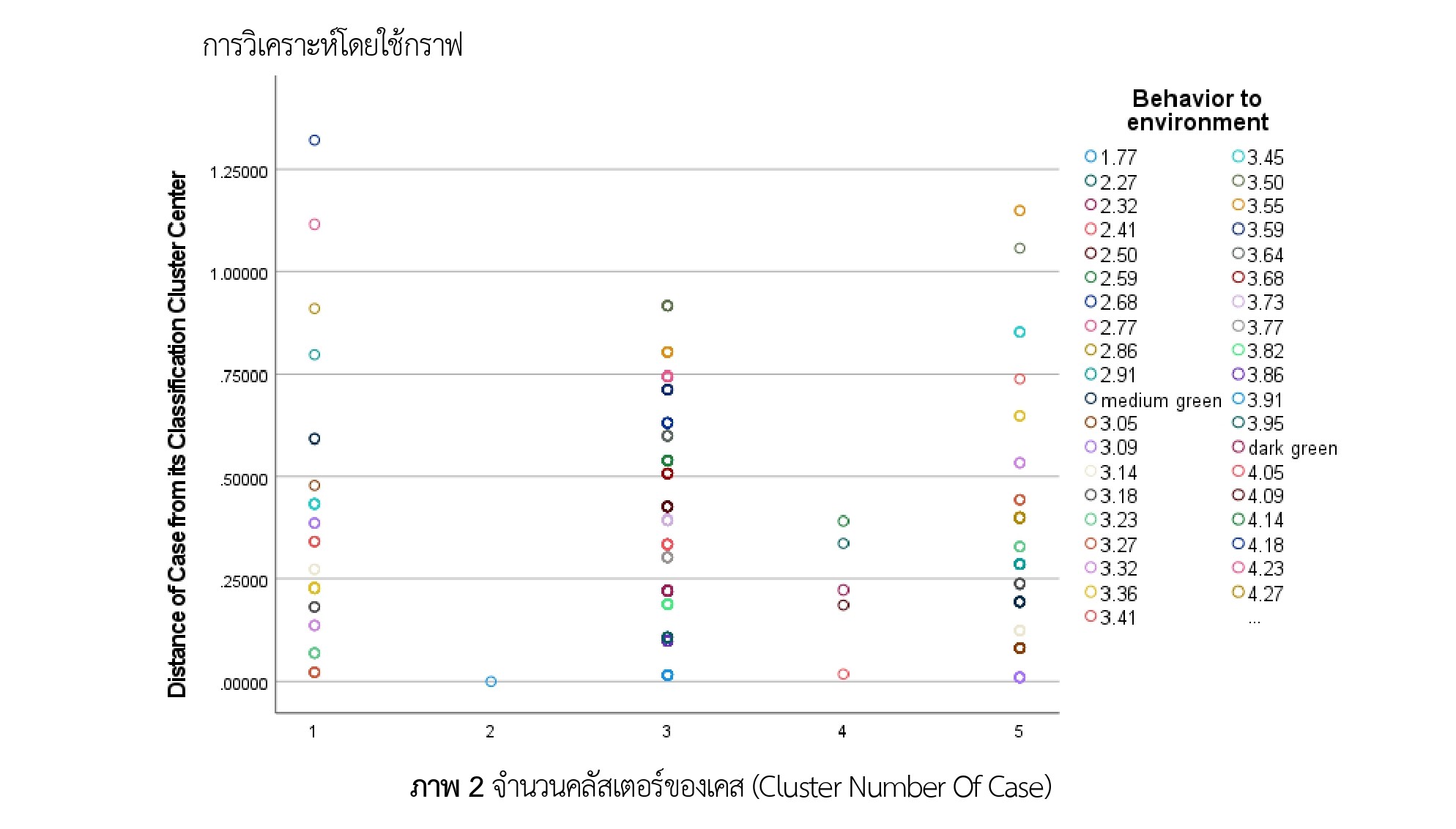
การวิจัยนี้มีวัตถุประสงค์เพื่อศึกษาพฤติกรรมความรับผิดชอบต่อสิ่งแวดล้อมเมื่อไปเยือนพื้นที่ธรรมชาติของเยาวชนไทย โดยใช้วิธีการเก็บข้อมูลออนไลน์จากประชากรไทยที่มีอายุระหว่าง 19 - 25 ปี จำนวน 485 คน ผลวิจัยพบว่าเยาวชนส่วนใหญ่มีพฤติกรรมความรับผิดชอบต่อสิ่งแวดล้อมอยู่ในระดับมาก เมื่อนำพฤติกรรมกลุ่มตัวอย่างมาทำการวิเคราะห์จำแนกกลุ่มแบบ K-means Cluster Analysis โดยกำหนดให้ k = 5 ผลวิจัยพบว่า เยาวชนจำแนกได้ 5 กลุ่ม แล้วพบว่ามีอัตราร้อยละของกลุ่มเยาวชนตามเฉดสีเขียวและมีพฤติกรรมที่แตกต่างกันไป ดังนี้ 1) กลุ่มเขียวอ่อนมาก มีจำนวนน้อยที่สุดคิดเป็นร้อยละ 0.20 ของกลุ่มตัวอย่าง กลุ่มนี้จะเป็นกลุ่มที่ไม่ปฏิบัติพฤติกรรมความรับผิดชอบต่อสิ่งแวดล้อมเลย ไม่ใส่ใจด้านสิ่งแวดล้อม มีพฤติกรรมความรับผิดชอบต่อสิ่งแวดล้อมระดับน้อยที่สุด 2) กลุ่มเขียวอ่อน คิดเป็นร้อยละ 1.03 ของกลุ่มตัวอย่าง กลุ่มนี้จะเป็นกลุ่มที่ปฏิบัติพฤติกรรมความรับผิดชอบต่อสิ่งแวดล้อมบ้าง ใส่ใจด้านสิ่งแวดล้อมบ้าง มีพฤติกรรมความรับผิดชอบต่อสิ่งแวดล้อมระดับน้อย 3) กลุ่มเขียว คิดเป็นร้อยละ 12.17 ของกลุ่มตัวอย่าง กลุ่มนี้จะเป็นกลุ่มที่ปฏิบัติพฤติกรรมความรับผิดชอบต่อสิ่งแวดล้อมนาน ๆ ครั้ง ใส่ใจด้านสิ่งแวดล้อมนาน ๆ ครั้ง มีพฤติกรรมความรับผิดชอบต่อสิ่งแวดล้อมระดับปานกลาง 4) กลุ่มเขียวเข้ม มีจำนวนมากที่สุดคิดเป็นร้อยละ 61.03 ของกลุ่มตัวอย่าง กลุ่มนี้จะเป็นกลุ่มปฏิบัติพฤติกรรมความรับผิดชอบต่อสิ่งแวดล้อมบ่อยครั้ง ใส่ใจด้านสิ่งแวดล้อมบ่อยครั้ง มีพฤติกรรมความรับผิดชอบต่อสิ่งแวดล้อมระดับมาก และ 5) กลุ่มเขียวเข้มมาก คิดเป็นร้อยละ 25.57 ของกลุ่มตัวอย่าง กลุ่มนี้เป็นกลุ่มปฏิบัติพฤติกรรมความรับผิดชอบต่อสิ่งแวดล้อมเป็นประจำ ใส่ใจด้านสิ่งแวดล้อมเป็นประจำ มีพฤติกรรมความรับผิดชอบต่อสิ่งแวดล้อมระดับมากที่สุด
เอกสารอ้างอิง
Bateman, J. (2020). NOAA finds ocean heat content was the highest in recorded history. NOAA (National Oceanic and Atmospheric Administration U.S. Department of Commerce). Retrieved May 12, 2022 from https://www.noaa.gov/news/2019-was-2nd-hottest-year-on-record-for-earth-say-noaa-nasa
Dolnicar, S., Crouch, I., G., & Long, P. (2008). Environment-friendly Tourist: What Do We Really Know About Them?. Journal of Sustainable Tourism, 16(2), 197-210.
Elkington, J., & Hailes, J. (1988). The Green Consumer Guide. London: Victor Gollancz.
Green Network. (2021). Retrieved August, 22, 2022 from https://www.greennetworkthailand.com
Hair, J. F., Black, W. C., Babin, B. J, Anderson, R., & Tathum, R. (2006). Multivariate Data Analysis (6th ed.). Upper Saddle River: Prentice Hall.
Haws, K. L., Winterich, K. P., & Naylor, R. W. (2014). Seeing the world through GREEN-tinted glasses: Green consumption values and responses to environmentally friendly products. Journal of consumer psychology, 24(3), 336-354. https://doi.org/10.1016/j.jcps.2013.11.002
Jackson, T. (2004). Motivating sustainable consumption: A review of evidence on consumer behavior and behavioral change. London: Policy Studies Institute. Report to the Sustainable Development Research Network.
MacMillan, A., & Turrentine, J. (2021). Global Warming 101. NRDC (Natural Resources Defense Council). Retrieved May 12, 2022 from https://www.nrdc.org/stories/global-warming-101#warming
McDonald, S., Oates, C., Alevizou, P. J., Young, W. & Hwang, K. (2006) Communication strategies for sustainable technologies: Identifying patterns in consumer behavior. Paper presented at Greening of Industry Network’s 13th International Conference Interaction and Communication: A Clear Route to Sustainability. 2-5 July, University of Cardiff.
Mintel Group. (1994). The Green Consumer: The Green Conscience. London: Mintel International.
Office of the National Economic and Social Development Council (NESDC). (2010). National Economic and Social Development Plan Issue 11 (2011-2016). Prime Minister's Office. (in Thai)
Office of the National Economic and Social Development Council (NESDC). (2016). National Economic and Social Development Plan No. 12 (2017-2021). Prime Minister's Office. (in Thai)
Ottman, J. A. (1992). Industry's response to green consumerism. Journal of Business Strategy, 13(4), 3-7.
Peattie, K. (2001). Towards sustainability: The third age of green marketing. The marketing review, 2(2), 129-146.
Risbey, J. S., O'Kane, T. J., Monselesan, D. P., Franzke, C. L., & Horenko, I. (2018). On the dynamics of austral heat waves. Journal of Geophysical Research: Atmospheres, 123(1), 38-57. https://doi.org/10.1002/2017JD027222
Rovinelli, R. J., & Hambleton, R. K. (1977). On the Use of Content Specialists in the Assessment of Criterion-Referenced Test Item Validity. Tijdschrift Voor Onderwijs Research, 2, 49-60.
Weaver, D. B. (2002). Hard-core Ecotourist in Lamington National Park. Australia. Journal of Ecotourism, 1(1), 19-35.
Weaver, D. B., & Lawton, L. J. (2002). Overnight Ecotourist Market Segmentation in the Gold Coast Hinterland of Australia. Journal of Travel Research, 40(3), 270-280.
Witherspoon, S. (1994). The Greening of Britain: Romance and Rationality. In: R. Jowell, J. Curtis, L. Brook and D. Ahendt (eds.) British Social Attitudes: The 11th Report (pp. 107-139). Aldershot, UK: Dartmouth.
Yamane, T. (1973). Statistics: An Introductory Analysis (3rd ed.). New York: Harper and Row.
ดาวน์โหลด
เผยแพร่แล้ว
รูปแบบการอ้างอิง
ฉบับ
ประเภทบทความ
สัญญาอนุญาต
ลิขสิทธิ์ (c) 2024 วารสารมนุษยศาสตร์และสังคมศาสตร์ มหาวิทยาลัยราชภัฏพิบูลสงคราม

อนุญาตภายใต้เงื่อนไข Creative Commons Attribution-NonCommercial-NoDerivatives 4.0 International License.
บทความหรือข้อคิดเห็นใดใดที่ปรากฏในวารสารมนุษยศาสตร์และสังคมศาสตร์ มหาวิทยาลัยราชภัฏพิบูลสงครามเป็นวรรณกรรมของผู้เขียน ซึ่งบรรณาธิการไม่จำเป็นต้องเห็นด้วย บทความที่ได้รับการตีพิมพ์เป็นลิขสิทธิ์ของวารสารมนุษยศาสตร์และสังคมศาสตร์ มหาวิทยาลัยราชภัฏพิบูลสงคราม