บุพปัจจัยของความสัมพันธ์กับผู้มีส่วนได้เสียเพื่อความได้เปรียบทางการแข่งขันและความไว้วางใจของนักลงทุนที่ส่งผลต่อความยั่งยืนของบริษัทจดทะเบียนในตลาดหลักทรัพย์แห่งประเทศไทย
DOI:
https://doi.org/10.14456/psruhss.2024.17คำสำคัญ:
ความสัมพันธ์กับผู้มีส่วนได้เสีย, ความได้เปรียบทางการแข่งขัน , ความไว้วางใจของนักลงทุน , ความยั่งยืนของบริษัท, ตลาดหลักทรัพย์แห่งประเทศไทยบทคัดย่อ
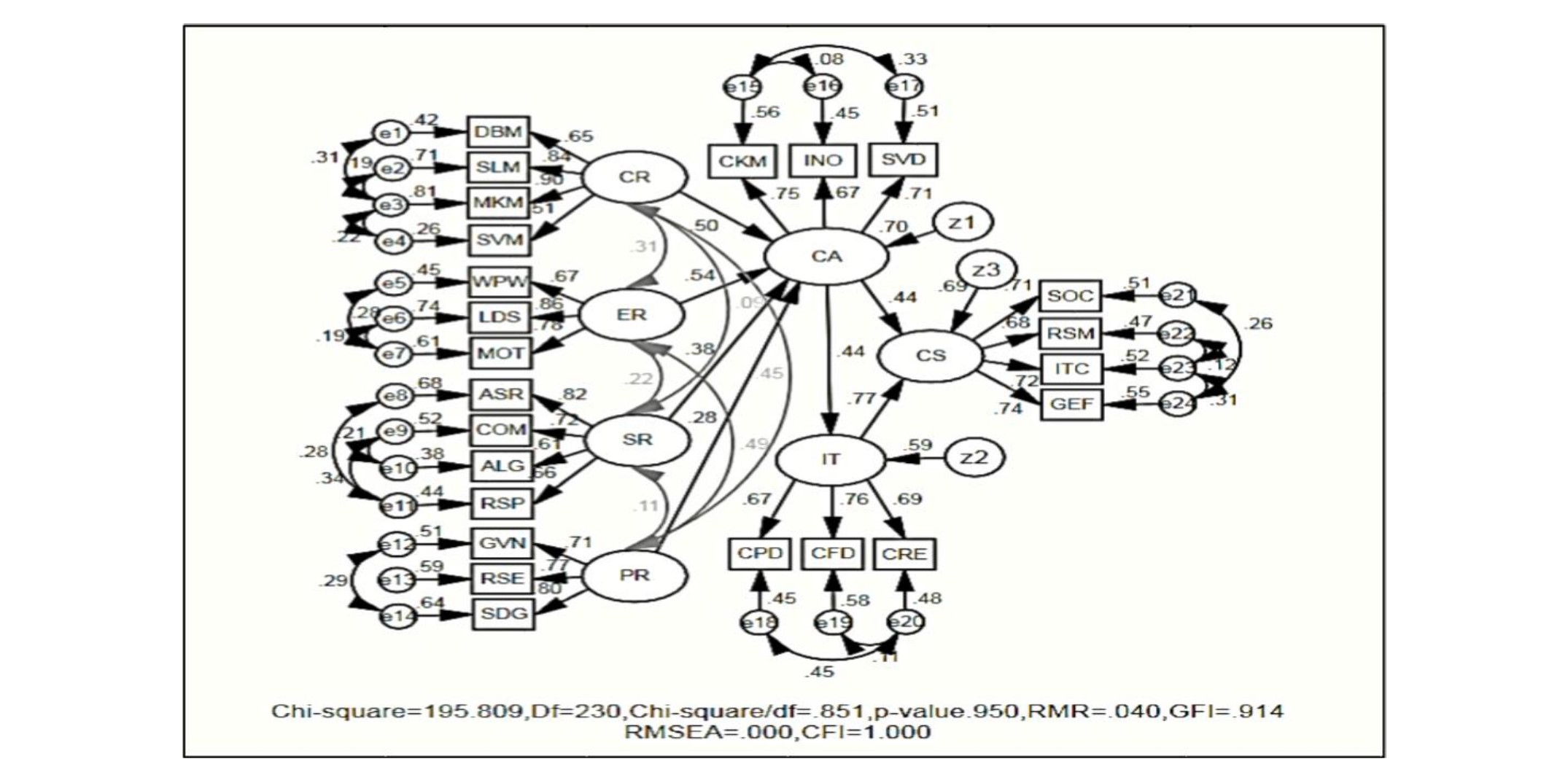
การศึกษานี้มีวัตถุประสงค์เพื่อ 1) ทดสอบความกลมกลืนของแบบจำลองความยั่งยืนบริษัทจดทะเบียนในตลาดหลักทรัพย์แห่งประเทศไทยที่ประกอบด้วย ความสัมพันธ์ของผู้มีส่วนได้เสีย ความได้เปรียบทางการแข่งขัน และความไว้วางใจของนักลงทุนกับข้อมูลเชิงประจักษ์ และ 2) ศึกษาถึงอิทธิพลของความสัมพันธ์กับผู้มีส่วนได้เสีย ความได้เปรียบทางการแข่งขัน และความไว้วางใจของนักลงทุนที่มีต่อความยั่งยืนบริษัทจดทะเบียนในตลาดหลักทรัพย์แห่งประเทศไทย ใช้แบบสอบถามเป็นเครื่องมือในการเก็บข้อมูลจาก 422 บริษัท และสถิติอ้างอิงที่ใช้ในการทดสอบสมมติฐานคือ การวิเคราะห์แบบจำลองสมการโครงสร้าง ผลการศึกษา พบว่า 1) แบบจำลองมีความกลมกลืนกับข้อมูลเชิงประจักษ์ (Chi-square/df = .851, p-value = .950, RMR = .040, GFI = .914, RMSEA = .000 และ CFI = 1.000) 2) ความสัมพันธ์กับผู้มีส่วนได้เสีย ซึ่งได้แก่ ความสัมพันธ์กับพนักงาน ความสัมพันธ์กับลูกค้า ความสัมพันธ์กับคู่ค้า และความสัมพันธ์กับสาธารณชน ส่งผลทางตรงเชิงบวกกับความได้เปรียบทางการแข่งขันของบริษัทด้วยค่าอิทธิพลเท่ากับ .543, .501, .384 และ .283 ตามลำดับ ความได้เปรียบทางการแข่งขันของบริษัทส่งผลทางตรงเชิงบวกกับความยั่งยืนของบริษัทและความไว้วางใจของนักลงทุนด้วยค่าอิทธิพลเท่ากับ .444 และ .441 ตามลำดับ และความไว้วางใจของนักลงทุนส่งผลทางตรงเชิงบวกกับความยั่งยืนของบริษัทด้วยค่าอิทธิพลเท่ากับ .772
เอกสารอ้างอิง
ตลาดหลักทรัพย์แห่งประเทศไทย. (2565). กลุ่มอุตสาหกรรมและหมวดธุรกิจในตลาดหลักทรัพย์แห่งประเทศไทย. สืบค้น 15 ตุลาคม 2565, จาก https://www.set.or.th/th/market/get-quote/stock/
นรีรัตน์ สันธยาติ. (2561). ภาคตลาดทุนทั่วโลก ผนึกกำลังเดินหน้าขับเคลื่อนการพัฒนาที่ยั่งยืนในเวที UN SSE Global Dialogue 2018. สืบค้น 21 มิถุนายน พ.ศ. 2565, จาก https://www.setsustainability.com/download/y32m9eb7dq86xkt
ปิยารมย์ ปิยะไทยเสรี. (2561). IPO Roadmap เส้นทางสู่การเป็นบริษัทจดทะเบียน. กรุงเทพฯ: ศูนย์ส่งเสริมการพัฒนาความรู้ตลาดทุน (TSI).
Abdioglu, N. (2020). The Role of Corporate Sustainability on Firm Value: An Application on Borsa Istanbul. In Handbook of Research on Creating Sustainable Value in the Global Economy. Pennsylvania: IGI Global.
Alvino, F., Di Vaio, A., Hassan, R., & Palladino, R. (2020). Intellectual capital and sustainable development: A systematic literature review. Journal of Intellectual Capital, 22(1), 76-94.
Amel-Zadeh, A., & Serafeim, G. (2018). Why and how investors use ESG information: Evidence from a global survey. Financial Analysts Journal, 74(3), 87-103.
Arimie, J. C., & Oronsaye, A. O. (2020). Assessing Employee Relations and Organizational Performance: a Literature Review. International Journal of Applied Research in Business and Management, 1(1), 1-17.
Awan, U., Kraslawski, A., & Huiskonen, J. (2017). Understanding the relationship between stakeholder pressure and sustainability performance in manufacturing firms in Pakistan. Procedia Manufacturing, 11, 768-777.
Bajo, E., Croci, E., & Marinelli, N. (2020). Institutional investor networks and firm value. Journal of Business Research, 112, 65-80.
Bardos, K. S., Ertugrul, M., & Gao, L. S. (2020). Corporate social responsibility, product market perception, and firm value. Journal of Corporate Finance, 62, 101588.
Brhane, H., & Zewdie, S. (2018). A literature review on the effects of employee relation on improving employee performance. International Journal in Management and Social Science, 6(4), 66-76.
Cepeda-Carrion, I., Martelo-Landroguez, S., Leal-Rodríguez, A. L., & Leal-Millán, A. (2017). Critical processes of knowledge management: An approach toward the creation of customer value. European Research on Management and Business Economics, 23(1), 1-7.
Chandrika, P. (2017). Impact of Internal Marketing on Human Resource Management–A study. IOSR Journal of Business and Management (IOSR-JBM), 6(4), 15-20.
Contini, M., Annunziata, E., Rizzi, F., & Frey, M. (2020). Exploring the influence of Corporate Social Responsibility (CSR) domains on consumers’ loyalty: an experiment in BRICS countries. Journal of Cleaner Production, 247, 119158.
Cronbach, L. J. (1970). Essentials of Psychological Testing. New York: Harper & Row.
Dakhlallh, M. M., Rashid, N., Abdullah, W. A. W., Qawqzeh, H. K., & Dakhlallh, A. M. (2020). Accrual-based Earnings Management, Real Earnings Management and Firm Performance: Evidence from Public Shareholders Listed Firms on Jordanian's Stock Market. Journal of Advanced Research in Dynamical and Control Systems, 12(1), 16-27.
Distanont, A., & Khongmalai, O. (2020). The role of innovation in creating a competitive advantage. Kasetsart Journal of Social Sciences, 41(1), 15-21.
Freeman, R. E. (1984). Strategic Management: A Stakeholder Approach. Boston: Pitman.
Gil-Gomez, H., Guerola-Navarro, V., Oltra-Badenes, R., & Lozano-Quilis, J. A. (2020). Customer relationship management: digital transformation and sustainable business model innovation. Economic research-Ekonomska istraživanja, 33(1), 2733-2750. https://doi.org/10.1080/1331677X.2019.1676283
Guiral, A., Moon, D., Tan, H. T., & Yu, Y. (2020). What Drives Investor Response to CSR Performance Reports?. Contemporary Accounting Research, 37(1), 101-130.
Hadj, T. B. (2020). Effects of corporate social responsibility towards stakeholders and environmental management on responsible innovation and competitiveness. Journal of Cleaner Production, 250, 119490. https://doi.org/10.1016/j.jclepro.2019.119490
Hair, J. F. (Jr.), Hult, G. T. M., Ringle, C. M., & Sarstedt, M. (2014). A Primer on Partial Least Squares Structural Equation Modeling (PLS-SEM). Thousand Oaks, CA: Sage Publications.
Hair, J. F., Black, W. C., Babin, B. J., & Anderson, R. E. (2010). Multivariate Data Analysis (7th ed.). New York: Pearson Prentice Hall.
Hakanen, M. (2017). The development and management of interpersonal trust in a business network in health, exercise, and wellbeing markets (Doctoral dissertation). University of Jyväskylä.
Jan, A. A., Lai, F. W., Draz, M. U., Tahir, M., Ali, S. E. A., Zahid, M., & Shad, M. K. (2021). Integrating sustainability practices into islamic corporate governance for sustainable firm performance: from the lens of agency and stakeholder theories. Qual Quant, 56, 2989–3012. https://doi.org/10.1007/s11135-021-01261-0
Javed, M., Rashid, M. A., Hussain, G., & Ali, H. Y. (2020). The effects of corporate social responsibility on corporate reputation and firm financial performance: Moderating role of responsible leadership. Corporate Social Responsibility and Environmental Management, 27(3), 1395-1409.
Kline, R. B. (2005). Principles and practice of structural equation modeling (2nd ed.). New York: Guilford Press.
Kumar, P., & Firoz, M. (2022). Does Accounting-based Financial Performance Value Environmental, Social and Governance (ESG) Disclosures? A detailed note on a corporate sustainability perspective. Australasian Accounting, Business and Finance Journal, 16(1), 41-72. http://dx.doi.org/10.14453/aabfj.v16i1.4
Kusumadewi, R. N., & Karyono, O. (2019). Impact of service quality and service innovations on competitive advantage in retailing. Budapest International Research and Critics Institute-Journal (BIRCI-Journal), 2(2), 366-374. https://doi.org/10.33258/birci.v2i2.306
Maharantika, S. F., & Fuad, F. (2022). The influence of environmental performance, environmental management systems, and corporate social responsibility disclosure on the financial performance. Diponegoro Journal of Accounting, 11(1), 1-15.
Maheshwari, P., & Kushwah, B. S. (2019). Customer loyalty approach of CRM. Journal of the Gujarat Research Society, 21(16), 64-72.
McCarthy, E. J. (1960). Basic Marketing, A managerial approach. Richard D. Irwin.
Meyer, J. M. (2015). Engaging the everyday: environmental social criticism and the resonance dilemma. Cambridge, MA: MIT Press.
Migdadi, M. M. (2020). Knowledge management, customer relationship management and innovation capabilities. Journal of Business & Industrial Marketing, 36(1), 111-124.
Mo, C. J., & Yu, T. (2022). Capturing complex, dynamic customer loyalty by integrating traditional and big data analyses. In Handbook of Research on Customer Loyalty. Massachusetts: Edward Elgar Publishing.
Naveed, M., Sohail, M. K., Abdin, S. Z., Awais, M., & Batool, N. (2020). Role of ESG disclosure in determining asset allocation decision: An individual investor perspective. Paradigms, 14(1), 157-166.
Nawrocki, T. L., & Szwajca, D. (2019). Corporate Reputation and Assessment of Companies by the Capital Market: Evidence from the Polish Banking Sector. Organization and Management Scientific Quarterly, 3(47), 111-121.
Nugroho, T. W., Hanani, N., Toiba, H., & Sujarwo, S. (2022). Promoting Subjective Well-Being among Rural and Urban Residents in Indonesia: Does Social Capital Matter?. Sustainability, 14(4), 2375. https://doi.org/10.3390/su14042375
Oliver, R. K., & Webber, M. D. (1982). Supply-chain management: logistics catches up with strategy, in Christopher, M. (1992), Logistics: The Strategic Issues, London: Chapman & Hall.
Ozmen, Y. S. (2017). How Employees Define Organisational Trust: Analysing Employee Trust in Organisation. Journal of Global Responsibility, 9(1), 21-40.
Pahurkar, R. N., Sangvikar, B. V., Khadke, K., & Kolte, A. (2020). An Exploratory Study of Important Dimensions in Strengthening Buyer-Supplier Relationship. International Journal on Emerging Technologies, 11(2), 803-810.
Pancasila, I., Haryono, S., & Sulistyo, B. A. (2020). Effects of work motivation and leadership toward work satisfaction and employee performance: Evidence from Indonesia. The Journal of Asian Finance, Economics, and Business, 7(6), 387-397.
Park, J. H., & Tran, T. B. H. (2018). Internal marketing, employee customer oriented-behaviors, and customer behavioral responses. Psychology & Marketing, 35(6), 412-426.
Patrucco, A. S., Moretto, A., Luzzini, D., & Glas, A. H. (2020). Obtaining supplier commitment: antecedents and performance outcomes. International Journal of Production Economics, 220, 107449. https://doi.org/10.1016/j.ijpe.2019.07.022
Porter, M. E. (1985). The Competitive Advantage: Creating and Sustaining Superior Performance. NY: Free Press.
Rizwan, A., & Mustafa, F. (2022). Fintech attaining sustainable development: an investor perspective of crowdfunding platforms in a developing country. Sustainability, 14(12), 7114.
Rovinelli, R. J., & Hambleton, R. K. (1977). On the use of content specialists in the assessment of criterion-referenced test item validity. Dutch Journal of Educational Research, 2, 49-60.
Schermelleh-Engel, K., Moosbrugger, H., & Muller, H. (2003). Evaluating the fit of structural equation models: tests of significance and goodness-of-fit models. Methods of Psychological Research Online, 8(2), 23-74.
Stocker, F., de Arruda, M. P., de Mascena, K. M., & Boaventura, J. M. (2020). Stakeholder engagement in sustainability reporting: a classification model. Corporate Social Responsibility and Environmental Management, 27(5), 2071-2080.
Tyndall, G. R. (1988). Supply-chain management innovations spur long-term strategic retail alliances. Marketing News, 22(26), 10.
Venkatesan, R., Kumar, V., & Reinartz, W. (2022). Customer relationship management in business markets. In Handbook of Business-to-Business Marketing (pp. 335-358). Edward Elgar Publishing. https://doi.org/10.4337/9781800376878.00028
Wang, H. (2014). Theories for competitive advantage. In H. Hasan (Eds.), Being Practical with Theory: A Window into Business Research (pp. 33-43). Wollongong, Australia: University of Wollongong.
Wang, W., Su, C., & Duxbury, D. (2021). Investor sentiment and stock returns: Global evidence. Journal of Empirical Finance, 63, 365-391.
Zhao, Z., Meng, F., He, Y., & Gu, Z. (2019). The influence of corporate social responsibility on competitive advantage with multiple mediations from social capital and dynamic capabilities. Sustainability, 11(1), 218. https://doi.org/10.3390/su11010218
ดาวน์โหลด
เผยแพร่แล้ว
รูปแบบการอ้างอิง
ฉบับ
ประเภทบทความ
สัญญาอนุญาต
ลิขสิทธิ์ (c) 2024 วารสารมนุษยศาสตร์และสังคมศาสตร์ มหาวิทยาลัยราชภัฏพิบูลสงคราม

อนุญาตภายใต้เงื่อนไข Creative Commons Attribution-NonCommercial-NoDerivatives 4.0 International License.
บทความหรือข้อคิดเห็นใดใดที่ปรากฏในวารสารมนุษยศาสตร์และสังคมศาสตร์ มหาวิทยาลัยราชภัฏพิบูลสงครามเป็นวรรณกรรมของผู้เขียน ซึ่งบรรณาธิการไม่จำเป็นต้องเห็นด้วย บทความที่ได้รับการตีพิมพ์เป็นลิขสิทธิ์ของวารสารมนุษยศาสตร์และสังคมศาสตร์ มหาวิทยาลัยราชภัฏพิบูลสงคราม