The Influence of Environmental Management Accounting as a Mediator of Top Management Support towards Environmental Performance by Green Work Climate Perceptions as a Moderating Variable of Thai Fruit and Vegetable Processing Businesses
DOI:
https://doi.org/10.14456/psruhss.2024.49Keywords:
Environmental management accounting, Top management support, Green Work Climate Perception, Environmental PerformanceAbstract
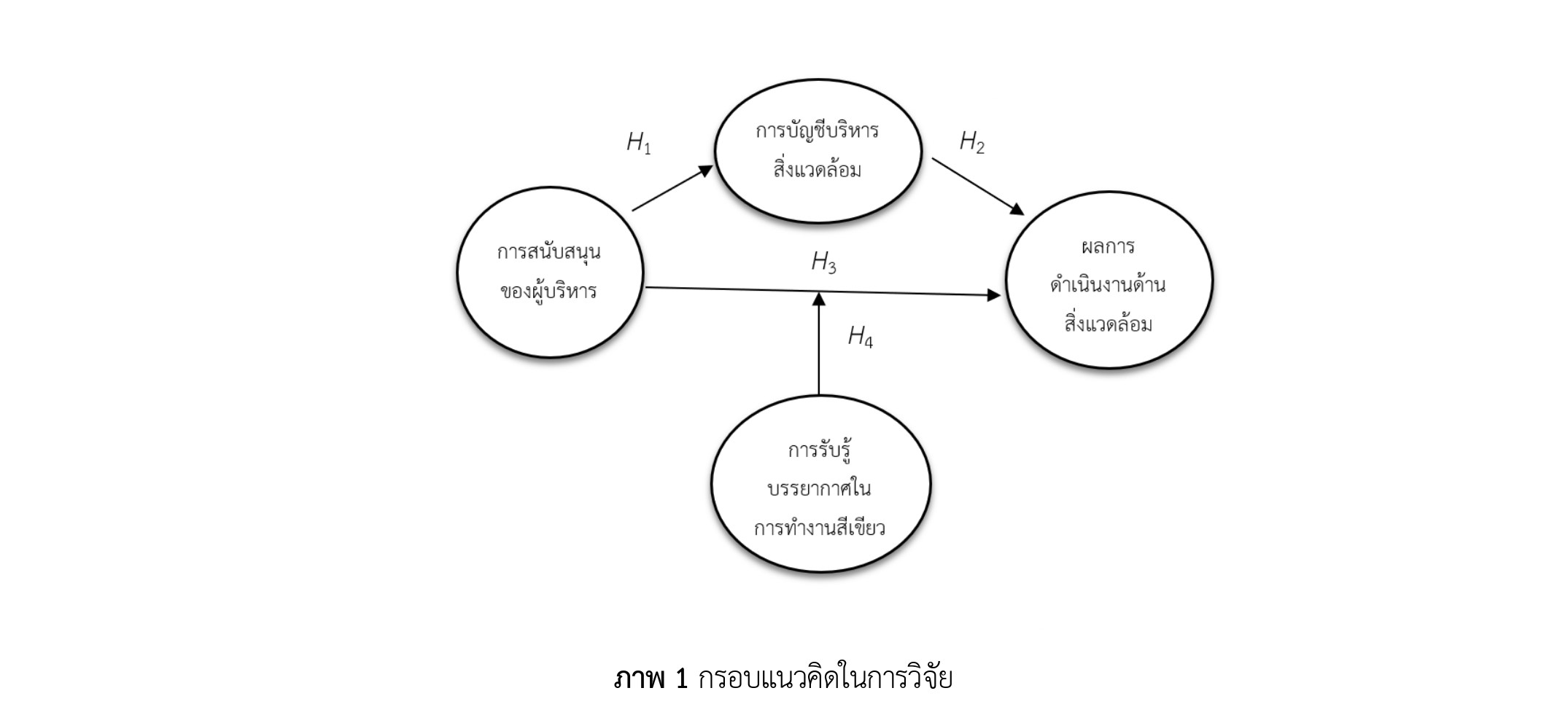
This research aimed to 1) analyze and develop an environmental management accounting (EMA) model, top management support, green work climate perceptions, and environmental performance of Thai fruit and vegetable processing businesses, and 2) examine the influence of EMA, top management support, and green work climate perceptions on the environmental performance of these businesses. Data collection involved administering a questionnaire to 340 registered legal entities in Thailand’s fruit and vegetable processing and preservation sector. In statistical analysis, structural equation modeling (SEM) was utilized to test the hypotheses. The findings revealed that : 1) the proposed model fit the empirical data well (Chi-square/df = 1.304, P-value = 0.105, GFI = 0.978, AGFI = 0.952, RMSEA = 0.030, and CFI = 0.998), and 2) the overall influence on environmental performance was positive and significant for both top management support (β = 0.668) and EMA (β = 0.434). Both top management support and EMA had direct positive influences on environmental performance (β = 0.268 and β = 0.434, respectively). Also, top management support had an indirect positive influence through green work climate perceptions (β = 0.400).
References
กรมพัฒนาธุรกิจการค้า. (2565). สถานประกอบการที่จดทะเบียนนิติบุคคลในหมวดแปรรูปและการถนอมผลไม้และผัก. สืบค้น 6 มกราคม 2567, จาก https://tsic.dbd.go.th/assets/book_business_man.pdf
มิ่งสรรพ์ ขาวสอาด และกอบกุล รายะนาคร. (2552). เครื่องมือทางเศรษฐศาสตร์เพื่อ การจัดการสิ่งแวดล้อม. กรุงเทพฯ: ล๊อคอินไซน์เวิร์ค.
ศิลปพร ศรีจั่นเพชร. (2552). การบัญชีตามความรับผิดชอบต่อสังคม. Journal of Business Administration The Association of Private Higher Education Institutions of Thailand, 6(1), 25-32.
Bresciani, S., Rehman, S. U., Giovando, G., & Alam, G. M. (2022). The role of environmental management accounting and environmental knowledge management practices influence on environmental performance: mediated-moderated model. Journal of Knowledge Management, 27(4), 896-918.
Byrd, D. R., Brookland, R. K., Washington, M. K., Gershenwald, J. E., Compton, C. C., Hess, K. R., ... & Meyer, L. R. (2017). AJCC cancer staging manual (Vol. 1024). M. B. Amin, S. B. Edge, & F. L. Greene (Eds.). New York: springer.
Carvalho, L. D. F., Pianowski, G., & Gonçalves, A. P. (2020). Personality differences and COVID-19: are extroversion and conscientiousness personality traits associated with engagement with containment measures?. Trends in psychiatry and psychotherapy, 42(2), 179-184. https://doi.org/10.1590/2237-6089-2020-0029
Cho, C. H., Kim, A., Rodrigue, M., & Schneider, T. (2020). Towards a better understanding of sustainability accounting and management research and teaching in North America: A look at the community. Sustainability Accounting, Management and Policy Journal, 11(6), 985-1007.
Damanpour, F. (2018). Organizational innovation: A meta-analysis of effects of determinants and moderators. In Organizational Innovation (p. 127-162). Routledge.
Damanpour, F., & Gopalakrishnan, S. (2001). The dynamics of the adoption of product and process innovations in organizations. Journal of management studies, 38(1), 45-65.
Deb, B. C., Rahman, M. M., & Rahman, M. S. (2022). The impact of environmental management accounting on environmental and financial performance: empirical evidence from Bangladesh. Journal of Accounting & Organizational Change, 19(3), 420-446.
Denzin, N. K. (1970). The research act: A theoretical introduction to sociological methods. Chicago, IL: Aldine.
Diamantopoulos, A., Siguaw, J. A., & Siguaw, J. A. (2000). Introducing LISREL: A Guide for the Uninitiated. Sage Publications, London. https://dx.doi.org/10.4135/9781849209359
Fornell, C., & Larcker, D. F. (1981). Evaluating structural equation models with unobservable variables and measurement error. Journal of marketing research, 18(1), 39-50.
Fuzi, N. M., Habidin, N. F., Janudin, S. E., & Ong, S. Y. Y. (2019). Environmental management accounting practices, environmental management system and environmental performance for the Malaysian manufacturing industry. International Journal of Business Excellence, 18(1), 120-136.
Hair, J. F., Black, W. C., Babin, B. J., & Anderson, R. E. (2010). Multivariate Data Analysis (7th Ed.). Pearson, New York.
Hair, J. F., Gabriel, M., & Patel, V. (2014). AMOS covariance-based structural equation modeling (CB-SEM): Guidelines on its application as a marketing research tool. Brazilian Journal of Marketing, 13(2), 44-55. https://doi.org/10.5585/remark.v13i2.2718
Haldorai, K., Kim, W. G., & Garcia, R. F. (2022). Top management green commitment and green intellectual capital as enablers of hotel environmental performance: The mediating role of green human resource management. Tourism Management, 88, 104431. https://doi.org/10.1016/j.tourman.2021.104431
Henseler, J., Ringle, C. M., & Sinkovics, R. R. (2009). The use of partial least squares path modeling in international marketing. In New challenges to international marketing (Vol. 20, pp. 277-319). Emerald Group Publishing Limited.
Henseler, J., Ringle, C. M., & Sinkovics, R. R. (2009). The use of partial least squares path modeling in international marketing. In New challenges to international marketing (pp. 277-319). Emerald Group Publishing Limited. https://doi.org/10.1108/S1474-7979(2009)0000020014
Koschate-Fischer, N., & Gartner, S. (2015). Brand trust: Scale development and validation. Schmalenbach Business Review, 67, 171-195.
Latan, H., Jabbour, C. J. C., de Sousa Jabbour, A. B. L., Wamba, S. F., & Shahbaz, M. (2018). Effects of environmental strategy, environmental uncertainty and top management's commitment on corporate environmental performance: The role of environmental management accounting. Journal of cleaner production, 180, 297-306.
Lee, J., & Joo, H. Y. (2020). The impact of top management’s support on the collaboration of green supply chain participants and environmental performance. Sustainability, 12(21), 9090.
Lutfi, L. (2023). Sharia Bank Deposits and Financing: Does Economic Turbulence Matter?. Journal of Economics, Business, and Accountancy Ventura, 26(3), 386-400.
Nkundabanyanga, S. K., Muramuzi, B., & Alinda, K. (2021). Environmental management accounting, board role performance, company characteristics and environmental performance disclosure. Journal of Accounting & Organizational Change, 17(5), 633-659.
Phan, T. N., Baird, K., & Su, S. (2017). The use and effectiveness of environmental management accounting. Australasian Journal of Environmental Management, 24(4), 355-374.
Rahman, M. M., & Islam, M. E. (2023). The impact of green accounting on environmental performance: mediating effects of energy efficiency. Environmental Science and Pollution Research, 30(26), 69431-69452.
Schermelleh-Engel, K., Moosbrugger, H., & Müller, H. (2003). Evaluating the Fit of Structural Equation Models: Tests of Significance and Descriptive Goodness-of-Fit Measures. Methods of Psychological Research, 8(2), 23–74.
Singh, S. K., Del Giudice, M., Chierici, R., & Graziano, D. (2020). Green innovation and environmental performance: The role of green transformational leadership and green human resource management. Technological forecasting and social change, 150, 119762.
Udayasankar, K. (2008). Corporate social responsibility and firm size. Journal of business ethics, 83(2), 167-175.
Wang, G., Yuan, Y., Chen, X., Li, J., & Zhou, X. (2018, October). Learning discriminative features with multiple granularities for person re-identification. In Proceedings of the 26th ACM international conference on Multimedia (pp. 274-282).
Zutshi, A., & Sohal, A. S. (2004). Adoption and maintenance of environmental management systems: critical success factors. Management of Environmental Quality: An International Journal, 15(4), 399-419.
Downloads
Published
How to Cite
Issue
Section
License
Copyright (c) 2024 Humanities and Social Sciences Journal of Pibulsongkram Rajabhat University

This work is licensed under a Creative Commons Attribution-NonCommercial-NoDerivatives 4.0 International License.
Any articles or comments appearing in the Journal of Humanities and Social Sciences, Rajabhat Phibulsongkram University, are the intellectual property of the authors, and do not necessarily reflect the views of the editorial board. Published articles are copyrighted by the Journal of Humanities and Social Sciences, Rajabhat Phibulsongkram University.