การเปลี่ยนแปลงกับความต้องการพัฒนาเศรษฐกิจชุมชนชาติพันธุ์มูเซอดำ บ้านขอบด้ง ตำบลม่อนปิ่น อำเภอฝาง จังหวัดเชียงใหม่
DOI:
https://doi.org/10.14456/psruhss.2025.18คำสำคัญ:
การเปลี่ยนแปลง, การพัฒนาเศรษฐกิจ , ชุมชนชาติพันธุ์บทคัดย่อ
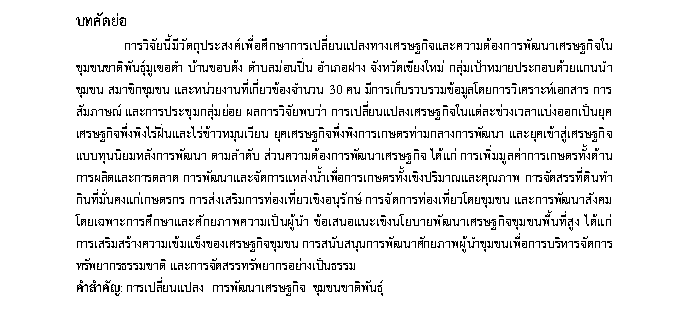
การวิจัยนี้มีวัตถุประสงค์เพื่อศึกษาการเปลี่ยนแปลงทางเศรษฐกิจและความต้องการพัฒนาเศรษฐกิจในชุมชนชาติพันธุ์มูเซอดำ บ้านขอบด้ง ตำบลม่อนปิ่น อำเภอฝาง จังหวัดเชียงใหม่ กลุ่มเป้าหมายประกอบด้วยแกนนำชุมชน สมาชิกชุมชน และหน่วยงานที่เกี่ยวข้องจำนวน 30 คน มีการเก็บรวบรวมข้อมูลโดยการวิเคราะห์เอกสาร การสัมภาษณ์ และการประชุมกลุ่มย่อย ผลการวิจัยพบว่า การเปลี่ยนแปลงเศรษฐกิจในแต่ละช่วงเวลาแบ่งออกเป็นยุคเศรษฐกิจพึ่งพิงไร่ฝิ่นและไร่ข้าวหมุนเวียน ยุคเศรษฐกิจพึ่งพิงการเกษตรท่ามกลางการพัฒนา และยุคเข้าสู่เศรษฐกิจแบบทุนนิยมหลังการพัฒนา ตามลำดับ ส่วนความต้องการพัฒนาเศรษฐกิจ ได้แก่ การเพิ่มมูลค่าการเกษตรทั้งด้านการผลิตและการตลาด การพัฒนาและจัดการแหล่งน้ำเพื่อการเกษตรทั้งเชิงปริมาณและคุณภาพ การจัดสรรที่ดินทำกินที่มั่นคงแก่เกษตรกร การส่งเสริมการท่องเที่ยวเชิงอนุรักษ์ การจัดการท่องเที่ยวโดยชุมชน และการพัฒนาสังคมโดยเฉพาะการศึกษาและศักยภาพความเป็นผู้นำ ข้อเสนอแนะเชิงนโยบายพัฒนาเศรษฐกิจชุมชนพื้นที่สูง ได้แก่ การเสริมสร้างความเข้มแข็งของเศรษฐกิจชุมชน การสนับสนุนการพัฒนาศักยภาพผู้นำชุมชนเพื่อการบริหารจัดการทรัพยากรธรรมชาติ และการจัดสรรทรัพยากรอย่างเป็นธรรม
เอกสารอ้างอิง
Awan, A. G. (2016). Wave of Anti-Globalization and Capitalism and its impact on World Economy. Global Journal of Management and Social Sciences, 2(4), 1-21.
Baymul, C., & Sen, K. (2020). Was Kuznets right? New evidence on the relationship between structural transformation and inequality. The Journal of Development Studies, 56(9), 1643–1662. https://doi.org/10.1080/00220388.2019.1702161
Bezrukov, N., Huk, L., Chmil, H., Verbivska, L., Komchatnykh, O., & Kozlovskyi, Y. (2022). Digitalization as a trend of modern development of the world economy. WSEAS Transactions on Environment and Development, 18, 120–129. https://doi.org/10.37394/232015.2022.18.13
Clark, J. S., Porath, S., Thiele, J., & Jobe, M. (2020). Action research. Manhattan, Kansas: New Pairie Press.
Debnath, B. (2019). Efficacy of sustainable livelihood approach as a tool for measuring socioeconomic condition as compared to other tools. International Journal of Applied Social Science, 6(2), 445-9.
Jeerat, P., Kruekum, P., Sakkatat, P., Rungkawat, N., & Fongmul, S. (2022). A potential elevation model of sustainable agriculture practice of small-scale farmers in highland local communities, Chiang Mai Province. Journal of SaengKhomKham Buddhist Studies, 7(3), 479-499. (In Thai).
Liu, X. (2020). Structural changes and economic growth in China over the past 40 years of reform and opening-up. China Political Economy, 3(1), 19-38. https://doi.org/10.1108/CPE-05-2020-0010
Manachansuk, S., & Kittisaro, P.B. (2021). Evolution of government, economy, and society of Thailand. Journal of Research and Academics, 4(1), 255-268. (In Thai).
Pounpunwong, W. (2017). The development of rural into the urban: a case study Doi Mon Cham, Mae Rim district, Chiang Mai Province. Journal of Political Science and Public Administration Journal, 8(2). 55-80. (In Thai).
Rattanachauy, S. (2017). Community development in dynamic of new era. Journal of Politics and governance, 7(1), 72-87. (In Thai).
Siriwongwanngarm, P. & Thitiluck, S. (2022). Community economic development in the upper northern region of Thailand: potential and roles of community and state in the development. Journal of MCU Peace Studies, 10(1), 227-239. (in Thai).
Talerngsri, K., & Pongkijvorasin, S. (2017). Agricultural business on highlands and sustainability: lesson learns and recommendations for development. Bangkok: knowledge Network Institute of Thailand and Thailand Research Fund.
Thaha, R., & Galib, W. K. (2022). Analysis of modernization theory in the perspective of Rostow’s economic growth theory. Journal of Judikaltura, 1(1), 24–30. https://doi.org/10.61963/jkt.v1i1.24
Todaro, M. P., & Smith, S. C. (2020). Economic development (13th ed.). Pearson.
Tran, D. T., Doan, M. H., & Do, N. T. (2020). Vietnam after 2020: toward a prosperous economy, social inclusion and environmental sustainability. International Journal of Economic Policy Studies, 14(2), 313–326. https://doi.org/10.1007/s42495-020-00046-x
Yamsrisuk, C. & Issariyanon, S. (2021). Political economy on economic changes of Phuket Province. Nakhon Lampang Buddhist’s Journal, 10(3), 86-97. (In Thai).
ดาวน์โหลด
เผยแพร่แล้ว
รูปแบบการอ้างอิง
ฉบับ
ประเภทบทความ
สัญญาอนุญาต
ลิขสิทธิ์ (c) 2025 วารสารมนุษยศาสตร์และสังคมศาสตร์ มหาวิทยาลัยราชภัฏพิบูลสงคราม

อนุญาตภายใต้เงื่อนไข Creative Commons Attribution-NonCommercial-NoDerivatives 4.0 International License.
บทความหรือข้อคิดเห็นใดใดที่ปรากฏในวารสารมนุษยศาสตร์และสังคมศาสตร์ มหาวิทยาลัยราชภัฏพิบูลสงครามเป็นวรรณกรรมของผู้เขียน ซึ่งบรรณาธิการไม่จำเป็นต้องเห็นด้วย บทความที่ได้รับการตีพิมพ์เป็นลิขสิทธิ์ของวารสารมนุษยศาสตร์และสังคมศาสตร์ มหาวิทยาลัยราชภัฏพิบูลสงคราม