
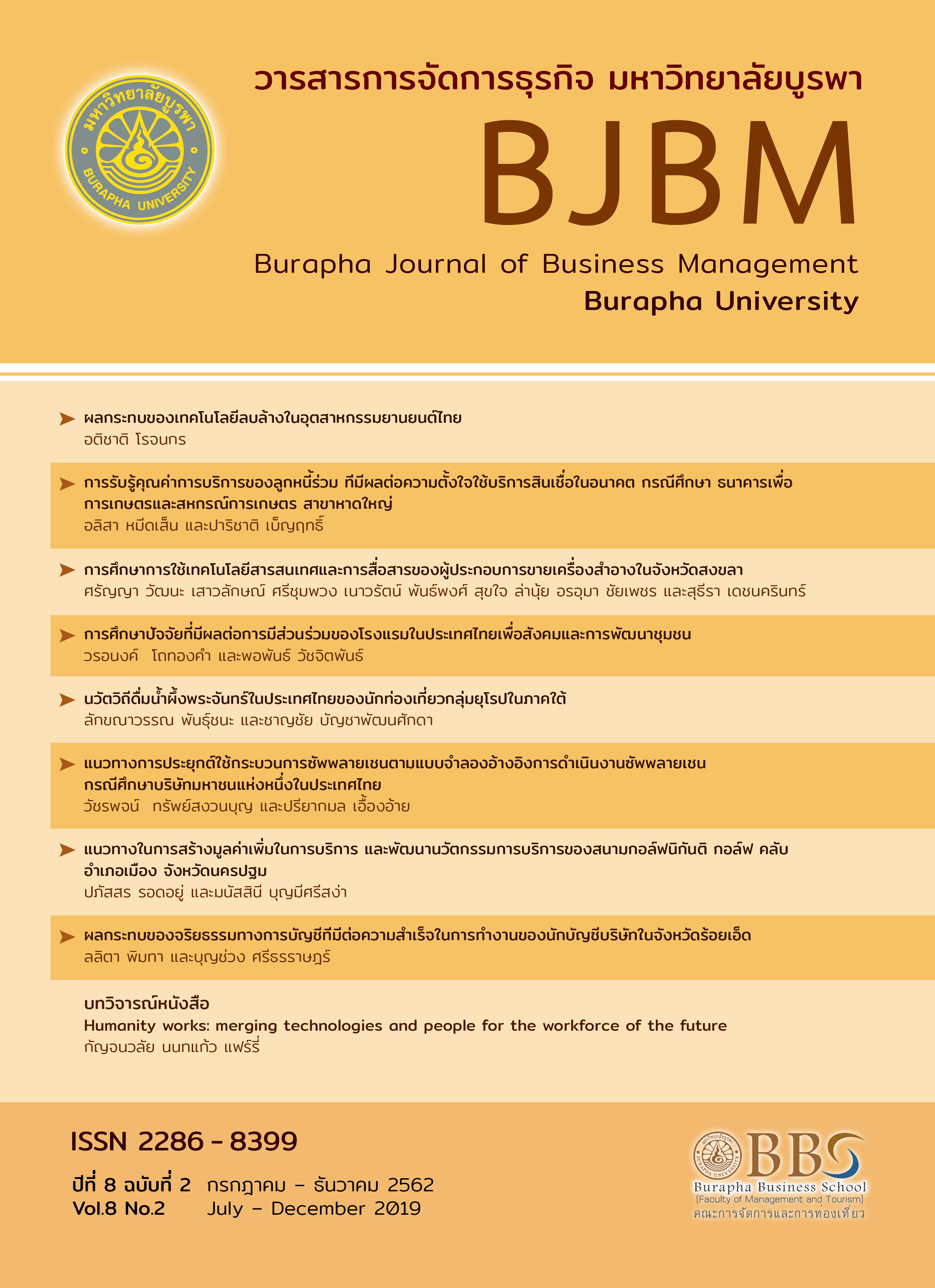
A Study of Factors Affecting Involvement of Hotels in Social Responsibility and Local Community Development in Thailand การมีส่วนร่วมของโรงแรม
Article Sidebar
Main Article Content
Abstract
Involvement of hotels in community development is an approach to corporate social responsibility together with value creation for stakeholders and sustainable development. This research aims to study and appreciate the importance of hotel participation in the internal operation and in the development of the local community in social-cultural, environmental and economic aspects. The questionnaires were mailed to managers of the 1-5 star hotels which were members of the Thai Hotels Association. The sample used in the study consisted of 221 hotels which completed the questionnaires. The results showed that when considering the hotel profiles, 4-5 star hotels or large hotels with more than 300 employees had higher internal engagement and community development activities. We also found that hotels were less involved in community development in economic aspect than in social-cultural and environmental aspects. The results of the research led to the increase of the capability to participation in the internal activities of the hotel for social and community development activities, such as cooperation with business in the community. Collaboration with educational institutions by having good and effective project management.
Article Details
The article to be published in the Burapha Journal of Business Management must not have been previously published in any journal and must not be under consideration by other journals. If copyright infringement is found, or the comments in the articles are contrary to ethics, it is deemed to be the opinion and direct responsibility of the article’s authors, not the opinion or responsibility of the Burapha Business School, Burapha University. Wanting to publicize any content in the Burapha Journal of Business Management, permission must be obtained from the editorial team of the Burapha Journal of Business Management according to the copyright laws.
References
ธินิกานต์ สังข์สุวรรณ. (2018). กิจกรรมการท่องเที่ยวเชิงสร้างสรรค์ที่เกาะเสม็ด. วารสารวิทยาลัยดุสิตธานี ปีที่ 12 ฉบับพิเศษ เดือนพฤษภาคม 2561. 356-367.
ระชานนท์ ทวีผล. (2558). การให้ความหมายและรูปแบบกิจกรรมความรับผิดชอบต่อสังคมของโรงแรมในเขตอำเภอหัวหิน จังหวัดประจวบคีรีขันธ์. วารสารการจัดการธุรกิจ คณะการจัดการและการท่องเที่ยว มหาวิทยาลัยบูรพา, 4(1), 24-37.
สานิตย์ หนูนิล, วิโรจน์ เจษฎาลักษณ์ และจันทนา แสนสุข. (2559). องค์ประกอบและรูปแบบของความรับผิดชอบต่อสังคมเชิงกลยุทธ์ธุรกิจโรงแรมในประเทศไทย. วารสารวิชาการสมาคมสถาบันอุดมศึกษาเอกแห่งประเทศไทยในพระราชูปถัมภ์สมเด็จพระเทพรัตนราชสุดาฯสยามบรมกุมารี, 22(2), 69-78.
หงสกุล เมสนุกูล. (2555). แนวทางการจัดการสิ่งแวดล้อมของธุรกิจที่พักตามมาตรฐานโรงแรมใบไม้สีเขียวของ Six Senses Hideaway เกาะยาวน้อย จังหวัดภูเก็ต. การประชุมวิชาการแห่งชาติ มหาวิทยาลัยเกษตรศาสตร์ วิทยาเขตกำแพงแสน ครั้งที่ 9, 686-697.
Abdel-Maksoud, A., Kamel, H., & Elbanna, S. (2016). Investigating relationships between stakeholders’ pressure, eco-control systems and hotel performance. International Journal of Hospitality Management, 59, 95-104.
Accor Hotels. 2016. Planet 21. Retrieved May 1, 2016, from https://www.accorhotels.com/gb/ sustainabledevelopment/index.shtml.
Amari Hotels Resort and Spa. (2018). Social responsibility. Retrieved July 8, 2018, from https://www.amari.com/social-responsibility/
Aref, F., & Ma’rof, R. (2009). “Assessing the level of community participation as a component of community capacity building for tourism development”. Euro. J. Soc. Sci. 8(1), 68-75.
Babbie, E. (2002). The basics of social research. Belmont, CA,: Wadsworth.
Barnard, C. I. (1968). The functions of the executive (Vol. 11): Harvard university press.
Brundtland Commission. (1987). World commission on environment and development. Our common future. Retrieved May 1, 2016, from https://public.wsu.edu/~susdev/WCED87.html.
Dusit Hotels and Resort. (2018). Corporate social responsibility. Retrieved June 11, 2018, from https://www.dusit.com/th/csr/online.
Elkington, J. (1997). “Cannibals with forks - the triple bottom line of twenty-first century Business”. Mankato, MN: Capstone.
Freeman, R.E. (1984). Strategic management: A stakeholder approach. Boston, Pitman. Retrieved May 1, 2016, from https://books.google.com/books.
Han, H., Hsu, L-T. J., Lee, J-S., & Sheu, C. (2011). Are lodging customers ready to go green? An examination of attitudes, demographics, and eco-friendly intentions. International Journal of Hospitality Management, 30(2), 345-355,
Hair, J. F., Black, W. C., Babin, B. J., & Anderson (2010). Multivariate data analysis (7thed.). New Jersey: Pearson Education
Hsieh, Y.-C. (2012). Hotel companies' environmental policies and practices: a content analysis of their web pages. International Journal of Contemporary Hospitality Management, 24(1), 97-121.
Mandy Nok Hotel. (2018). Corporate social responsibility. Retrieved October 10, 2018, from https://www.mandynokhotel.com/th/index.php
Masa’deh, R. E., Nasseef, M. A., Sunna, C., Suliman, M., & Albawab, M. (2017). The effect of hotel development on sustainable tourism development. International Journal of Business Administration, 8(4), 16.
Mensah, I. (2006). Environmental management practices among hotels in the greater Accra region. International Journal of Hospitality Management, 25(3), 414-431.
Mrema, A. A. (2015). Contribution of tourist hotels in socio-economic development of local communities in Monduli District, Northern Tanzania. Journal of Hospitality Management and Tourism, 6(6), 71-79
Muganda M, Sahli M, Smith KA (2010). Tourism’s contribution to poverty alleviation: A community perspective from Tanzania. Dev. Southern Afr. 27:629-646.
Porter, M. E., & Kramer, M. R. (2012). Shared value: die brücke von corporate social responsibility zu corporate strategy. In Corporate Social Responsibility. Berlin, Germany: Springer Gabler. 137-153.
Reed, M. S. (2008). Stakeholder participation for environmental management: a literature review. Biological Conservation, 141(10), 2417-2431.
Roseland, M. (2000). Sustainable community development: integrating environmental, economic, and social objectives. Progress in planning, 54(2), 73-132.
Royal Cliff Beach Hotels Group. (2018). Corporate social responsibility. Retrieved October 10, 2018, from https://www.royalcliff.com/th/online.
Thai Hotels Association. (2017). Member list. Retrieved March 27, 2017, from https://www. thaihotels. org/16750708/memberlist
The Legacy River Kwai Resort. (2018). Corporate social responsibility. Retrieved October 3, 2018, from https://thelegacyresort.takraonline.com/Blog/newsletter-categorylist.aspxonline
Thotongkam, W., & Vachajitpan, P. (2018). Involvement in community development of hotels in Thailand. Proceeding of 7th International Conference on Advancement of Development Administration 2018 Social Sciences and Interdisciplinary Studies (The 7th ICADA 2018-SSIS). National Institute of Development Administration (NIDA), Bangkok, Thailand, May 2018. 22.
UNCTAD (2007). FDI in tourism: the development dimension, UNCTAD current studies on FDI and development No.4, New York and Geneva, United Nations
Xu, X., & Gursoy, D. (2015). Influence of sustainable hospitality supply chain management on customers’ attitudes and behaviors. International journal of hospitality management, 49, 105-116.
