
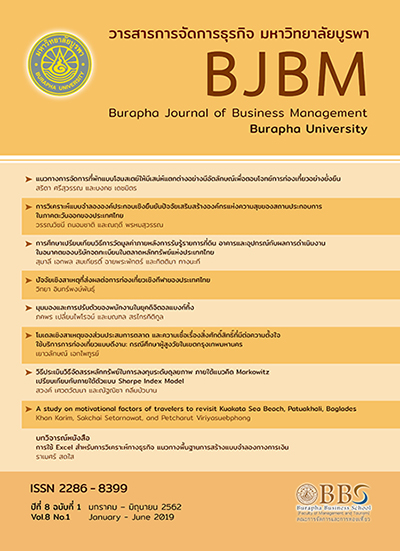
An Empirical Evaluation of Optimal Asset Allocations Under Markowitz Frontier in Comparison with Sharpe Index Model.
Article Sidebar
Main Article Content
Abstract
The objective of this research is to verity the concept of asset allocation under Markowitz efficient frontier and Sharpe’s Index model. The research methodology centers on the calculus of optimization with the investor objective function and certain constraints involving seven step of calculation.Under Markowitz theory, the key variables involved : expected returns, variances, standard deviation, co-variance and co-efficient of correlation. On the other hand, the Sharpe model make use of beta () and unsystematic error terms. All these parameters are calculated using the common stocks randomly selected from the stock exchange market of Thailand.
The sample of fifteen portfolios of common stocks divided into three stocks each indicates very similar coefficients of the asset allocation under the two selected models. This consistency of asset allocation between the two models answers the third objective of this study that the allocation among the stocks from the stock Exchange of Thailand should epitomize ‘insured asset allocation’ or the momentum TAA.
Article Details
The article to be published in the Burapha Journal of Business Management must not have been previously published in any journal and must not be under consideration by other journals. If copyright infringement is found, or the comments in the articles are contrary to ethics, it is deemed to be the opinion and direct responsibility of the article’s authors, not the opinion or responsibility of the Burapha Business School, Burapha University. Wanting to publicize any content in the Burapha Journal of Business Management, permission must be obtained from the editorial team of the Burapha Journal of Business Management according to the copyright laws.
