Network Management System for Cooperation in Promoting Sustainable Development of the Multi-campuses under the Office of the Secondary Education Service Area, Chiang Mai
DOI:
https://doi.org/10.14456/psruhss.2025.3Keywords:
Management system, Cooperation network, Promoting sustainable development, Multi-campusesAbstract
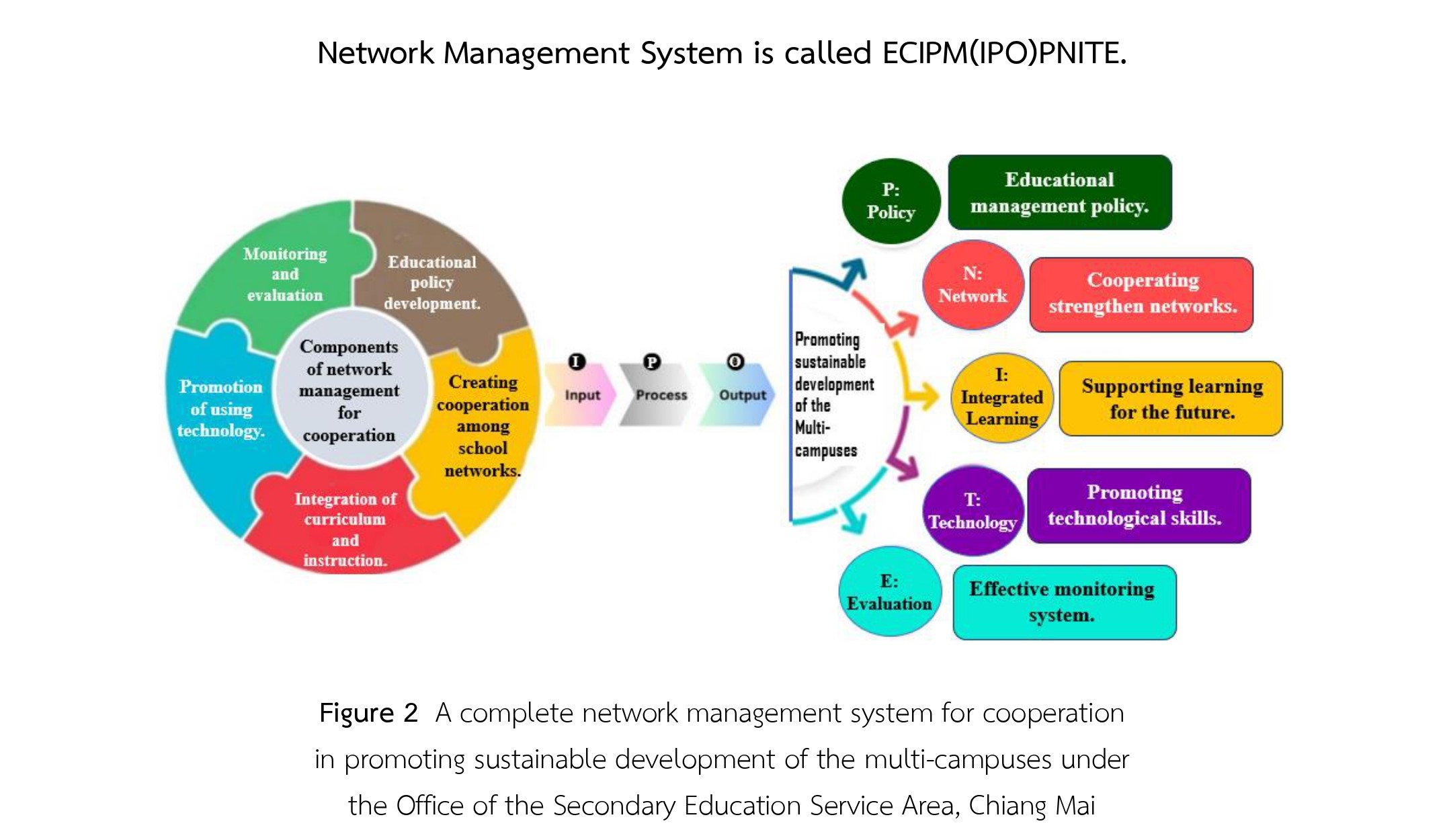
The purposes of this multi-phase mixed methods research were: 1) to study the components of the network management for cooperation in promoting sustainable development; 2) to investigate the current conditions, problems, and factors contributing to success of the network management for cooperation in promoting sustainable development; and 3) to develop a network management system for cooperation in promoting sustainable development of the multi-campuses under the Office of the Secondary Education Service Area, Chiang Mai. Key informants consisted of 65 experts, and the research instruments included a synthesis table of components, a confirmation form, a semi-structured interview form, a verifying form of correction and appropriateness, and an evaluation form of possibility and utility. Statistical analyses included frequency, percentage, mean, standard deviation, and content analysis. The results revealed that: 1. The network management for cooperation consisted of five core components after confirmation as follows: educational policy development, creating cooperation among school networks, Integration of curriculum and instructional management, promotion of using technology, and monitoring and evaluation. 2. The current conditions are that the multi-campus faces challenges such as unclear implementation and personnel readiness. Problems are insufficient goal setting, resource support, coordination, delays, and technology adoption. Factors contributing to success require clear policies, adequate resources, and continuous progress evaluation. 3. The development of the network management system for cooperation based on system theory (IPO) in promoting sustainable development of the multi-campuses under the Office of the Secondary Education Service Area, Chiang Mai, consisted of five aspects as follows: educational management policy, cooperating strengthens networks, supporting learning for the future, promoting technological skills, and effective monitoring system. The percentage of correction was at 92.51 and the appropriateness was at 96.79. The possibility and utility overall and in each aspect were at the highest level.
References
Chaichana, P., & Supising, J. (2024). Academic Cooperation Network Administration of Educational Institutions. Refereed Proceedings of the 25th. National Academic Conference and Research Presentations, Western University", 23rd. December 2024. (pp. 168 - 178). Phathum Thani: Western University. [In Thai]
Galais, C., Fernández‐Martínez, J. L., Font, J., & Smith, G. (2021). Testing the input‐process‐output model of public participation. European Journal of Political Research, 60(4), 807 - 828. https://doi.org/10.1111/1475-6765.12427
Gqwabaza, N., & Maqoqa, T. (2024). The Role of Collaboration and Networking in the Digital Age: Students’ Perspectives. E-Journal of Humanities, Arts and Social Sciences (EHASS), 5(11), 1757 - 1769. https://doi.org/10.38159/ehass.202451111
Jenjarrussakul, B., Senasu, K., Sritanyarat, D., & Petchsawang, P. (2024). Thai Public Administration Towards Sustainable Development. Humanities and Social Sciences Journal of Pibulsongkram Rajabhat University, 18(1), 72 – 88. https://doi.org/10.14456/psruhss.2024.6 [In Thai]
Office of the Education Council, Ministry of Education. (2017). National Education Plan 2017 – 2036. Retrieved from https://www.onec.go.th/index.php/book/BookView/1540
Pino-Yancovic, M., Parrao, C. G., Ahumada, L., & Gonzalez, A. (2019). Promoting collaboration in a competitive context: school improvement networks in Chile. Journal of educational administration, 58(2), 208 - 226. https://doi.org/10.1108/JEA-11-2018-0213
Supising, J., Boonrawd, S., Taweeboonyawat, S., Chaichana, P., Khomwarn, S., & Kanrha, J. (2024). The Problem States of school administration in driving the Sustainable development Goals (SDGs) and the Factors Supporting the Success of Driving the Sustainable development Goals (SDGs). Refereed Proceedings of the 23th. National Academic Conference and Research Presentations, Western University", 25rd. December 2023. (pp. 348-358). Phathum Thani: Western University. [In Thai]
Supising, J., Boonrawd, S., Taweeboonyawat, S., Chaichana, P., Puthaprasert, C., & Kosanpipat, S. (2024). School Administration Model in Driving the Sustainable development Goals (SDGs). Interdisciplinary Research Review, 19(4), 39-51. Retrieved from https://ph02.tci-thaijo.org/index.php/jtir/article/view/251203
Supising, J., Kosanpipat, S., Puthaprasert, C., & Poungkaew, P. (2023). Develop a Driving System of Management in Work-Integrated Education for Rajabhat Universities in the Upper Northern Region. Interdisciplinary Research Review, 18(2), 27-34. https://ph02.tci-thaijo.org/index.php/jtir/issue/download/16939/4194#page=31
Tangchitcharoenkhul, R., Srisai, J., & Tangjitjaroenkun, J. (2024). Factors Affecting to the Success of Cooperative Networking for Elevating of Educational Provision Efficiency at Early Childhood Level under Local Administrative Organization. Journal of Education and Innovation, 26(4), 285 – 301. https://so06.tci-thaijo.org/index.php/edujournal_nu/article/view/269247/185635 [In Thai]
Theerangsu, K., & Chanawongse, A. (2021). The Guideline for Development of Network Cooperation for Schools under the Office of Secondary Educational Service Area 24. Journal of Roi Et Rajabhat University, 15(2), 20 – 30. https://so03.tci-thaijo.org/index.php/reru/article/view/230483 [In Thai]
UNESCO. (2024). What you need to know about education for sustainable development. Retrieved from https://www.unesco.org/en/sustainable-development/education/need-know
UNESCO. (2024). What you need to know about UNESCO Associated Schools Network. Retrieved from https://www.unesco.org/en/aspnet/need-know
Downloads
Published
How to Cite
Issue
Section
License
Copyright (c) 2025 Humanities and Social Sciences Journal of Pibulsongkram Rajabhat University

This work is licensed under a Creative Commons Attribution-NonCommercial-NoDerivatives 4.0 International License.
Any articles or comments appearing in the Journal of Humanities and Social Sciences, Rajabhat Phibulsongkram University, are the intellectual property of the authors, and do not necessarily reflect the views of the editorial board. Published articles are copyrighted by the Journal of Humanities and Social Sciences, Rajabhat Phibulsongkram University.