
A Comparison of Decision-making (Effectuation and Causation) Strategies during the Innovation Diffusion: A Simulation-Based Approach
DOI:
https://doi.org/10.14456/psruhss.2025.5Keywords:
Effectuation, Causation, Strategic decision-making, Innovation diffusion, NKC modelAbstract
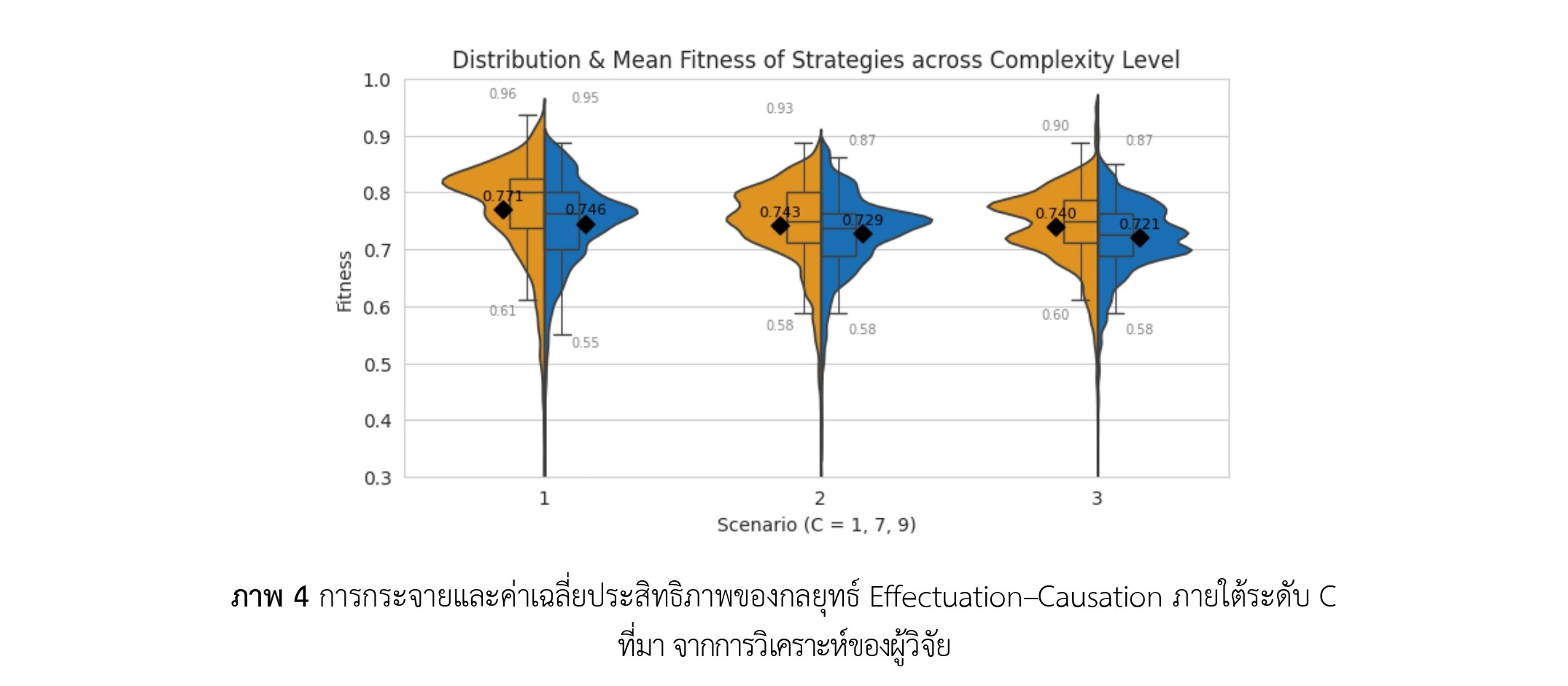
This study aims to (1) compare the strategic performance of decision-making approaches based on effectuation and causation under varying levels of environmental complexity and volatility; (2) assess the consistency of their outcomes; and (3) evaluate the performance of both strategies across the Pre- and Post-Chasm phases of innovation diffusion. The research employed an NKC model with strategic decision components N = 10 and internal coupling (K) values of 2 and 5 representing the two strategies respectively under simulation scenarios with complexity values C = 1, 7, 9 and volatility values co = –0.1, –0.7, –0.9, conducting 100 time steps and 100 Monte Carlo replications per strategy in each scenario. The findings reveal that the effectuation strategy consistently outperforms causation across all complexity levels, with statistically significant differences in average fitness (***p < 0.001) and corresponding performance gaps (Δ = +0.025, +0.014, and +0.019, respectively). While both strategies yielded comparable outcomes during the Pre-Chasm phase (p > 0.05), effectuation exhibited superior performance across all scenarios in the Post-Chasm phase (Δ = +0.030, +0.017, and +0.022). Moreover, the variance in fitness decreased over time, converging to a narrow range (≈ 0.002–0.003), suggesting enhanced long-term stability. A key insight is that the effectuation strategy can reduce early-stage volatility and foster long-term strategic stability. The emergence of strategic inflection points, evidenced by mean fitness trajectories and variance levels, underscores the importance of detecting critical market transition signals to enable timely and appropriate strategic adaptation.
References
Aggrey, O. K., Djan, A. K., Antoh, N. a. D., & Tettey, L. N. (2021b). “Dodging the bullet” are effectual managers better off in a crisis? A case of Ghanaian agricultural SMEs. Journal of Enterprising Communities People and Places in the Global Economy, 15(5), 755 – 772. https//doi.org/10.1108/jec-02-2021-0021
Alzamora-Ruiz, J., Del Mar Fuentes-Fuentes, M., & Martinez-Fiestas, M. (2021). Together or separately? Direct and synergistic effects of Effectuation and Causation on innovation in technology-based SMEs. International Entrepreneurship and Management Journal, 17(4), 1917 – 1943. https//doi.org/10.1007/s11365-021-00743-9
Arend, R. J. (2022). Balancing the perceptions of NK modelling with critical insights. Journal of Innovation and Entrepreneurship, 11(1), 23. https//doi.org/10.1186/s13731-022-00212-9
Autio, E., & Thomas, L. D. (2022). Researching ecosystems in innovation contexts. Innovation & Management Review, 19(1), 12 - 25. DOI10.1108/INMR-08-2021-0151
Autio, E., Nambisan, S., Thomas, L. D., & Wright, M. (2018). Digital affordances, spatial affordances, and the genesis of entrepreneurial ecosystems. Strategic Entrepreneurship Journal, 12(1), 72-95. https//papers.ssrn.com/sol3/Delivery.cfm?abstractid=3003540
Baimai, C. (2021). Systems approach to modern business administration. Parichart Journal, [online]. Retrieved from https://so05.tci-thaijo.org/index.php/parichartjournal/article/view/242363
Baumann, O., Schmidt, J., & Stieglitz, N. (2019). Effective search in rugged performance landscapes: A review and outlook. Journal of Management, 45(1), 285-318. https://doi.org/10.1177/0149206318808594
Berends, H., Jelinek, M., Reymen, I., & Stultiëns, R. (2014). Product innovation processes in small firms Combining entrepreneurial effectuation and managerial causation. Journal of Product Innovation Management, 31(3), 616 - 635. https//doi.org/10.1111/jpim.12117
Bollen, K. A., & Lilly, A. G. (2023). Continuity and change in methodology in social forces. Social Forces, 101(3), 1069-1080. https://doi.org/10.1093/sf/soac133
Bull, L. (2022). Nonbinary Representations in the NK and NKCS Models. Complex Systems, 31(1), 87 – 101. https//doi.org/10.25088/ComplexSystems.31.1.87
Cavusgil, S. T., & Deligonul, S. Z. (2025). Dynamic capabilities framework and its transformative contributions. Journal of International Business Studies, 56(1), 33 - 42. https//doi.org/10.1057/s41267-024-00758-8
Chandler, G. N., DeTienne, D. R., McKelvie, A., & Mumford, T. V. (2011). Causation and effectuation processes A validation study. Journal of Business Venturing, 26(3), 375 - 390. https//doi.org/10.1016/j.jbusvent.2009.10.006
Chen, N. (2021). Behind clubhouse’s trajectory and phenom. College of Alameda. June. Retrieved from https//doi.org/10.20944/preprints202106.0103.v1
Christensen, C., Hall, T., Dillon, K., & Duncan, D. S. (2016). Competing against luck. The story of innovation and customer choice. First edition. New York, NY HarperBusiness an imprint of HarperCollins Publishers. Retrieved from https//onlinemarketingmoment.wordpress.com/wp-content/uploads/2016/11/pdf-take-aways.pdf
Cristofaro, M., Helfat, C. E., & Teece, D. J. (2025). Adapting, Shaping, Evolving Refocusing on the Dynamic Capabilities–Environment Nexus. Academy of Management Collections, 4(1), 20 - 46. https//doi.org/10.5465/amc.2022.0008
Frattini, F., Dell'Era, C., & Landoni, P. (2022). Crossing the chasm Product innovation strategy and the role of lead users in the post-adoption stage. Journal of Product Innovation Management, 39(1), 121 - 143.
Ganco, M., & Agarwal, R. (2009). Performance differentials between diversifying entrants and entrepreneurial start-ups A complexity approach. Academy of Management Review, 34(2), 228 – 252. https//doi.org/10.5465/amr.2009.36982618
Ganco, M., & Hoetker, G. (2009). NK modeling methodology in the strategy literature Bounded search on a rugged landscape. In Research methodology in strategy and management (pp. 237-268). Emerald Group Publishing Limited. https//doi.org/10.1108/S1479-8387(2009)0000005010
Guo, R. (2018). Strategic decision-making logics, entrepreneurial capability and opportunity exploitation in high-tech new ventures. Journal of Business Economics and Management, 19(2), 235 - 252. https//doi.org/10.3846/jbem.2018.5201
Hordijk, W., & Kauffman, S. A. (2005). Correlation analysis of coupled fitness landscapes. Complexity, 10(6), 41 – 49. https//doi.org/10.1002/cplx.20092
Kauffman, S. A. (1993). The Origins of Order Self-Organization and Selection in Evolution. New York/Oxford Oxford University Press.
Leenawong, C., & Wattanasiripong, N. (2005). Replacement Algorithms for the Multiple Complex-System Model. Current Applied Science and Technology, 5(1), 329 - 338. retrieved from https//li01.tci-thaijo.org/index.php/cast/article/view/162314
Levinthal, D. A. (1997). Adaptation on rugged landscapes. Management Science, 43(7), 934 – 950. https//doi.org/10.1287/mnsc.43.7.934
Mahr, A., Cichon, M., Mateo, S., Grajeda, C., & Baggili, I. (2021). Zooming into the pandemic!
A forensic analysis of the Zoom Application. Forensic Science International Digital Investigation, 36, 301107. https//doi.org/10.1016/j.fsidi.2021.301107
McKelvey, B. (2004). Toward a complexity science of entrepreneurship. Journal of Business Venturing, 19(3), 313 – 341. https//doi.org/10.1016/S0883-9026(03)00034-X
Moore, G. A. (1991). Crossing the chasm Marketing and selling high-tech products to mainstream customers. Harper Business. Retrieved from http//soloway.pbworks.com/w/file/fetch/46715502/Crossing-The-Chasm.pdf
Osiyevskyy, O., Shirokova, G., & Ehsani, M. (2023). The role of effectuation and causation for SME survival amidst economic crisis. International Journal of Entrepreneurial Behavior & Research, 29(7), 1664 - 1697. https//doi.org/10.1108/IJEBR-04-2022-0350
Rogers, E. M. (1962). Diffusion of innovations. Free Press. Retrieved from https//books.google.com/books?id=9U1K5LjUOwEC
Rogers, E. M. (2003). Diffusion of innovations (5th ed.). New York, NY Free Press. Retrieved from https//books.google.com/books?id=9U1K5LjUOwEC
Sarasvathy, S. D. (2008). Effectuation Elements of entrepreneurial expertise. Edward Elgar Publishing. https//doi.org/10.4337/9781848440197
Sarasvathy, S. D. (2001). Causation and effectuation. Academy of Management Review, 26(2), 243–263. https//doi.org/10.5465/amr.2001.4378020
Shirokova, G., Osiyevskyy, O., Laskovaia, A., & MahdaviMazdeh, H. (2020). Navigating the emerging market context Performance implications of Effectuation and Causation for SMEs during adverse economic conditions in Russia. Strategic Entrepreneurship Journal, 14(3), 470-500. https//doi.org/10.1002/sej.1353
Snowden, D. J., & Boone, M. E. (2007). A leader’s framework for decision making. Harvard Business Review, 85(11), 68–76.
Vanderstraeten, J., Hermans, J., van Witteloostuijn, A., & Dejardin, M. (2020). SME innovativeness in a dynamic environment Is there any value in combining Causation and Effectuation? Technology Analysis & Strategic Management, 32(5), 543 - 556. https//doi.org/10.1080/09537325.2020.1766672
Vidgen, R., & Bull, L. (2011). Applications of Kauffman’s coevolutionary NKCS model to management and organization studies. The sage handbook of complexity and management, 201-218.
Welter, C., & Kim, S. (2018). Effectuation under risk and uncertainty A simulation model. Journal of Business Venturing, 33(1), 100 – 116. https//doi.org/10.1016/j.jbusvent.2017.11.005
Yu, X., Tao, Y., Tao, X., Xia, F., & Li, Y. (2018). Managing uncertainty in emerging economies The interaction effects between Causation and Effectuation on firm performance. Technological Forecasting and Social Change, 135, 121 - 131. https//doi.org/10.1016/j.techfore.2017.11.017
Downloads
Published
How to Cite
Issue
Section
License
Copyright (c) 2025 Humanities and Social Sciences Journal of Pibulsongkram Rajabhat University

This work is licensed under a Creative Commons Attribution-NonCommercial-NoDerivatives 4.0 International License.
Any articles or comments appearing in the Journal of Humanities and Social Sciences, Rajabhat Phibulsongkram University, are the intellectual property of the authors, and do not necessarily reflect the views of the editorial board. Published articles are copyrighted by the Journal of Humanities and Social Sciences, Rajabhat Phibulsongkram University.