
การเปรียบเทียบกลยุทธ์การตัดสินใจ (แบบอิงผลลัพธ์และแบบอิงเหตุ - ผล) ในการแพร่กระจายนวัตกรรม แบบจำลองเชิงสถานการณ์
DOI:
https://doi.org/10.14456/psruhss.2025.5คำสำคัญ:
กลยุทธ์แบบอิงผลลัพธ์ , กลยุทธ์แบบอิงเหตุ-ผล , การตัดสินใจเชิงกลยุทธ์ , การแพร่กระจายนวัตกรรม , แบบจำลอง NKCบทคัดย่อ
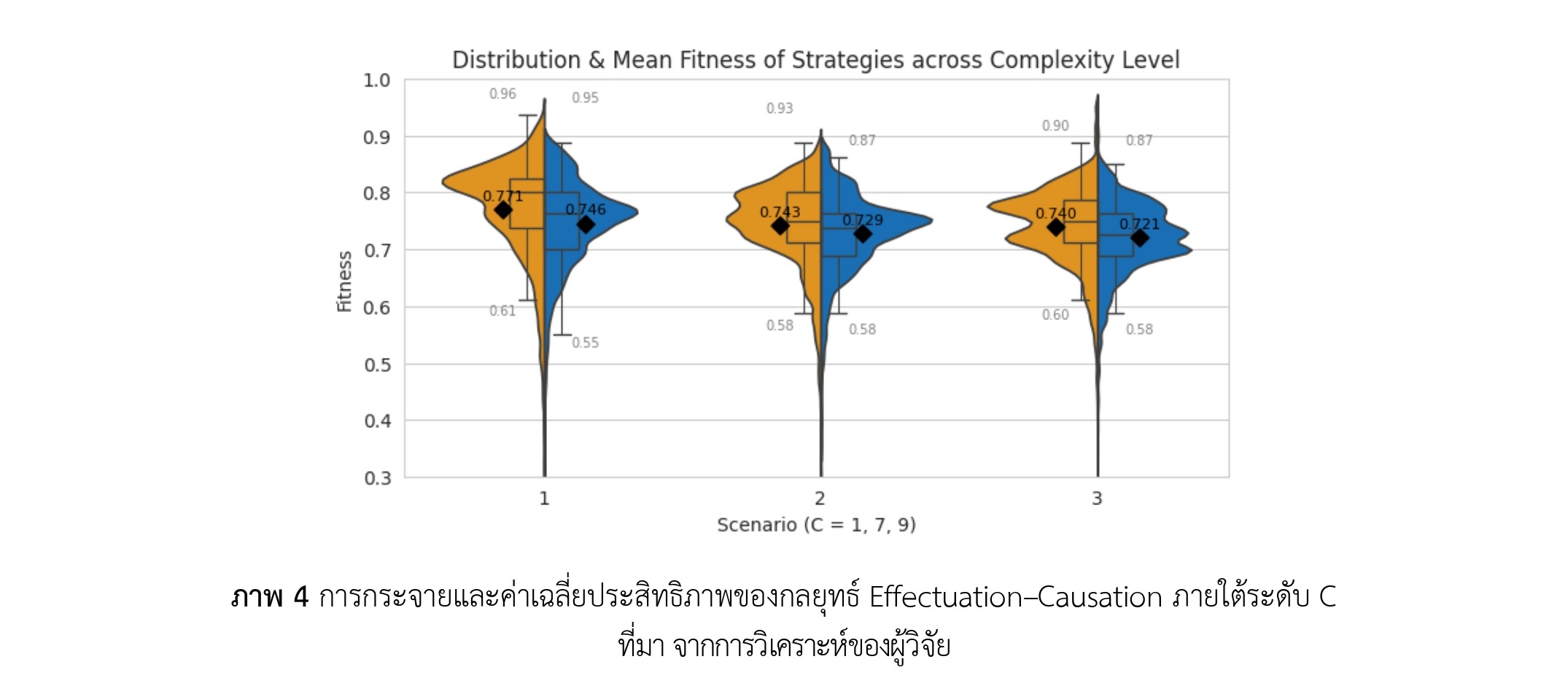
การวิจัยนี้มีวัตถุประสงค์เพื่อ (1) เปรียบเทียบประสิทธิภาพของกลยุทธ์การตัดสินใจแบบอิงผลลัพธ์และแบบอิงเหตุ-ผลในสถานการณ์จำลองที่มีระดับความซับซ้อน (C) และความผันผวน (co) ต่างกัน (2) เปรียบเทียบความสม่ำเสมอของผลลัพธ์ของกลยุทธ์และ (3) เปรียบเทียบประสิทธิภาพของกลยุทธ์ทั้งสองแบบระหว่างช่วงเวลาก่อนและหลังการข้ามจุดเปลี่ยนเชิงกลยุทธ์ การศึกษานี้ใช้แบบจำลอง NKC มีจำนวนองค์ประกอบกลยุทธ์ N = 10 และค่าความเชื่อมโยงภายใน (K) เท่ากับ 2 และ 5 แทนกลยุทธ์ทั้งสองตามลำดับ ภายใต้สถานการณ์จำลองที่มีค่าความซับซ้อน C = 1, 7, 9 และค่าความผันผวน co = –0.1, –0.7, –0.9 ทำการจำลอง 100 ขั้นตอนเวลาและทำซ้ำ 100 รอบด้วยวิธีมอนติคาร์โลต่อกลยุทธ์ในแต่ละสถานการณ์ ผลการวิจัยพบว่า กลยุทธ์แบบอิงผลลัพธ์ให้ค่าประสิทธิภาพเฉลี่ยสูงกว่าแบบอิงเหตุ-ผลอย่างมีนัยสำคัญในทุกระดับของความซับซ้อน (***p < 0.001) โดยมีค่าผลต่างเฉลี่ย Δ เท่ากับ + 0.025, + 0.014 และ + 0.019 ตามลำดับ ช่วงก่อนข้ามจุดเปลี่ยนเชิงกลยุทธ์ ทั้งสองกลยุทธ์มีผลลัพธ์ใกล้เคียงกัน (p > 0.05) แต่ในช่วงหลัง กลยุทธ์แบบอิงผลลัพธ์ให้ค่าฟิตเนสสูงกว่าในทุกสถานการณ์ (Δ = + 0.030, + 0.017, + 0.022) และมีความแปรปรวนลดลงจนใกล้เคียงกัน (≈ 0.002 – 0.003) ผลการวิจัยชี้ว่า กลยุทธ์แบบอิงผลลัพธ์สามารถลดความผันผวนในระยะต้นและสร้างความเสถียรเชิงกลยุทธ์ในระยะยาวการเกิดจุดสลับกลยุทธ์ปรากฎในรูปแบบค่าเฉลี่ยฟิตเนสและระดับความแปรปรวน สะท้อนถึงความสำคัญของการตรวจจับสัญญาณจุดเปลี่ยนผ่านที่สำคัญของตลาดเพื่อให้สามารถปรับกลยุทธ์ได้ทันอย่างเหมาะสม
เอกสารอ้างอิง
Aggrey, O. K., Djan, A. K., Antoh, N. a. D., & Tettey, L. N. (2021b). “Dodging the bullet” are effectual managers better off in a crisis? A case of Ghanaian agricultural SMEs. Journal of Enterprising Communities People and Places in the Global Economy, 15(5), 755 – 772. https//doi.org/10.1108/jec-02-2021-0021
Alzamora-Ruiz, J., Del Mar Fuentes-Fuentes, M., & Martinez-Fiestas, M. (2021). Together or separately? Direct and synergistic effects of Effectuation and Causation on innovation in technology-based SMEs. International Entrepreneurship and Management Journal, 17(4), 1917 – 1943. https//doi.org/10.1007/s11365-021-00743-9
Arend, R. J. (2022). Balancing the perceptions of NK modelling with critical insights. Journal of Innovation and Entrepreneurship, 11(1), 23. https//doi.org/10.1186/s13731-022-00212-9
Autio, E., & Thomas, L. D. (2022). Researching ecosystems in innovation contexts. Innovation & Management Review, 19(1), 12 - 25. DOI10.1108/INMR-08-2021-0151
Autio, E., Nambisan, S., Thomas, L. D., & Wright, M. (2018). Digital affordances, spatial affordances, and the genesis of entrepreneurial ecosystems. Strategic Entrepreneurship Journal, 12(1), 72-95. https//papers.ssrn.com/sol3/Delivery.cfm?abstractid=3003540
Baimai, C. (2021). Systems approach to modern business administration. Parichart Journal, [online]. Retrieved from https://so05.tci-thaijo.org/index.php/parichartjournal/article/view/242363
Baumann, O., Schmidt, J., & Stieglitz, N. (2019). Effective search in rugged performance landscapes: A review and outlook. Journal of Management, 45(1), 285-318. https://doi.org/10.1177/0149206318808594
Berends, H., Jelinek, M., Reymen, I., & Stultiëns, R. (2014). Product innovation processes in small firms Combining entrepreneurial effectuation and managerial causation. Journal of Product Innovation Management, 31(3), 616 - 635. https//doi.org/10.1111/jpim.12117
Bollen, K. A., & Lilly, A. G. (2023). Continuity and change in methodology in social forces. Social Forces, 101(3), 1069-1080. https://doi.org/10.1093/sf/soac133
Bull, L. (2022). Nonbinary Representations in the NK and NKCS Models. Complex Systems, 31(1), 87 – 101. https//doi.org/10.25088/ComplexSystems.31.1.87
Cavusgil, S. T., & Deligonul, S. Z. (2025). Dynamic capabilities framework and its transformative contributions. Journal of International Business Studies, 56(1), 33 - 42. https//doi.org/10.1057/s41267-024-00758-8
Chandler, G. N., DeTienne, D. R., McKelvie, A., & Mumford, T. V. (2011). Causation and effectuation processes A validation study. Journal of Business Venturing, 26(3), 375 - 390. https//doi.org/10.1016/j.jbusvent.2009.10.006
Chen, N. (2021). Behind clubhouse’s trajectory and phenom. College of Alameda. June. Retrieved from https//doi.org/10.20944/preprints202106.0103.v1
Christensen, C., Hall, T., Dillon, K., & Duncan, D. S. (2016). Competing against luck. The story of innovation and customer choice. First edition. New York, NY HarperBusiness an imprint of HarperCollins Publishers. Retrieved from https//onlinemarketingmoment.wordpress.com/wp-content/uploads/2016/11/pdf-take-aways.pdf
Cristofaro, M., Helfat, C. E., & Teece, D. J. (2025). Adapting, Shaping, Evolving Refocusing on the Dynamic Capabilities–Environment Nexus. Academy of Management Collections, 4(1), 20 - 46. https//doi.org/10.5465/amc.2022.0008
Frattini, F., Dell'Era, C., & Landoni, P. (2022). Crossing the chasm Product innovation strategy and the role of lead users in the post-adoption stage. Journal of Product Innovation Management, 39(1), 121 - 143.
Ganco, M., & Agarwal, R. (2009). Performance differentials between diversifying entrants and entrepreneurial start-ups A complexity approach. Academy of Management Review, 34(2), 228 – 252. https//doi.org/10.5465/amr.2009.36982618
Ganco, M., & Hoetker, G. (2009). NK modeling methodology in the strategy literature Bounded search on a rugged landscape. In Research methodology in strategy and management (pp. 237-268). Emerald Group Publishing Limited. https//doi.org/10.1108/S1479-8387(2009)0000005010
Guo, R. (2018). Strategic decision-making logics, entrepreneurial capability and opportunity exploitation in high-tech new ventures. Journal of Business Economics and Management, 19(2), 235 - 252. https//doi.org/10.3846/jbem.2018.5201
Hordijk, W., & Kauffman, S. A. (2005). Correlation analysis of coupled fitness landscapes. Complexity, 10(6), 41 – 49. https//doi.org/10.1002/cplx.20092
Kauffman, S. A. (1993). The Origins of Order Self-Organization and Selection in Evolution. New York/Oxford Oxford University Press.
Leenawong, C., & Wattanasiripong, N. (2005). Replacement Algorithms for the Multiple Complex-System Model. Current Applied Science and Technology, 5(1), 329 - 338. retrieved from https//li01.tci-thaijo.org/index.php/cast/article/view/162314
Levinthal, D. A. (1997). Adaptation on rugged landscapes. Management Science, 43(7), 934 – 950. https//doi.org/10.1287/mnsc.43.7.934
Mahr, A., Cichon, M., Mateo, S., Grajeda, C., & Baggili, I. (2021). Zooming into the pandemic!
A forensic analysis of the Zoom Application. Forensic Science International Digital Investigation, 36, 301107. https//doi.org/10.1016/j.fsidi.2021.301107
McKelvey, B. (2004). Toward a complexity science of entrepreneurship. Journal of Business Venturing, 19(3), 313 – 341. https//doi.org/10.1016/S0883-9026(03)00034-X
Moore, G. A. (1991). Crossing the chasm Marketing and selling high-tech products to mainstream customers. Harper Business. Retrieved from http//soloway.pbworks.com/w/file/fetch/46715502/Crossing-The-Chasm.pdf
Osiyevskyy, O., Shirokova, G., & Ehsani, M. (2023). The role of effectuation and causation for SME survival amidst economic crisis. International Journal of Entrepreneurial Behavior & Research, 29(7), 1664 - 1697. https//doi.org/10.1108/IJEBR-04-2022-0350
Rogers, E. M. (1962). Diffusion of innovations. Free Press. Retrieved from https//books.google.com/books?id=9U1K5LjUOwEC
Rogers, E. M. (2003). Diffusion of innovations (5th ed.). New York, NY Free Press. Retrieved from https//books.google.com/books?id=9U1K5LjUOwEC
Sarasvathy, S. D. (2008). Effectuation Elements of entrepreneurial expertise. Edward Elgar Publishing. https//doi.org/10.4337/9781848440197
Sarasvathy, S. D. (2001). Causation and effectuation. Academy of Management Review, 26(2), 243–263. https//doi.org/10.5465/amr.2001.4378020
Shirokova, G., Osiyevskyy, O., Laskovaia, A., & MahdaviMazdeh, H. (2020). Navigating the emerging market context Performance implications of Effectuation and Causation for SMEs during adverse economic conditions in Russia. Strategic Entrepreneurship Journal, 14(3), 470-500. https//doi.org/10.1002/sej.1353
Snowden, D. J., & Boone, M. E. (2007). A leader’s framework for decision making. Harvard Business Review, 85(11), 68–76.
Vanderstraeten, J., Hermans, J., van Witteloostuijn, A., & Dejardin, M. (2020). SME innovativeness in a dynamic environment Is there any value in combining Causation and Effectuation? Technology Analysis & Strategic Management, 32(5), 543 - 556. https//doi.org/10.1080/09537325.2020.1766672
Vidgen, R., & Bull, L. (2011). Applications of Kauffman’s coevolutionary NKCS model to management and organization studies. The sage handbook of complexity and management, 201-218.
Welter, C., & Kim, S. (2018). Effectuation under risk and uncertainty A simulation model. Journal of Business Venturing, 33(1), 100 – 116. https//doi.org/10.1016/j.jbusvent.2017.11.005
Yu, X., Tao, Y., Tao, X., Xia, F., & Li, Y. (2018). Managing uncertainty in emerging economies The interaction effects between Causation and Effectuation on firm performance. Technological Forecasting and Social Change, 135, 121 - 131. https//doi.org/10.1016/j.techfore.2017.11.017
ดาวน์โหลด
เผยแพร่แล้ว
รูปแบบการอ้างอิง
ฉบับ
ประเภทบทความ
สัญญาอนุญาต
ลิขสิทธิ์ (c) 2025 วารสารมนุษยศาสตร์และสังคมศาสตร์ มหาวิทยาลัยราชภัฏพิบูลสงคราม

อนุญาตภายใต้เงื่อนไข Creative Commons Attribution-NonCommercial-NoDerivatives 4.0 International License.
บทความหรือข้อคิดเห็นใดใดที่ปรากฏในวารสารมนุษยศาสตร์และสังคมศาสตร์ มหาวิทยาลัยราชภัฏพิบูลสงครามเป็นวรรณกรรมของผู้เขียน ซึ่งบรรณาธิการไม่จำเป็นต้องเห็นด้วย บทความที่ได้รับการตีพิมพ์เป็นลิขสิทธิ์ของวารสารมนุษยศาสตร์และสังคมศาสตร์ มหาวิทยาลัยราชภัฏพิบูลสงคราม