Tourism Promotion of Carrying Capacity for Satun UNESCO Global Geopark
DOI:
https://doi.org/10.14456/psruhss.2026.6Keywords:
Tourism promotion, Carrying capacity, Satun unesco global geopark, Tourism management, Sustainable tourismAbstract
The research project titled “Tourism Promotion of Carrying Capacity for Satun UNESCO Global Geopark” aimed to; 1) assess the tourism carrying capacity within Satun UNESCO Global Geopark; 2) study measures to regulate the number of tourists at a sustainable level that does not cause damage to tourist sites within the Geopark through participatory approaches; and 3) propose a suitable mechanism to lower the impact of visitors of the Satun UNESCO Global Geopark. using a mixed-methods research design incorporating both qualitative and quantitative approaches. Data collection instruments included assessment forms, questionnaires, interview protocols, focus group discussions, and workshops. The study involved 30 key informants consisting of community representatives, tourism entrepreneurs, government agencies, and local stakeholders and a sample of 400 tourists aged 20 and above who had visited the geopark. Data were analyzed using both descriptive and inferential statistics.
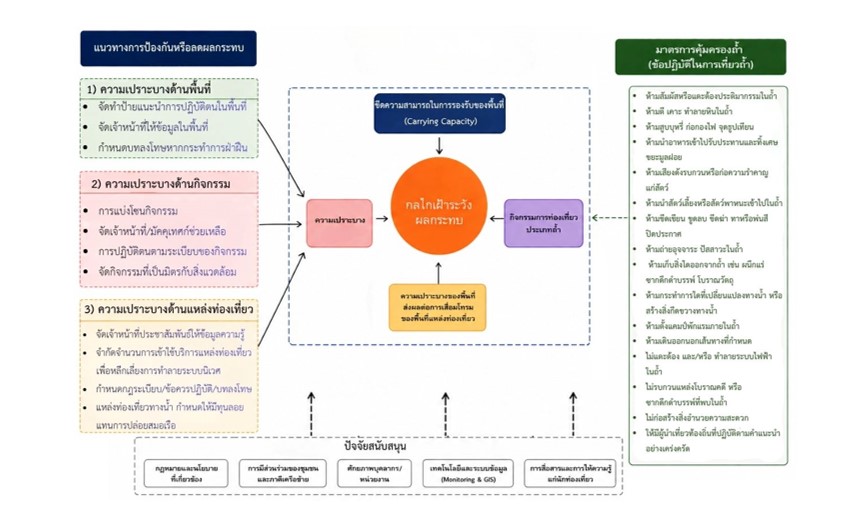
The study results revealed that the tourism carrying capacity (CC) indicators of the Satun UNESCO Global Geopark were classified as follows: 1) ecological/geological aspects were at the "At and Approach CC" level; 2) physical aspects were at the "Exceed CC" level; 3) psychological aspects were at the " Below CC, Exceed CC, At and Approach CC " level; 4) economic aspects were at the "At and Approach CC" level; 5) sociocultural aspects across all three dimensions were at the "Below CC" level; and 6) most facility aspects were at the "Below CC" level. The tourist volume control measures comprised: 1) management measures, 2) safety measures, and 3) rules and regulations. Regarding the appropriate impact-monitoring mechanism for visitor capacity, the study suggests establishing recreational activity zoning, installing warning and interpretive signage, constructing designated walkways for fossil-viewing, stationing on-site staff, and implementing visitor safety systems. Therefore, relevant agencies should determine tourist spatial carrying capacities to promote conservation and prevent impacts that pose risks and damages to tourism resources within the Satun UNESCO Global Geopark.
References
กรมการท่องเที่ยว. (2563). คู่มือการบริหารจัดการแหล่งท่องเที่ยวเชิงสร้างสรรค์. https://www.dot.go.th/storage/3_01_2562/JiIBmnsOzmzCAgf0M9h83hZ1RoJkUmlPFJA8lTMG.pdf
กรมทรัพยากรธรณี. (2556). การจำแนกเขตเพื่อการจัดการด้านธรณีวิทยาและทรัพยากรธรณีจังหวัดสตูล. กรุงเทพฯ: ออนป้า.
กรมทรัพยากรธรณี. (2558). แผนแม่บทการบริหารจัดการอุทยานธรณีสตูล ภายใต้โครงการจัดทำแนวทางการบริหารจัดการธรณีวิทยา/แหล่งอนุรักษ์ธรณีวิทยาหรืออุทยานธรณีภาคใต้ (จังหวัดสตูล) (รายงานการวิจัย). กรุงเทพฯ: ค็อกคิวเมนท์ พลัส.
กรมอุทยานแห่งชาติ สัตว์ป่า และพันธุ์พืช. (2564). สถิตินักท่องเที่ยวอุทยานแห่งชาติ. https://portal.dnp.go.th/Content/nationalpark?contentId=20014
กองเศรษฐกิจการท่องเที่ยวและกีฬา. (2563). สถิตินักท่องเที่ยวจังหวัดสตูล. กระทรวงการท่องเที่ยวและกีฬา. https://www.mots.go.th/news/category/740
กระทรวงการท่องเที่ยวและกีฬา. (2563). แผนปฏิบัติการเพื่อขับเคลื่อนการท่องเที่ยวสู่การพัฒนาอย่างยั่งยืน. https://www.mots.go.th/images/v2022_1683100352472RmluYWwg4LmA4Lil4LmI4Lih4LmB4Lic4LiZIFNERy5wZGY=.pdf
กระทรวงทรัพยากรธรรมชาติและสิ่งแวดล้อม. (2563). ประกาศคณะกรรมการนโยบายบริหารจัดการถ้ำแห่งชาติเรื่อง ข้อปฏิบัติในการคุ้มครองถ้ำ. https://drive.google.com/file/d/1Vi7S_sTNj2q_5PgCTvO 1OYj2i9vhzh_x/view
การท่องเที่ยวแห่งประเทศไทย. (2562). โครงการเสริมสร้างเครือข่ายทางการท่องเที่ยว “เจ้าบ้านที่ดี”. https://www.dot.go.th/storage/3_01_2562/BVCW4DRQxnOTDokTQQA6EnMuXB4dpxg2sYUpHbbz.pdf.
การท่องเที่ยวแห่งประเทศไทย. (2563). “คาดการณ์สถานการณ์การท่องเที่ยวไทย” 2 April – June 2020. https://tatreviewmagazine.com/e_magazine/vol-6-no-2-april-june-2020-3/
การท่องเที่ยวแห่งประเทศไทย สำนักงานจังหวัดสตูล. (2563). สถานการณ์การท่องเที่ยวสตูล. www.tourismthailand.org/satun
จตุรงค์ คงแก้ว, ภูวดล บุตรรัตน์, นิพนธ์ พงศ์สุวรรณ และพงศ์ธีระ บัวเพ็ชร. (2556). ขีดความสามารถในการรองรับและมาตรการการจัดการท่องเที่ยวแนวปะการังน้ำตื้นเกาะไข่นอก จังหวัดพังงา. วารสารสิ่งแวดล้อมและทรัพยากรธรรมชาติ, 11(1), 70-87.
ดรรชนี เอมพันธุ์, พิมพ์ลภัส พงศกรรังศิลป์ และวันชัย อรุณประภารัตน์. (2562). การกำหนดขีดความสามารถในการรองรับการท่องเที่ยวเพื่อสร้างมาตรฐานการบริหารจัดการแหล่งท่องเที่ยวในพื้นที่หมู่เกาะลันตา จังหวัดกระบี่ (รายงานการวิจัย). กรุงเทพฯ: สำนักงานการวิจัยแห่งชาติ.
นราวดี บัวขวัญ, วนิดา เพ็ชร์ลมุล, และภัชภุล ตรีพันธ์. (2559). ขีดความสามารถในการรองรับของการท่องเที่ยวโดยชุมชนในพื้นที่ 5 จังหวัดชายแดนภาคใต้ (สตูล สงขลา ปัตตานี ยะลา และนราธิวาส). กรุงเทพฯ: สำนักงานคณะกรรมการวิจัยแห่งชาติ และสำนักงานกองทุนสนับสนุนการวิจัย.
นิพล เชื้อเมืองพาน, นิออน ศรีสมยง, ธนธร วชิรขจร, อรวรรณ บุญพัฒน์, และ วงศ์ระวิทย์ น้อมนำทรัพย์. (2563). ศักยภาพและขีดความสามารถในการรองรับได้ของแหล่งท่องเที่ยวน้ำพุร้อนกลุ่มท่องเที่ยวอารยธรรมล้านนา. วารสารศิลปกรรมบูรพา, 23(2), 167-187. https://so01.tci-thaijo.org/index.php/buraphaJ/article/view/246433
เบญจมาศ ณ ทองแก้ว. (2557). การศึกษาขีดความสามารถในการรับรอง (carrying capacity) การท่องเที่ยวโดยชุมชนของเกาะพิทักษ์ จังหวัดชุมพร (รายงานการวิจัย). กรุงเทพฯ: สำนักงานคณะกรรมการวิจัยแห่งชาติ.
ปุณิกา พลอัมพร. (2556). การประเมินขีดความสามารถการรองรับการท่องเที่ยวชายหาดชะอำ จังหวัดเพชรบุรี (วิทยานิพนธ์ปริญญามหาบัณฑิต). นครปฐม: มหาวิทยาลัยมหิดล.
พิมพ์ลภัส พงศกรรังศิลป์, ศิวฤทธิ์ พงศกรรังศิลป์, กนกวรรณ แก้วอุไทย, สุทธิณี พรพันธุ์ไพบูลย์ และสุรศักดิ์ ชูทอง. (2562). การกำหนดขีดความสามารถในการรองรับการท่องเที่ยวด้านกายภาพ จิตวิทยา สังคม วัฒนธรรมและเศรษฐกิจของแหล่งท่องเที่ยวในหมู่เกาะลันตา จังหวัดกระบี่ (รายงานการวิจัย). กรุงเทพฯ: สำนักงานคณะกรรมการส่งเสริมวิทยาศาสตร์ วิจัยและนวัตกรรม (สกสว.).
ภาควิชาวิทยาศาสตร์ทางทะเล คณะประมง มหาวิทยาลัยเกษตรศาสตร์. (2561). โครงการศึกษาขีดความสามารถในการรองรับการใช้ประโยชน์ ด้านนันทนาการในพื้นที่อุทยานแห่งชาติหาดนพรัตน์ธารา- หมู่เกาะพีพี จังหวัดกระบี่ (รายงานการวิจัย). กรุงเทพฯ: มหาวิทยาลัยเกษตรศาสตร์.
อรอนงค์ เฉียบแหลม, ปวิธ ตันสกุล, บุศรินทร์ นันทะเขต และศิรินันท์ พันธรักษ์. (2563). การพัฒนาแนวทางในการอนุรักษ์ฐานทรัพยากรและการสื่อความหมายธรรมชาติ ในอุทยานธรณีโลกสตูล (รายงานการวิจัย). กรุงเทพฯ: สำนักงานคณะกรรมการส่งเสริมวิทยาศาสตร์ วิจัยและนวัตกรรม (สกสว.).
อารยา จันทร์สกุล. (2561). Overtourism: ผลกระทบและแนวทางการจัดการเพื่อความยั่งยืน. https://www.bot.or.th/content/dam/bot/documents/th/research-and-publications/article/regional/2018/2018-Overtourism.pdf
Drápela, E. (2023). Creating strategies to mitigate the adverse effects of overtourism in rural destinations: Experience from the Czech Republic. Sustainability, 15(24), Article 16958. https://doi.org/10.3390/su152416958
Kismartini, K., & Pujiyono, B. (2023). Dynamic capabilities in collaboration based management of GeoPark in Bangka Belitung, Indonesia. Journal of Tourism & Development, 41, 79–94. https://doi.org/10.34624/rtd.v41i0.27712
Leka, A., Lagarias, A., Panagiotopoulou, M., & Stratigea, A. (2022). Development of a Tourism Carrying Capacity Index (TCCI) for sustainable management of coastal areas in Mediterranean islands - Case study Naxos, Greece. Ocean and Coastal Management, 216, Article 105978. https://doi.org/10.1016/j.ocecoaman.2021.105978
Long, C., Lu, S., Chang, J., Zhu, J., & Chen, L. (2022). Tourism environmental carrying capacity review, hotspot, issue, and prospect. International Journal of Environmental Research and Public Health, 19(24), Article 16663. https://doi.org/10.3390/ijerph192416663
Manning, R. E. (2011). Indicators and standards in parks and outdoor recreation. In M. Budruk & R. Phillips (Eds.), Quality of life community indicators for parks, recreation and tourism management (pp. 11–22). Springer. https://doi.org/10.1007/978-90-481-9861-0_2
Nghi, T., Lan, N. T., Thai, N. D., Mai, D., & Thanh, D. X. (2007). Tourism carrying capacity assessment for Phong Nha-Ke Bang and Dong Hoi, Quang Binh Province. VNU Journal of Science, Earth Sciences, 23(1), 80-87.
Nunnally, J. C., & Bernstein, I. H. (1994). Psychometric theory (3rd ed.). New York, NY: McGraw-Hill.
Pulido-Fernández, J. I., Carrillo-Hidalgo, I., López-Sánchez, Y., & Casado-Montilla, J. (2025). Assessing social carrying capacity of tourists in protected natural areas. Current Issues in Tourism, 28(7), 1062–1078. https://doi.org/10.1080/13683500.2024.2320865
Rovinelli, R. J., & Hambleton, R. K. (1976). On the use of content specialists in the assessment of criterion-referenced test item validity. ERIC, 19-23. https://eric.ed.gov/?id=ED121845
Santos, P. L. A., & Brilha, J. (2023). A review on tourism carrying capacity assessment and a proposal for its application on geological sites. Geoheritage, 15, Article 47. https://doi.org/10.1007/s12371-023-00810-3.
Shelby, B., & Heberlein, T. A. (1986). Carrying capacity in recreation settings. Oregon State University Press.
Skiniti, G., Lilli, M., Skarakis, N., Tournaki, S., Nikolaidis, N., & Tsoutsos, T. (2024). A holistic approach for tourism carrying capacity estimation in sensitive ecological areas. Environment, Development and Sustainability, 26, 31971–31995. https://doi.org/10.1007/s10668-024-04805-0
Stankey, G. H., Cole, D. N., Lucas, R. C., Petersen, M. E., & Frissell, S. S. (1985). The limits of acceptable change (LAC) system for wilderness planning (General Technical Report INT-176). U.S. Department of Agriculture, Forest Service, Intermountain Forest and Range Experiment Station. https://research.fs.usda.gov/download/treesearch/66741.pdf
UNEP and PAP/RAC (2009). Workshop on Integrated Coastal Urban Water Planning in Coastal Areas of the Mediterranean (Report). https://iczmplatform.org//storage/documents/ dUQjtOvaYDo1InnEKNO55C1DEr4C8OeHCThZdqPW.pdf
UNESCO. (2020). List of UNESCO Global Geoparks and Regional Networks. https://www.unesco.org/en/iggp/geoparks?hub=67817#full-list-of-unesco-global-geoparks
Yamane, T. (1973). Statistics: An introductory analysis (3rd ed.). New York: Harper and Row.
Zekan, B., Weismayer, C., Gunter, U., Schuh, B., & Sedlacek, S. (2022). Regional sustainability and tourism carrying capacities. Journal of Cleaner Production, 339, Article 130624. https://doi.org/10.1016/j.jclepro.2022.130624
Downloads
Published
How to Cite
Issue
Section
License
Copyright (c) 2026 Humanities and Social Sciences Journal of Pibulsongkram Rajabhat University

This work is licensed under a Creative Commons Attribution-NonCommercial-NoDerivatives 4.0 International License.
Any articles or comments appearing in the Journal of Humanities and Social Sciences, Rajabhat Phibulsongkram University, are the intellectual property of the authors, and do not necessarily reflect the views of the editorial board. Published articles are copyrighted by the Journal of Humanities and Social Sciences, Rajabhat Phibulsongkram University.