The Community participation and the Development of collective agreement between Camping business and Communities
DOI:
https://doi.org/10.14456/psruhss.2026.17Keywords:
Community participation, Collective agreement, Camping business, Sustainable tourism, Participatory managementAbstract
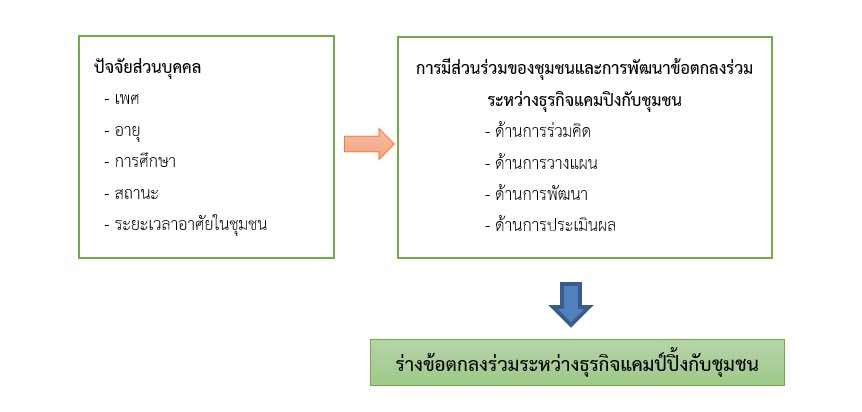
This study aimed to 1. examine the level of community participation in the context of camping tourism, 2. analyze the influence of community participation on the development of draft agreements between business operators and local communities, and 3. develop a framework that supports sustainable tourism. A sequential explanatory mixed methods design was employed. Quantitative data were collected from 451 participants using questionnaires and stratified random sampling, and analyzed using descriptive and inferential statistics (Chi-square). Qualitative data were obtained from 12 key informants, including focus group discussions, and analyzed through content analysis.
The research findings revealed that** the overall level of community participation was high ( = 3.88). The most prominent aspects included resource management, land use, and the regulation of tourist numbers. However, the community also expressed concerns regarding water usage, waste management, environmental impacts, and safety issues. In addition, statistically significant differences were found among certain groups of respondents. In particular, age was identified as a significant factor influencing the evaluation of agreements
The study developed a draft agreement consisting of 7 key dimensions and 21 components, covering resources, land use, environment, safety, local economy, management, and monitoring mechanisms. Among stakeholders, 85.6% agreed that the framework is practically applicable, and 81.2% considered it verifiable. The Chi-square test revealed that age significantly influenced the evaluation of the draft agreement (p < 0.001). Overall, most stakeholders perceived the agreement as both feasible and accountable, and additionally proposed the establishment of a local fund to support community development and conservation efforts.
In conclusion, the proposed agreement framework effectively balances economic growth, environmental sustainability, and community empowerment. The study also presents an integrated model linking participation theory with practical agreement mechanisms, offering a valuable prototype for sustainable community-based tourism development in other contexts.
References
กรุงเทพธุรกิจ. (2567). เศรษฐกิจไทยฟื้นตัวในปี 2567. สืบค้น 8 ธันวาคม 2567, จาก https://www.bangkokbiznews.com
พรรณี พิมาพันธุ์ศร. (2563). รูปแบบการมีส่วนร่วมเพื่อการคิดสร้างสรรค์สู่การเพิ่มมูลค่าภูมิปัญญาท้องถิ่นของชุมชน. วารสารบริหารธุรกิจศรีนครินทรวิโรฒ, 9(2), 105-116. https://so01.tci-thaijo.org/index.php/BJBM/article/view/244450
วนิดา รุ่งโยธิน. (2561). การมีส่วนร่วมของประชาชนในการพัฒนาชุมชนของเทศบาลตำบลบ้านบึง อำเภอบ้านบึง จังหวัดชลบุรี (วิทยานิพนธ์ปริญญามหาบัณฑิต). ชลบุรี: มหาวิทยาลัยบูรพา. https://buuir.buu.ac.th/bitstream/1234567890/8692/1/59910289.pdf
สุรางคนา ศรีสุทธ. (2563). การจัดการธุรกิจแคมปิ้งเชิงยั่งยืน: กรณีศึกษาแคมป์ในประเทศไทย. วารสารการท่องเที่ยวเชิงนิเวศ, 12(2), 45–62.
Bramwell, B., & Lane, B. (2021). Critical research on the governance of tourism and sustainability. Journal of Sustainable Tourism, 29(1), 1–20. https://doi.org/10.1080/09669582.2020.1720659
Braun, V., & Clarke, V. (2021). Thematic analysis: A practical guide. SAGE Publications. https://doi.org/10.1177/1035719X211058251
Cochran, W.G. (1977). Sampling Techniques (3rd Ed.). New York: John Wiley & Sons.
Creswell, J. W., & Plano Clark, V. L. (2018). Designing and Conducting Mixed Methods Research (3rd ed.). Thousand Oaks, CA: SAGE.
Farmaki, A. (2021). Memory and forgetfulness in tourism crisis research. Tourism management, 83, 104210. https://doi.org/10.1016/j.tourman.2020.104210
Field, A. (2020). Discovering statistics using IBM SPSS Statistics (5th ed.). SAGE Publications.
Hair, J. F., Hult, G. T. M., Ringle, C. M., & Sarstedt, M. (2021). A primer on partial least squares structural equation modeling (PLS-SEM) (3rd ed.). SAGE Publications.
Hall, C. M. (2019). Constructing Sustainable Tourism Development: The 2030 Agenda and the Managerial Ecology of Sustainable Tourism. Journal of Sustainable Tourism, 27, 1044-1060. https://doi.org/10.1080/09669582.2018.1560456
Higgins-Desbiolles, F. (2020). Socialising tourism for social and ecological justice after COVID-19. Tourism Geographies, 22(3), 610–623. https://doi.org/10.1080/14616688.2020.1757748
Ioannides, D., & Gyimóthy, S. (2020). The COVID-19 crisis as an opportunity for escaping the unsustainable global tourism path. Tourism Geographies, 22(3), 624–632. https://doi.org/10.1080/14616688.2020.1763445
Israel, M., & Hay, I. (2021). Research ethics for social scientists (3rd ed.). SAGE Publications.
Jamal, T., & Camargo, B. A. (2018). Tourism governance and policy: Whither justice?. Tourism management perspectives, 25, 205-208. https://doi.org/10.1016/j.tmp.2017.11.009
Li, H., Liu, D., & He, J. (2022). Exploring Differentiated Conservation Priorities of Urban Green Space Based on Tradeoffs of Ecological Functions. Sustainability, 14(3), 1845. https://doi.org/10.3390/su14031845
Lin, V. S., Qin, Y., Li, G., & Jiang, F. (2022). Multiple effects of “distance” on domestic tourism demand: A comparison before and after the emergence of COVID-19. Annals of Tourism Research, 95, 103440. https://doi.org/10.1016/j.annals.2022.103440
Mullet, T. C., & Morton, J. M. (2021). Snowmobile effects on height and live stem abundance of wetland shrubs in south-central Alaska. Journal of Outdoor Recreation and Tourism, 33, 100347. https://doi.org/10.1016/j.jort.2020.100347
Nunkoo, R. (2015). Tourism development and trust in local government. Tourism management, 46, 623-634. https://doi.org/10.1016/j.tourman.2014.08.016
Rasoolimanesh, S. M., Ramakrishna, S., Hall, C. M., Esfandiar, K., & Seyfi, S. (2023). A systematic scoping review of sustainable tourism indicators in relation to the sustainable development goals. Journal of Sustainable Tourism, 31(7), 1497–1517. https://doi.org/10.1080/09669582.2020.1775621
Ruckli, A. K., Hörtenhuber, S. J., Ferrari, P., Guy, J., Helmerichs, J., Hoste, R., Hubbard, C., Kasperczyk, N., Leeb, C., Malak-Rawlikowska, A., Valros, A., & Dippel, S. (2022). Integrative Sustainability Analysis of European Pig Farms: Development of a Multi-Criteria Assessment Tool. Sustainability, 14(10), 5988. https://doi.org/10.3390/su14105988
Scheyvens, R. A., Movono, A., & Auckram, S. (2023). Pacific peoples and the pandemic: exploring multiple well-beings of people in tourism-dependent communities. Journal of Sustainable Tourism, 31(1), 111–130. https://doi.org/10.1080/09669582.2021.1970757
Downloads
Published
How to Cite
Issue
Section
License
Copyright (c) 2026 Humanities and Social Sciences Journal of Pibulsongkram Rajabhat University

This work is licensed under a Creative Commons Attribution-NonCommercial-NoDerivatives 4.0 International License.
Any articles or comments appearing in the Journal of Humanities and Social Sciences, Rajabhat Phibulsongkram University, are the intellectual property of the authors, and do not necessarily reflect the views of the editorial board. Published articles are copyrighted by the Journal of Humanities and Social Sciences, Rajabhat Phibulsongkram University.