Factors Affecting Mutelu Behavior of Foreign Tourists at Wat Phakho, Songkhla Province
DOI:
https://doi.org/10.14456/psruhss.2025.40Keywords:
Influencing factors, Mutelu behavior, Foreign tourists, Wat phakhoAbstract
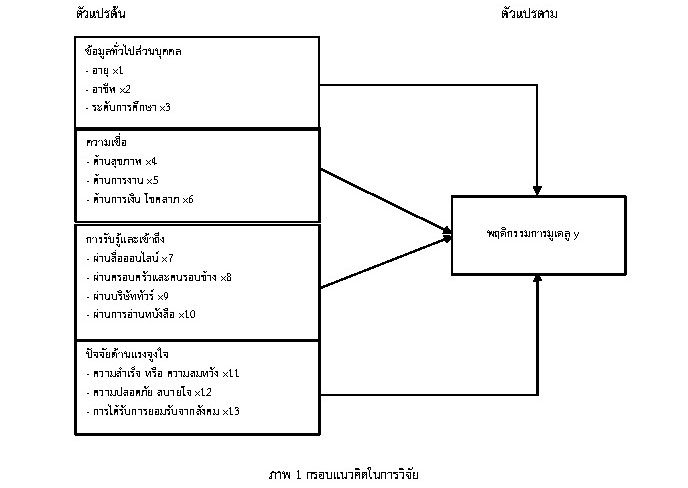
This study aimed to investigate the "Mutelu" behavior of international tourists at Wat Phako, Songkhla Province, and to examine the factors influencing such behavior. The research employed a quantitative approach, with a sample of 400 international tourists visiting Wat Phako, selected through accidental sampling. Data were analyzed using descriptive statistics and multiple regression analysis.
The findings revealed that most respondents were aged between 40–49 years, held a bachelor's degree, worked as employees, and were predominantly from Malaysia. Overall, the level of Mutelu behavior was moderate. The most popular activity was merit-making, while amulet worship was less favored. Belief in luck and financial stability emerged as the most influential factors, followed by the motivation to feel safe and achieve success. Conversely, acquiring information through books and family had the least influence. The results of multiple regression analysis showed that the independent variables collectively accounted for 46.1% of the variance in Mutelu behavior (R² = 0.461), with statistical significance at the .05 level. The significantly positive predictors included acquiring information through books, belief in luck and wealth, the desire for success or fulfillment, and a sense of safety. On the other hand, negative predictors included educational level, health concerns, occupation, and the desire for social acceptance. These findings suggest that Mutelu practices serve as a coping mechanism for managing economic and psychological uncertainty among international tourists, especially in a volatile global context.
References
จิราภรณ์ ภัทราภานุภัทร. (2528). สถานภาพการศึกษาเรื่องคติความเชื่อของไทย. กรุงเทพฯ: จุฬาลงกรณ์มหาวิทยาลัย.
ธันยนันท์ กิตติพูนเกียรติ และนฤมล สีรุ้ง. (2554). พฤติกรรมและปัจจัยที่ส่งผลต่อการบูชาสิ่งศักดิ์สิทธิ์ของนักศึกษากลุ่มชายรักชาย มหาวิทยาลัยศิลปากร (ปริญญานิพนธ์มหาบัณฑิต). กรุงเทพฯ: มหาวิทยาลัยศิลปากร.
พระสุธีรัตนบัณฑิต, พระใบฎีกาสัญญา อภิวณฺโณ และผุสดี จิระวัฒนกิจ. (2559). ยุทธศาสตร์การท่องเที่ยวทางพระพุทธศาสนาและวัฒนธรรมของไทยและอาเซียน. กรุงเทพฯ: มหาวิทยาลัยมหาจุฬาลงกรณราชวิทยาลัย.
ลัดดาวัลย์ เพชรโรจน์ และอัจฉรา ชำนิประศาสน์. (2545). ระเบียบวิธีการวิจัย. กรุงเทพฯ: ม.ป.พ.
วุฒิชัย เสนีย์วงศ์ ณ อยุธยา. (2550). การสร้างแบบสอบถามเพื่อการวิจัย (พิมพ์ครั้งที่ 5). จุฬาลงกรณ์มหาวิทยาลัย.
ศิริพร เจนวิทยาอมรเวช. (2554). พฤติกรรมการเช่าบูชาความเชื่อและความศรัทธาในพระเครื่องและวัตถุมงคลของเภสัชกร (วิทยานิพนธ์ปริญญามหาบัณฑิต). กรุงเทพฯ: มหาวิทยาลัยศิลปากร.
สมโภชน์ เอี่ยมสุภาษิต. (2526). การปรับพฤติกรรม. กรุงเทพฯ: โอเดียนสโตร์.
สำนักงานประชาสัมพันธ์จังหวัดสงขลา. (2566). สถิตินักท่องเที่ยวต่างชาติในจังหวัดสงขลา ปี 2566. สงขลา: สำนักงานประชาสัมพันธ์.
สุดาวรรณ ขันธมิตร. (2538). พฤติกรรมการบริโภคอาหารของนักเรียนชั้นประถมศึกษาปีที่ 6 สังกัดสำนักงานคณะกรรมการการประถมศึกษาแห่งชาติในภาคกลาง (รายงานผลงานวิจัย). กรุงเทพฯ: จุฬาลงกรณ์มหาวิทยาลัย.
สุภาวดี กังวานวาณิชย์. (2557). ศึกษาวิเคราะห์เรื่อง ทัศนคติและพฤติกรรมของผู้บริโภคกับความเชื่อในเรื่องเครื่องรางของขลังในเขตกรุงเทพมหานคร (วิทยานิพนธ์ปริญญามหาบัณฑิต). นครปฐม: มหาวิทยาลัยมหิดล.
อธิป จันทร์สุริยะ. (2564). มูเตลู: ความเชื่อกับการท่องเที่ยว. วารสารทีทัศน์วัฒนธรรม สํานักศิลปะและวัฒนธรรม มหาวิทยาลัยราชภัฏบ้านสมเด็จเจ้าพระยา, 20(1), 220-240.
Cochran, W. (1953). Sampling techniques. John Wiley & Sons.
Innnews. (2564). มูเตลู มาจากไหน แปลว่าอะไร. สืบค้น จาก https://www.innnews.co.th/horoscope/news_40779/
Downloads
Published
How to Cite
Issue
Section
License
Copyright (c) 2025 Humanities and Social Sciences Journal of Pibulsongkram Rajabhat University

This work is licensed under a Creative Commons Attribution-NonCommercial-NoDerivatives 4.0 International License.
Any articles or comments appearing in the Journal of Humanities and Social Sciences, Rajabhat Phibulsongkram University, are the intellectual property of the authors, and do not necessarily reflect the views of the editorial board. Published articles are copyrighted by the Journal of Humanities and Social Sciences, Rajabhat Phibulsongkram University.