Transnational Crime: The Threat to Thailand from the Call Center Gangs
DOI:
https://doi.org/10.14456/psruhss.2025.21Keywords:
Transnational crime, Threat, Call center gangsAbstract
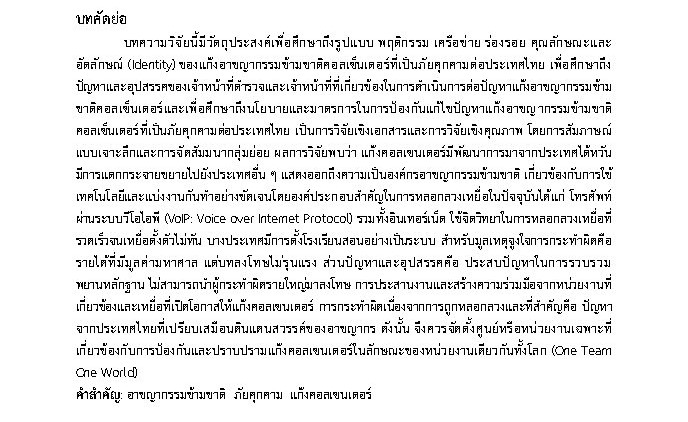
The research articles were: to gain knowledge of the transnational call center crime, especially its pattern, behavior, network, trace, characteristics, and identity; to identify problems and difficulties for the police officers and relevant staff in dealing with the transnational call center gangs; and to study the policy and measures on preventing and solving such an illegal act, acknowledged as a national threat to Thailand. This study was qualitative research methods, including in-depth interviews and a focus group seminar using purposive sampling. Call center gangs have evolved from Taiwan, showing signs of spreading to many other countries as organizations that are able to seamlessly transnationalize and share work with a significant history of deception. Current victims include VoIP (Voice over Internet Protocol) telephony has reportedly been exploited to deceive victims and victims set up trackers in certain countries in schools. As for the motive for committing the offense, it is that the income is huge, but the penalties are not severe. As for problems and obstacles, having trouble collecting evidence Major offenders cannot be punished. Coordination and cooperation from relevant agencies and victims open up opportunities for call center gangs. committed a crime because of being deceived, and most importantly, Problems in Thailand, which is like a paradise for thieves. Therefore, specific centers or agencies should be established for the prevention and suppression of call center gangs in the form of a single agency throughout the world (One Team, One World).
References
คณะทำงานสร้างเสริมภูมิคุ้มกันภัยอาชญากรรมทางเทคโนโลยี สำนักงานตำรวจแห่งชาติ. (2566). ตร.จับมือหน่วยงานรัฐ เตือนภัยคอลเซ็นเตอร์ ลวงประชาชน เสียหาย 400 ล้าน. สืบค้น 19 มีนาคม 2567, จาก https://pctpr.police.go.th/blog/?p=136
ทวีป ศรีน่วม. (2555). มาตรการทางกฎหมายเพื่อป้องกันและปราบปรามการร่วมกันฉ้อโกงประชาชนโดยใช้ระบบโทรศัพท์. วารสารวิชาการมหาวิทยาลัยปทุมธานี, 4(3), 54-69.
สำนักงานตำรวจแห่งชาติ. (2561). การจับกุมผู้ต้องหาที่เป็นสมาชิกของแก๊งคอลเซนเตอร์ข้ามชาติใน พ.ศ. 2561. สืบค้น 12 มีนาคม 2562, จาก https://www.thaipost.net/main/detail/18108
สุมนทิพย์ จิตสว่าง, นัทธี จิตสว่าง และประพจน์ อนุศิริ. (2556). การจัดการความรู้เกี่ยวกับการป้องกันปราบปรามแก๊งอาชญากรรมข้ามชาติที่ก่อเหตุคดีเกี่ยวกับทรัพย์ในเขตกรุงเทพมหานคร (รายงานการวิจัย). กรุงเทพฯ: สำนักงานคณะกรรมการสนับสนุนการวิจัย (สกว.).
DroidSans. (2567). เปิดสถิติ 14 ที่ภัยออนไลน์ที่คนไทยโดนหลอกมากสุด 2566 พบหลอกขายสินค้าออนไลน์ และหลอกโอนเงินเพื่อสมัครงานเป็นอันดับต้น ๆ. สืบค้น 19 มีนาคม 2567, จาก https://droidsans.com/14-online-cyber-2024-and-aoc-hotline/
Grimes, G. A., Hough, M. G., & Signorella, M. L. (2007). Email end users and spam: relations of gender and age group to attitudes and actions. Computers in human behavior, 23(1), 318-332.
Seager, P. (2018). Five psychological reasons why people fall for scams – and how to avoid them. Retrieved November 9, 2019, form http://theconversation.com/five-psychological-reasons-why-people-fall-for-scams-and-how-to-avoid-them-102421
Siegel, L. J. (2006). Criminology: Theories, patterns, & typologies (9th ed.). Belmont, CA: Wadsworth Publishing.
Downloads
Published
How to Cite
Issue
Section
License
Copyright (c) 2025 Humanities and Social Sciences Journal of Pibulsongkram Rajabhat University

This work is licensed under a Creative Commons Attribution-NonCommercial-NoDerivatives 4.0 International License.
Any articles or comments appearing in the Journal of Humanities and Social Sciences, Rajabhat Phibulsongkram University, are the intellectual property of the authors, and do not necessarily reflect the views of the editorial board. Published articles are copyrighted by the Journal of Humanities and Social Sciences, Rajabhat Phibulsongkram University.