
Development Strategies for the Kao Na Pa Hom Phanom Community Enterprise Towards GAP Rice Production
DOI:
https://doi.org/10.14456/psruhss.2025.29Keywords:
Learning process, Development strategies, Self-management, Change agents, Good agricultural practicesAbstract
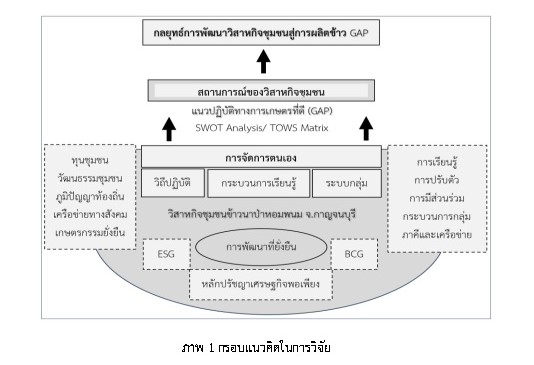
This qualitative research aimed to study the self-management practices of the Khao Na Pa Hom Phanom community enterprise, analyze its current situation, and synthesize development strategies toward Good Agricultural Practices (GAP). The study employed purposive sampling with 37 community enterprise informants and 3 government experts. Data collection utilized in-depth interviews, focus group discussions, and participant observation. Content analysis and SWOT/TOWS matrix techniques were applied for data analysis, with triangulation and stakeholder feedback ensuring credibility. Findings revealed that self-management practices were grounded in self-reliance based on sufficiency economy philosophy, integration of indigenous knowledge with contemporary innovations, and robust group systems with effective change agents. The community enterprise’s advantages included rich ecological resources and local wisdom, but faced limitations from climate conditions, market competition, a lack of production standards, and an aging population. Opportunities arose from health-conscious customer trends and government supportive policies. Development strategies comprised four approaches: 1) creating innovations from local wisdom for the health market; 2) utilizing appropriate technology to enhance sustainable production efficiency; 3) integrating local wisdom with smart systems; and 4) establishing a mechanism for intergenerational knowledge transfer. The integrated community rice center serves as the key implementation mechanism. This research successfully developed 10 change agents for GAP rice production covering 104.5 rai (approximately 16.7 hectares), reflecting a sustainable community enterprise development approach driven by community self-management.
References
จินตนา โต้งสูงเนิน และจุฑาทิพย์ สุทธิเทพ. (2568). การบริหารจัดการกลุ่มการผลิตข้าวเพื่อเข้าสู่การรับรองมาตรฐานตามการปฏิบัติการเกษตรที่ดี (GAP) กลุ่มนาแปลงใหญ่ ตำบลมะเกลือใหม่ อำเภอสูงเนิน จังหวัดนครราชสีมา. วารสารวิทยาการจัดการปริทัศน์, 27(1), 145-157.
ศูนย์วิจัยและสนับสนุนเป้าหมายการพัฒนาที่ยั่งยืน. (2568). แนวคิดดำเนินธุรกิจอย่างยั่งยืน คำนึงถึงสิ่งแวดล้อม สังคม และธรรมาภิบาล. https://www.sdgmove.com/2024/04/29/sdg-vocab-61-environment-social-governance-esg/
สำนักงานนโยบายและยุทธศาสตร์การค้า. (2566). แนวทางการขับเคลื่อนการพัฒนาเศรษฐกิจ BCG Model. นนทบุรี: กระทรวงพาณิชย์.
สำนักงานพัฒนาวิทยาศาสตร์และเทคโนโลยีแห่งชาติ. (2566). โมเดลเศรษฐกิจ BCG ในภาคเกษตร: การขับเคลื่อนการพัฒนาเศรษฐกิจชีวภาพ เศรษฐกิจหมุนเวียน และเศรษฐกิจสีเขียวเพื่อการพัฒนาที่ยั่งยืน. กรุงเทพฯ: สำนักงานพัฒนาวิทยาศาสตร์และเทคโนโลยีแห่งชาติ.
Dweck, C. S., & Yeager, D. S. (2021). A growth mindset about intelligence. In R. J. Sternberg (Ed.), The Cambridge handbook of intelligence and cognitive neuroscience (pp. 24-47). Cambridge University Press.
El Mahi, A. (2021). SWOT analysis strategy as a methodology for improving policy planning. Journal of Government and Economics, 4(1), 100025.
Fan, X., Wang, L., Shao, G., & Wang, Y. (2024). Impact of climate change on grain production and food security in China. Journal of Environmental Management, 349, 119213.
Food and Agriculture Organization (FAO). (2022). The state of food and agriculture 2022: Leveraging automation in agriculture for transforming agrifood systems. Rome, Food and Agriculture Organization of the United Nations.
García-Maraver, A., & Popovici, C. (2023). The challenges of implementing good agricultural practices (GAP) for smallholder rice farmers: A systematic review. Sustainable Agriculture Research, 12(2), 34-49. https://doi.org/10.3390/w15030402
Ishikawa, K. (1986). Guide to quality control (2nd ed.). JUSE Press.
Jha, S., Kaechele, H., & Sieber, S. (2021). Factors influencing the adoption of sustainable agricultural practices by smallholder farmers: A systematic review of the literature. Land Use Policy, 111, 105772.
Jitsanguan, T., & Thongrak, S. (2022). BCG in agriculture: Alternative approaches to achieve sustainable development goals. NIDA Journal of Environmental Management, 18(1), 41-56.
Mariyono, J. (2021). Determinants of adoption of good agricultural practices for efficient and environment-friendly rice farming. International Journal of Environmental Science and Technology, 18(9), 2669-2678.
Merriam, S. B., & Baumgartner, L. M. (2020). Learning in adulthood: A comprehensive guide (4th ed.). Jossey-Bass. https://doi.org/10.1002/9781119641742
Rivera-Huerta, R., Fallas, E. M., Castro, V. M., & Díaz, T. (2023). Adoption of GAP standards and digital tools among aging smallholder farmers: Barriers and solutions. Journal of Rural Studies, 97, 108-119.
Singh, R., & Rahman, S. (2022). Good agricultural practices (GAP) adoption among smallholder farmers in developing countries: Challenges and policy implications. Food Control, 131, 108458.
Siwasak, P., Pradubwong, S., & Makpan, N. (2023). Community enterprise development in Thailand: Problems, opportunities, and strategic approaches. Asian Journal of Agriculture and Rural Development, 13(2), 89-105.
Suwanmaneepong, S., Kultawanich, K., Khurnpoon, L., Sabaijai, P.E., Cavite, H.J., Llones, C., Lepcha, N., & Kerdsriserm, C. (2023). Alternate Wetting and Drying as Water-Saving Technology: An Adoption Intention in the Perspective of Good Agricultural Practices (GAP) Suburban Rice Farmers in Thailand. Water, 15, 402.
Tang, L., Zhou, M., Lei, Q., Zhang, X., & Zou, J. (2022). Carbon neutrality and food security in Chinese rice-based cropping systems via optimizing water management. Science of The Total Environment, 844, 157160.
Tomlinson, I., Potter, C., & MacMillan, T. (2023). Integrating environmental, social, and economic perspectives in sustainable agriculture: A conceptual framework. Journal of Rural Studies, 97, 315-324.
Udomwech, A., & Tanpichai, P. (2023). Kao Na Pa Hom Phanom Community Enterprise: Developing the Rainfed Rice Farmers’ Potential towards the Change Agents with the GROW Model Group Process in Ban Phanom Nang Community, Huai Krachao District, Kanchanaburi Province . Sripatum Review of Humanities and Social Sciences, 23(2), 95–109.
Wezel, A., Herren, B. G., Kerr, R. B., Barrios, E., Gonçalves, A. L. R., & Sinclair, F. (2023). Agroecological principles and elements and their implications for transitioning to sustainable food systems: A review. Agronomy for Sustainable Development, 43(1), 1-23.
Downloads
Published
How to Cite
Issue
Section
License
Copyright (c) 2025 Humanities and Social Sciences Journal of Pibulsongkram Rajabhat University

This work is licensed under a Creative Commons Attribution-NonCommercial-NoDerivatives 4.0 International License.
Any articles or comments appearing in the Journal of Humanities and Social Sciences, Rajabhat Phibulsongkram University, are the intellectual property of the authors, and do not necessarily reflect the views of the editorial board. Published articles are copyrighted by the Journal of Humanities and Social Sciences, Rajabhat Phibulsongkram University.