
Logistics Innovation Capability Influences Logistics Performance & Firm Performance of Logistics Service Providers in Thailand
DOI:
https://doi.org/10.14456/psruhss.2025.38Keywords:
Logistics innovation capability, Supply chain risks, Logistics performance, Firm performanceAbstract
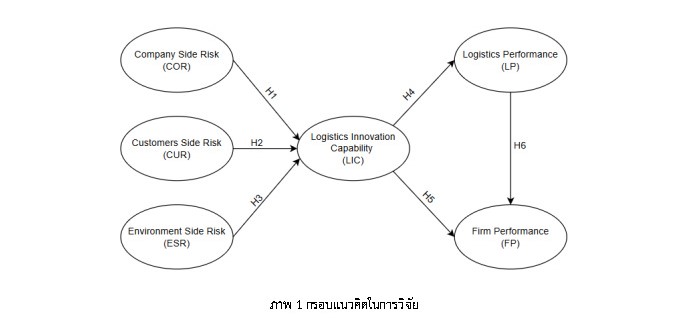
This study aimed to examine the relationships between supply chain risks, logistics innovation capability, and organizational performance among logistics service providers in Thailand. A quantitative research design was employed. Data were collected through questionnaires from 400 logistics service providers certified under the ISO 9001 quality standard and listed by relevant government agencies. The data were analyzed using Structural Equation Modeling (SEM) and path analysis. The results revealed that logistics innovation capability significantly influenced firm risk, customer-related risk, and environmental risk. In addition, logistics innovation capability had a direct effect on both logistics performance and overall organizational performance. Logistics performance was also found to significantly affect the organization performance of logistics service providers in Thailand. The findings offer empirical insights into how enhancing logistics innovation capability can mitigate supply chain risks and support the development of strategic risk management practices, particularly within the context of modern industry.
References
Angkanurakbun, C., & Wanarat, S. (2016). The mediating effect of product innovation capability on entrepreneurial pro-activeness and hotel performance. International Journal of Innovation Management, 20(03), 1-21. https://doi.org/10.1142/S1363919616500353
Coşkun, A. E., & Erturgut, R. (2021). An empirical research on developing a logistics performance scale. International Journal of Productivity and Performance Management, 71(7), 2605-2629. https://doi.org/10.1108/IJPPM-10-2020-0513
Dai, J., Che, W., Lim, J. J., & Shou, Y. J. I. M. M. (2020). Service Innovation of cold chain logistics service providers: A multiple-case study in china. Industrial Marketing Management, 89, 143–156. https://doi.org/10.1016/j.indmarman.2019.08.002
Diamantopoulos, A., & Siguaw, J. A. (2000). Introducing LISREL: A guide for the uninitiated.
Forslund, H. (2012). Performance management in supply chains: logistics service providers’ perspective. International Journal of Physical Distribution & Logistics Management, 42(3), 296–311. https://doi.org/10.1108/09600031211225972
Frank, A. G., Dalenogare, L. S., & Ayala, N. F. (2019). Industry 4.0 technologies: Implementation patterns in manufacturing companies. International journal of production economics, 210, 15-26. https://doi.org/10.1016/j.ijpe.2019.01.004
Green, K., Whitten, W. D., & Inman, R. A. (2008). The impact of logistics performance on organizational performance in a supply chain context. Supply Chain Management: An International Journal, 13(4), 317–327. https://doi.org/10.1108/13598540810882206
Guido, J.L.M., Enrico, C., & Marta, Z. (2008), “Supply risk management vs supplier selection to manage the supply risk in the EPC supply chain”, Management Research News, 31(11), 846-866. https://doi.org/10.1108/01409170810913042
Hair, J. F., Astrachan, C. B., Moisescu, O. I., Radomir, L., Sarstedt, M., Vaithilingam, S., & Ringle, C. M. (2021). Executing and interpreting applications of PLS-SEM: Updates for family business researchers. Journal of Family Business Strategy, 12(3), 100392. https://doi.org/10.1016/j.jfbs.2020.100392
Hair, J., Hollingsworth, C. L., Randolph, A. B., & Chong, A. Y. L. (2017). An updated and expanded assessment of PLS-SEM in information systems research. Industrial management & data systems, 117(3), 442-458. https://doi.org/10.1108/IMDS-04-2016-0130
Hayati, F., Hossainzadeh, M., Shayanpour, S., Abedi-Gheshlaghi, Z., & Mousavi, S. S. B. (2015). Prevention of cisplatin nephrotoxicity. Journal of nephropharmacology, 5(1), 57-60.
Khan, S. A. R., Zhang, Y., Anees, M., Golpîra, H., Lahmar, A., & Qianli, D. (2018). Green supply chain management, economic growth and environment: A GMM based evidence. Journal of Cleaner Production, 185, 588-599. https://doi.org/10.1016/j.jclepro.2018.02.226
Kirono, I., Armanu, A., Hadiwidjojo, D., & Solimun, S. (2019). Logistics performance collaboration Strategy and information sharing with logistics capability as mediator variable (study in Gafeksi East Java Indonesia). International journal of quality & reliability management, 36(8), 1301–1317. https://doi.org/10.1108/IJQRM-11-2017-0246
Koh, B. H., Wong, W. P., Tang, C. F., & Lim, M. K. (2018). The double-edge resource-based view of logistics performance and governance in Asian countries. Asia Pacifi c Journal of Marketing and Logistics, 30(3), 652–668. https://doi.org/10.1108/APJML-07-2017-0135
Lyu, G., Chen, L., & Huo, B. (2019). The impact of logistics platforms and location on logistics resource integration and operational performance. The International Journal of Logistics Management, 30(2), 549–568. https://doi.org/10.1108/IJLM-02-2018-0048
Parast, M. & Spillan, J. (2014). Logistics and supply chain process integration as a source of Competitive advantage: An empirical analysis. The International Journal of Logistics Management, 25(2), 289–314.
Rathachatranon, W. (2018). Analysis on structural equation models for public administration researches. Asian Political Science Review, 2(2), 33-43.
Seferlis, P. & Varbanov, P. (2014). Process innovation through integration approaches at multiple scales: A perspective. Clean Technologies and Environmental Policy, 16(7), 1229–1234. https://doi.org/10.1007/s10098-014-0837-1
Shaukat, S., Nawaz, M. S., & Naz, S. (2013). Effects of innovation types on firm performance: An empirical study on Pakistan's manufacturing sector. Pakistan Journal of Commerce and Social Sciences (PJCSS), 7(2), 243-262.
Simangunsong, E., Hendry, L.C., & Stevenson, M. (2012), “Supply-chain uncertainty: a review and theoretical foundation for future research”, International Journal of Production Research, 50(16), 4493-4523.
Stacho, Z., Stachová, K., & Cagáňová, D. (2020). Participation of all employee categories in innovation processes in Slovak organisations. Mobile Networks and Applications, 25(3), 853-859. https://doi.org/10.1007/s11036-020-01518-2
Stachová, K., Stacho, Z., Blštáková, J., Hlatká, M., & M. Kapustina, L. (2018). Motivation of employees for creativity as a form of support to manage innovation processes in transportation-logistics companies. Nase More, 65(4), 180–186.
Suvittawat, A. (2020). Logistics service innovation for business growth: A case study of logistics service entrepreneurs. Polish Journal of Management Studies, 21(1), 394–407. https://doi.org/10.1007/s11036-020-01518-2
Thongkruer, P., & Wanarat, S. (2020). Logistics service quality: where we are and where we go in the context of airline industry. Management Research Review, 44(2), 209-235. https://doi.org/10.1108/MRR-12-2019-0544
Varbanov, P. S., & Seferlis, P. (2014). Process innovation through Integration approaches at multiple scales: a perspective. Clean Technologies and Environmental Policy, 16, 1229-1234. https://doi.org/10.1108/MRR-12-2019-0544
Wang, M. (2016a). Logistics Capability, Supply Chain Uncertainty and Risk, and Logistics Performance: An Empirical Analysis of the Australian Courier Industry, RMIT University. Melbourne, Australia.
Wang, M. (2018). “Impacts of supply chain uncertainty and risk on the logistics performance”, Asia Pacific Journal of Marketing and Logistics, 30(3), 689-704. https://doi.org/10.1108/APJML-04-2017-0065
Wollschlaeger, M., Sauter, T., & Jasperneite, J. (2017). The future of industrial communication: Automation networks in the era of the internet of things and industry 4.0. IEEE industrial electronics magazine, 11(1), 17-27.
Yusheng, K., & Ibrahim, M. (2019). Service innovation, service delivery and customer satisfaction and loyalty in the banking sector of Ghana. International Journal of Bank Marketing, 37(5), 1215–1233. https://doi.org/10.1108/IJBM-06-2018-0142
Downloads
Published
How to Cite
Issue
Section
License
Copyright (c) 2025 Humanities and Social Sciences Journal of Pibulsongkram Rajabhat University

This work is licensed under a Creative Commons Attribution-NonCommercial-NoDerivatives 4.0 International License.
Any articles or comments appearing in the Journal of Humanities and Social Sciences, Rajabhat Phibulsongkram University, are the intellectual property of the authors, and do not necessarily reflect the views of the editorial board. Published articles are copyrighted by the Journal of Humanities and Social Sciences, Rajabhat Phibulsongkram University.