A Study of Factors which Motivate Supporting Personnel of Health Sciences Group, Naresuan University to Complete a Portfolio Requirement for a Promotion to a Higher Position and quality of life at work
DOI:
https://doi.org/10.14456/psruhss.2025.14Keywords:
Motivating factors, Supporting personnel, Personnel of characteristics, Quality work-life balanceAbstract
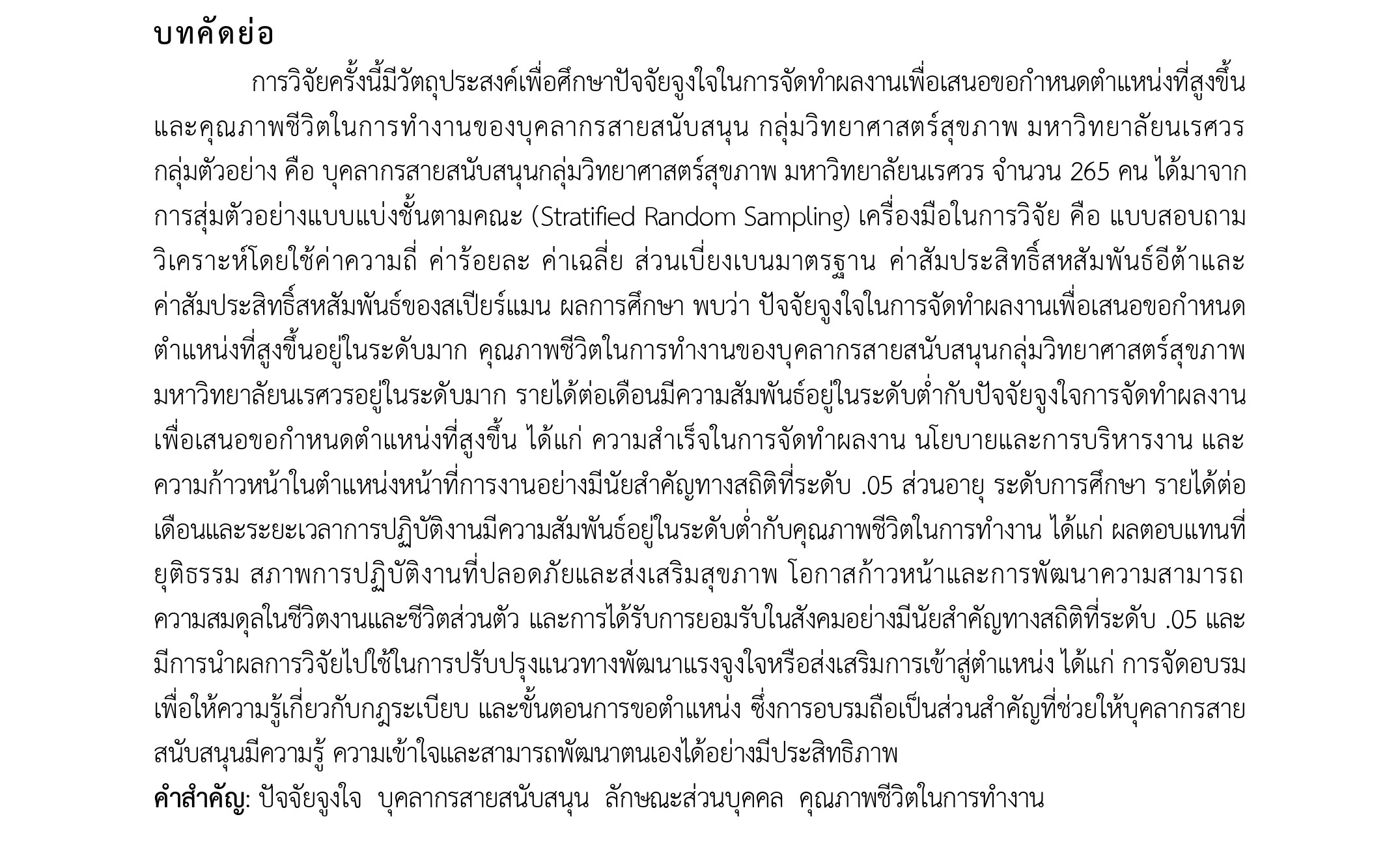
The objective of this research is to determine factors that motivate supporting personnel and quality of life at work of the Health Sciences Group, Naresuan University. The sample group consisted of 265 support personnel from the Health Science Group of Naresuan University, obtained by stratified random sampling. The research instrument was a questionnaire. The analysis used frequency, percentage, mean, standard deviation, Eta correlation coefficient, and Spearman's product moment correlation coefficient. The study results found that the motivation factors for preparing work to apply for a higher position were at a high level. The quality of working life of the support personnel in the Health Science Group, Naresuan University, was at a high level. Monthly income was lowly related to the motivation factor for presenting work results to seek higher positions Including success in the preparation of work results, policies and administration, and advancement in career positions.at a statistically significant level of .05. Age, education level, monthly income and length of employment were significantly and lowly associated with working life quality. These include fair compensation, safe and healthy working conditions, opportunities for advancement and development, work-life balance, and social recognition at a statistical level of .05. And the research results are used to improve the guidelines for developing motivation or promoting entry into positions, such as organizing training to provide knowledge about the rules and procedures for applying for positions. Training is an important part that helps support personnel gain knowledge, understanding and be able to develop themselves effectively.
References
กติกา ชาติน้ำเพชร. (2559). ความสัมพันธ์ระหว่างภาพแวดล้อมในการปฏิบัติงานกับผลการปฏิบัติงานของพนักงานมหาวิทยาลัยสังกัดสำนักอธิการบดีมหาวิทยาลัยบูรพา (งานนิพนธ์ปริญญามหาบัณฑิต). ชลบุรี: มหาวิทยาลัยบูรพา.
ดรุณี พรมทอง, และชัญญา อภิปาลกูล. (2558). แรงจูงใจในการปฏิบัติงานของบุคลากรสายสนับสนุน มหาวิทยาลัยเทคโนโลยีราชมงคลอีสาน วิทยาเขตขอนแก่น (วิทยานิพนธ์ปริญญามหาบัณฑิต). ขอนแก่น: มหาวิทยาลัยขอนแก่น.
ธิดารัตน์ สวนเศรษฐ, ระพิน ชูชื่น, และธนวิน ทองแพง. (2562). ปัจจัยที่ส่งผลต่อความผูกพันองค์กรของพนักงานสายสนับสนุนวิชาการในมหาวิทยาลัยบูรพา. e-Journal of Education Studies, Burapha University, 1(6), 55-67. https://so01.tci-thaijo.org/index.php/ejes/article/view/207566
นรีรัตน์ สุเมผา, และปิยธิดา อภิรักษ์สัตยา. (2560). ปัจจัยที่ส่งผลต่อการพัฒนาศักยภาพการทำวิจัยจากงานประจำของบุคลากรสายสนับสนุน คณะแพทยศาสตร์ มหาวิทยาลัยมหาสารคาม. วารสารสาระคาม, 8(2), 48-62. https://skjournal.msu.ac.th/Eng/pdfsplitE.php?p=MTU5MTg0NDc1NS5wZGZ8NTctNzE=
ประชาสัมพันธ์ มหาวิทยาลัยนเรศวร. (2562). พิธีเปิดการประชุมทบทวนนโยบาย (Retreat) และสัมมนาเชิงปฏิบัติการการพัฒนาผู้ใต้บังคับบัญชา เพื่อเข้าสู่ตำแหน่งที่สูงขึ้น ณ โครงการส่งเสริมการเรียนรู้เพื่อการอนุรักษ์และฟื้นฟูสิ่งแวดล้อมอันเนื่องมาจากพระราชดำริ อำเภอแม่สอด จังหวัดตาก ระหว่างวันที่ 9-10 กุมภาพันธ์ 2562. สืบค้น 17 ธันวาคม 2563, จาก https://old.nu.ac.th/?p=13440)
ประเสริฐ อุไร. (2559). แรงจูงใจในการปฏิบัติงานของพนักงาน กรณีศึกษา บริษัท เอจีซี ออโตโมทีฟ (ประเทศไทย) จำกัด (สารนิพนธ์ปริญญามหาบัณฑิต). กรุงเทพฯ: มหาวิทยาลัยเกริก.
พัชร แสงสุวรรณ, สุทธิพร บุญมาก, และเมธี ดิสวัสดิ์. (2563). ความสัมพันธ์ระหว่างปัจจัยส่วนบุคคลปัจจัยด้านครอบครัวและปัจจัยด้านที่ทำงานที่มีต่อองค์ประกอบคุณภาพชีวิตบุคลากรมหาวิทยาลัย เทคโนโลยีราชมงคลศรีวิชัย. วารสารวิจัยมหาวิทยาลัยเทคโนโลยีราชมงคลศรีวิชัย, 12(2), 323-334. https://li01.tci-thaijo.org/index.php/rmutsvrj/article/view/245419/167827
ยุทธศักดิ์ ชูประเสริฐ. (2562). ปัจจัยที่มีผลต่อแรงจูงใจในการปฏิบัติงานของพนักงาน: กรณีศึกษา องค์การบริหารส่วนตำบลกู่กาสิงห์อำเภอเกษตรวิสัย จังหวัดร้อยเอ็ด. วารสารการวิจัยการบริหารการพัฒนา, 9(3), 52-62. https://so01.tci-thaijo.org/index.php/JDAR/article/view/244014
รวิภา ธรรมโชติ. (2557). การวิเคราะห์นโยบายสาธารณะ. กรุงเทพฯ: คณะรัฐศาสตร์ มหาวิทยาลัยรามคำแหง.
วัชราภรณ์ ก้อนแก้ว. (2558). ปัจจัยจูงใจที่ส่งผลต่อความต้องการพัฒนาตนเองของบุคลากรสายสนับสนุนวิชาการ คณะแพทยศาสตร์ มหาวิทยาลัยเชียงใหม่ (วิทยานิพนธ์ปริญญามหาบัณฑิต). เชียงใหม่: มหาวิทยาลัยแม่โจ้.
วัลลภ รัฐฉัตรานนท์. (2562). การหาขนาดตัวอย่างที่เหมาะสมสำหรับการวิจัย: มายาคติในการใช้สูตรของทาโร่ยามาเนและเครทซี-มอร์แกน. วารสารสหวิทยาการวิจัยฉบับบัณฑิตศึกษา, 8(1), 11-28. https://so03.tci-thaijo.org/index.php/JIRGS/article/view/243621
สมนึก ภัททิยธนี. (2565). การวัดผลการศึกษา (พิมพ์ครั้งที่ 13 ฉบับปรับปรุง). กาฬสินธุ์: ประสานการพิมพ์.
สราลี แซงแสวง. (2559). คุณภาพชีวิตในการทำงานและความสมดุลของชีวิตในการทำงานของพนักงานระดับปฏิบัติการเจเนอเรชัน X และเจเนอเรชัน Y (สารนิพนธ์ปริญญามหาบัณฑิต). กรุงเทพฯ: มหาวิทยาลัยธรรมศาสตร์.
อันธิกา ศักขิณาดี. (2559). ความสัมพันธ์ระหว่างแรงจูงใจในการปฏิบัติงานกับผลการปฏิบัติงานของบุคลากรสายสนับสนุน มหาวิทยาลัยเทคโนโลยีราชมงคลตะวันออก (งานนิพนธ์ปริญญามหาบัณฑิต). ชลบุรี: มหาวิทยาลัยบูรพา.
Best, J. W. (1981). Research in Education (4th ed). New Delhi, NJ: Prentice-Hall.
Herzberg, F. (1959). The Motivation to Work. New York: John Wiley & Sons.
Simon Matome Nkgapele. (2025). Employee Motivation and Healthcare Quality in the Post-COVID-19 Pandemic: A South African Public Health Sector Perspective. Retrieved From https://www.researchgate.net/publication/390559090_Employee_Motivationand_Healthcare_Quality_in_the_Post-COVID-19_Pandemic_A_South_AfricanPublic_Health_Sector_Perspective.
Downloads
Published
How to Cite
Issue
Section
License
Copyright (c) 2025 Humanities and Social Sciences Journal of Pibulsongkram Rajabhat University

This work is licensed under a Creative Commons Attribution-NonCommercial-NoDerivatives 4.0 International License.
Any articles or comments appearing in the Journal of Humanities and Social Sciences, Rajabhat Phibulsongkram University, are the intellectual property of the authors, and do not necessarily reflect the views of the editorial board. Published articles are copyrighted by the Journal of Humanities and Social Sciences, Rajabhat Phibulsongkram University.