Learning organization as an intermediary factor that transfers organizational culture and knowledge management to the performance of vocational education institutions
DOI:
https://doi.org/10.14456/psruhss.2025.15Keywords:
Learning organization, Organizational culture, Knowledge management, Performance of vocational education institutionsAbstract
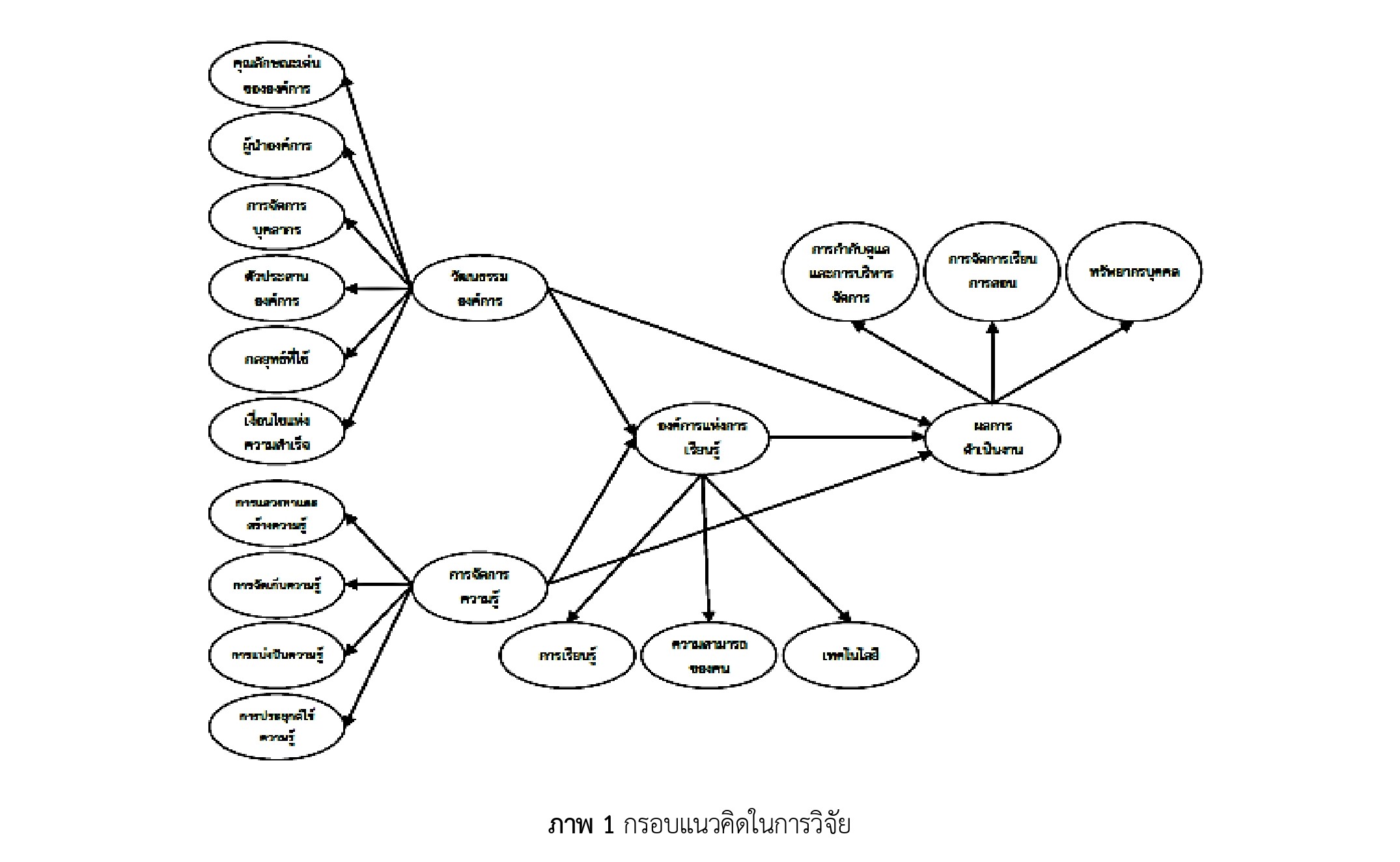
This study aimed to 1) study organizational culture, knowledge management, learning organization, and performance of vocational education institutions;
2) study the causal relationship between organizational culture, knowledge management, and learning organization that affect the performance of vocational education institutions; 3) study learning organization as a mediating factor that transmits organizational culture to the performance of vocational education institutions; and 4) study learning organization as a mediating factor that transmits knowledge management to the performance of vocational education institutions. This research was quantitative by collecting data from questionnaires from 320 deputy directors and teachers from vocational education institutions in Bangkok. The results of the study found that 1) deputy directors and teachers had the highest opinions on knowledge management (mean 4.38), followed by organizational culture (mean 4.27), and performance (mean 4.14); 2) organizational culture had a direct influence on learning organization with a path coefficient (DE = 0.29), and performance had a path coefficient (DE = 0.343). Knowledge management had a direct influence on learning organization. The path coefficient (DE = 0.648) and the performance have the path coefficient (DE = 0.231) and the learning organization has the total influence on the performance with the path coefficient (TE = 0.385).
3) Knowledge management is the serial mediating variable that connects the relationship between the learning organization to the performance of vocational education institutions equal to 0.515 and 4) Organizational culture is the serial mediating variable that connects the relationship between the learning organization to the performance of the educational institutions equal to 0.504.
References
ประพนธ์ ผาสุขยืด. (2559). การจัดการความรู้ฉบับมือใหม่หัดขับ (พิมพ์ครั้งที่ 5). กรุงเทพฯ: ใยไหม.
สำนักงานคณะกรรมการพัฒนาการเศรษฐกิจและสังคมแห่งชาติ. (2562). ยุทธศาสตร์ชาติระยะ 20 ปี (พ.ศ. 2560-2579) (พิมพ์ครั้งที่ 2). กรุงเทพฯ: สำนักงานเลขานุการของคณะกรรมการยุทธศาสตร์ชาติ สำนักงานคณะกรรมการพัฒนาการเศรษฐกิจและสังคมแห่งชาติ.
สำนักงานรับรองมาตรฐานและประเมินคุณภาพการศึกษา (องค์การมหาชน). (2562). หลักการ แนวคิด ทิศทาง การประเมินคุณภาพภายนอกรอบสี่. สืบค้น 15 พฤศจิกายน 2567, จาก http://qa.vru.ac.th/doc/2560/5.PowerPoint-%94.
Adam, M., & Hanafi, A. (2022). Readiness for organizational change. In 7th Sriwijaya Economics, Accounting, and Business Conference (SEABC 2021) (pp. 360-368). Atlantis Press. https://doi.org/10.2991/aebmr.k.220304.047
Akpa, V. O., Asikhia, O. U., & Nneji, N. E. (2021). Organizational culture and organizational performance: A review of literature. International Journal of Advances in Engineering and Management, 3(1), 361-372.
Allameh, M., Zamani, M., & Davoodi, S. M. R. (2011). The relationship between organizational culture and knowledge management:(A case study: Isfahan University). Procedia Computer Science, 3, 1224-1236. https://doi.org/10.1016/j.procs.2010.12.197
Aubrey, B. (2015). The Measure of Man : Leading Human Development. New York : McGraw Hill.
Becerra-Fernandez, I., & Sabherwal, R. (2014). Knowledge Management Systems and Processes. New York: Routledge. https://doi.org/10.4324/9781315715117
Beesley, L. G. A., & Cooper, C. (2008). Defining knowledge management (KM) activities: towards consensus. Journal of Knowledge Management, 12(3), 48-62. https://doi.org/10.1108/13673270810875859
Cameron, K. S., & Quinn, R. E. (2011). Diagnosing and Changing Organizational Culture: Based on the Competing Values Framework (3rd ed.). San Francisco: Jossey-Bass.
Chin, W. W., & Newsted, P. R. (1999). Structural Equation Modeling Analysis with Small Samples Using Partial Least Squares. in Statistical Strategies for Small Sample Research, Rick Hoyle (ed.), Thousand Oaks, CA: Sage Publications, pp. 307341.
Chu, K. W., Wang, M., & Yuen, A. H. (2011). Implementing knowledge management in school environment: Teachers' perception. Knowledge Management And E-Learning, 3(2), 139-152. http://hdl.handle.net/10722/135601
Cronbach, L. J. (1970). Essentials of Psychological Testing. New York: Harper & Row.
Cyert, R., & March, J. (2015). Behavioral theory of the firm. In Organizational Behavior 2 (pp. 60-77). Routledge.
Dekoulou, P., & Trivellas, P. (2015). Measuring the impact of learning organization on job satisfaction and individual performance in Greek advertising sector. Procedia-Social and Behavioral Sciences, 175, 367-375. https://doi.org/10.1016/j.sbspro.2015.01.1212
Dicle, Ü., & Okan, R. Y. (2015). The relationship between organizational structure and organizational learning in Turkish automotive R&D companies. International Journal of Managerial Studies and Research, 3(8), 62-71.
Elsbach, K. D., & Stigliani, I. (2018). Design thinking and organizational culture: A review and framework for future research. Journal of management, 44(6), 2274-2306. https://doi.org/10.1177/0149206317744252
Farooq, M. S., Riaz, S., Abid, A., Abid, K., & Naeem, M. A. (2019). A Survey on the Role of IoT in Agriculture for the Implementation of Smart Farming. Ieee Access, 7, 156237-156271. https://doi.org/10.1109/ACCESS.2019.2949703
Findik-Coşkunçay, D., Alkiş, N., & Özkan-Yildirim, S. (2018). A structural model for students' adoption of learning management systems: An empirical investigation in the higher education context. Journal of Educational Technology & Society, 21(2), 13-27. https://www.jstor.org/stable/26388376
Gil-Gomez, H., Guerola-Navarro, V., Oltra-Badenes, R., & Lozano-Quilis, J. A. (2020). Customer relationship management: digital transformation and sustainable business model innovation. Economic research-Ekonomska istraživanja, 33(1), 2733-2750. https://hrcak.srce.hr/file/370046
Hair, J. F., Black, W. C., Babin, B. J., & Anderson, R. E. (2010). Multivariate Data Analysis (7th ed.). New York: Pearson Prentice Hall.
Hsu, N. C., Gautam, R., Sayer, A. M., Bettenhausen, C., Li, C., Jeong, M. J., ... & Holben, B. N. (2012). Global and regional trends of aerosol optical depth over land and ocean using SeaWiFS measurements from 1997 to 2010. Atmospheric Chemistry and Physics, 12(17), 8037-8053. https://doi.org/10.5194/acp-12-8037-2012, 2012
Jamali, D., Sidani, Y., & Zouein, C. (2009). The learning organization: tracking progress in a developing country: a comparative analysis using the DLOQ. The learning organization, 16(2), 103-121. https://doi.org/10.1108/09696470910939198
Kwatubana, S. (2021). Indicators of personal mastery in the life narratives of principals of high-performing schools: an organisational perspective. International Journal of Management in Education, 15(3), 229-244. https://doi.org/10.1504/IJMIE.2021.114943
Lubis, F. R., & Hanum, F. (2020). Organizational culture. In 2nd Yogyakarta International Conference on Educational Management/Administration and Pedagogy (YICEMAP 2019) (pp. 88-91). Atlantis Press.
Mahmoudsalehi, M., Moradkhannejad, R., & Safari, K. (2012). How knowledge management is affected by organizational structure. The learning organization, 19(6), 518-528. https://doi.org/10.1108/09696471211266974
Marquardt, M. J. (2002). Building the learning organization: Mastering the 5 elements for corporate learning. United States of America: Consulting Psychologists.
Marsick, V., Watkins, K., & O’Connor, B. N. (2011). Researching workplace learning in the United States. The SAGE handbook of workplace learning, 198-209.
Minkov, M., & Hofstede, G. (2011). The evolution of Hofstede's doctrine. Cross cultural management: An international journal, 18(1), 10-20.
Moustaghfir, K., & Schiuma, G. (2013). Knowledge, learning, and innovation: research and perspectives. Journal of knowledge management, 17(4), 495-510. https://doi.org/10.1108/JKM-04-2013-0141
Mutmainah, U. M., & Panudju, A. T. (2017). Employee performance appraisal model using human resources scorecard and Analytical Hierarchy Process (AHP). International Journal of Scientific & Technology Research, 6(11), 81-84.
Nonaka, I., & Takeuchi, H. (2007). The knowledge-creating company. Harvard business review, 85(7/8), 162.
Pahurkar, R. N., Sangvikar, B. V., Khadke, K., & Kolte, A. (2020). An Exploratory Study of Important Dimensions in Strengthening Buyer-Supplier Relationship. International Journal on Emerging Technologies, 11(2), 803-810.
Patrucco, A. S., Moretto, A., Luzzini, D., & Glas, A. H. (2020). Obtaining supplier commitment: antecedents and performance outcomes. International Journal of Production Economics, 220, 107449. https://doi.org/10.1016/j.ijpe.2019.07.022
Ponnuswamy, I., & Manohar, H. L. (2014). Breaking the glass ceiling-a mixed methods study using watkins and marsick's learning organisation culture model. Asian Women, 30(3), 85-111.
Ponnuswamy, I., & Manohar, H. L. (2016). Impact of learning organization culture on performance in higher education institutions. Studies in Higher Education, 41(1), 21-36. https://doi.org/10.1080/03075079.2014.914920
Prajogo, D. I., & McDermott, C. M. (2011). The relationship between multidimensional organizational culture and performance. International Journal of Operations & Production Management, 31(7), 712-735. https://doi.org/10.1108/01443571111144823
Rovinelli, R. J., & Hambleton, R. K. (1977). On the use of content specialists in the assessment of criterion-referenced test item validity. Dutch Journal of Educational Research, 2, 49-60. https://files.eric.ed.gov/fulltext/ED121845.pdf
Sable, R. G., & Dave, G. B. (2016). A study on factors affecting learning organization. International Journal of Management, 7(7), 134-143.
Saleem, H., Li, Y., Ali, Z., Ayyoub, M., Wang, Y., & Mehreen, A. (2021). Big data use and its outcomes in supply chain context: the roles of information sharing and technological innovation. Journal of Enterprise Information Management, 34(4), 1121-1143. https://doi.org/10.1108/JEIM-03-2020-0119
Watkins, K. E., Marsick, V., & Kim, Y. S. (2011). The impact of lifelong learning on organizations. In Second international handbook of lifelong learning (pp. 859-873). Dordrecht: Springer Netherlands.
Downloads
Published
How to Cite
Issue
Section
License
Copyright (c) 2025 Humanities and Social Sciences Journal of Pibulsongkram Rajabhat University

This work is licensed under a Creative Commons Attribution-NonCommercial-NoDerivatives 4.0 International License.
Any articles or comments appearing in the Journal of Humanities and Social Sciences, Rajabhat Phibulsongkram University, are the intellectual property of the authors, and do not necessarily reflect the views of the editorial board. Published articles are copyrighted by the Journal of Humanities and Social Sciences, Rajabhat Phibulsongkram University.