Food culture and wisdom of the Tai Lue ethnic group Lamphun Province
DOI:
https://doi.org/10.14456/psruhss.2025.9Keywords:
Cultural, Food wisdom, Tai lue ethnicAbstract
This research aimed to study the history, culture and food wisdom of the Tai Lue ethnic group in Ban Thi Subdistrict, Ban Thi District, Lamphun Province, and to develop a food set of the Tai Lue Ban Thi ethnic group. This was a qualitative research using a structured interview with
27 people who provided information on Tai Lue culture and food wisdom using a chain selection method, in-depth interviews and focus group discussions, and content analysis. The research results found that the history of the Tai Lue people showed migration, settlement, village expansion, and the preservation of cultural identity, especially the food culture that combines simplicity and the use of local ingredients available in the area. They eat 3 meals, each consisting of steamed sticky rice and curry and chili paste for almost every meal. Beef is preferred over pork. The taste emphasizes saltiness from grains of salt and sourness from ripe tamarind. Sweetness is not preferred. The spiciness is moderate. There is an informal form of food culture transmission from learning from ancestors and exchanging knowledge within the community. The results of the development of
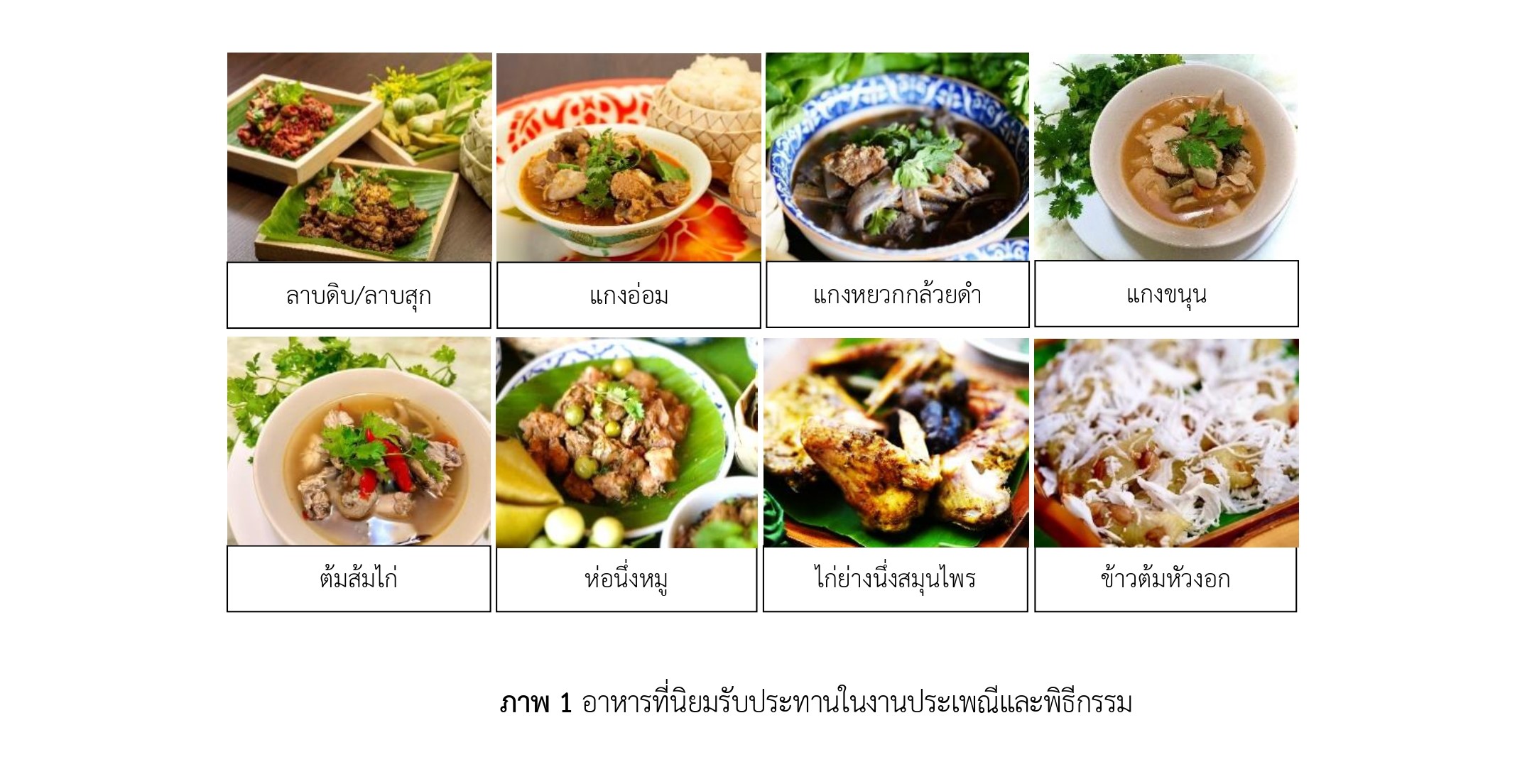
3 food sets, each set consisting of 5-6 savory items, sticky rice, chili paste, and various vegetables as ingredients in every set. There is 1 sweet dish, Khao Tom Hua Ngok.
References
ฉวีวรรณ สุวรรณาภา, อรอนงค์ วูวงศ์, และเสริมศิลป์ สุภเมธีสกุล. (2560). อาหารพื้นบ้าน : กระบวนการจัดการเพื่อพัฒนาคุณภาพชีวิตและจริยธรรมทางสังคมในชุมชนภาคเหนือ (รายงานการวิจัย). แพร่: มหาวิทยาลัยจุฬาลงกรณ์ราชวิทยาลัย.
ณิชมน ภมร, และพัชรี ตันติวิภาวัน. (2563). การจัดการความรู้ภูมิปัญญาท้องถิ่นด้านวัฒนธรรมอาหารพื้นบ้านภาคเหนือตอนบนของไทย. วารสารรังสิตบัณฑิตศึกษาในกลุ่มธุรกิจและสังคมศาสตร์, 6(2), 28-44. https://doi.org/10.14456/jrgbsrangsit.2020.19
ประชัน รักพงษ์, ธนากร สังเขป, ธีรศักดิ์ วงศ์คำแน่น, ประดิษฐ์ สรรพช่าง, เสน่ห์ อุ่นผูก, และสุรีย์รัตน์ หาญคำ. (2530). การศึกษาหมู่บ้านไทลื้อในจังหวัดลำปาง. ลำปาง: วิทยาลัยครูลำปาง.
ภาวนาโสภิต บุญญวิศิษฎ์ เมืองวงศ์, ภราดร สุขพันธ์, จันทรัสม์ ตาปูลิง, และบุญญาดา ประภัทรสิริ. (2567). ความเป็นไทยและความเป็นอื่นของกลุ่มชาติพันธุ์ไทลื้อ ไทยอง กะเหรี่ยงในจังหวัดลำพูน. Journal of MCU Peace Studies, 12(4), 1295-1308. https://so03.tci-thaijo.org/index.php/journal-peace/article/view/285760
มูลนิธิพัฒนาชุมชนและเขตภูเขา. (2559). ภูมิปัญญาในการรักษาพันธุ์พืชอาหารและการจัดการทรัพยากรของกลุ่มชาติพันธุ์ 9 ชนเผ่า. เชียงใหม่: วนิดาการพิมพ์.
รัตนาภรณ์ กองศรี, บัวพิมล แสนคำวัง, เดือนภา พุฒเกิด, ชลลดา อะติถะ, สุพรรษา ปาคำหน้อย, สิราวรรณ แปงใจ, สุรสิงห์ แสงโสด, และนิชธิมา บุญเฉลียว. (2564). การเปลี่ยนแปลงอัตลักษณ์ชุมชนเมืองสามไตในบ้านธิ จังหวัดลำพูน. วารสารข่วงผญา, 15(2), 1-14. https://so06.tci-thaijo.org/index.php/khuangpaya/article/view/249864
วารีพร ชูศรี, จุฑามาศ พรหมมนตรี, บุตรี บุญโรจน์พงศ์, นพดล ชูเศษ, และสรัญณี อุเส็นยาง. (2566). สำรับอาหารพื้นถิ่นในคาบสมุทรสทิงพระ. Journal of Roi Kaensarn Academi, 8(5), 270-286. https://so02.tci-thaijo.org/index.php/JRKSA/article/view/260671
เสาวภา ศักยพันธ์. (2558). อาหารในวิถีคนไทลื้อสิบสองปันนา. ข่วงผญา, 1(10), 207-226. https://so06.tci-thaijo.org/index.php/khuangpaya/article/view/236091
Anna Maria Stalmirska. (2024). Local Food in Tourism Destination Development: The Supply-Side Perspectives. Tourism Planning & Development, 21(2), 160-177. https://doi.org/10.1080/21568316.2021.1928739
Krajangchom, S. (2023). Origins and localization of Tai Lue food culture in Northern Thailand. Journal of Ethnic Foods, 10(14), 2-11. https://doi.org/10.1186/s42779-023-00179-2
Wungrath, J. (2021). Knowledge Management for Local Wisdom of Tai Lue Food. Turkish Online Journal of Qualitative Inquiry (TOJQI), 12(5), 1205-1211.
Downloads
Published
How to Cite
Issue
Section
License
Copyright (c) 2025 Humanities and Social Sciences Journal of Pibulsongkram Rajabhat University

This work is licensed under a Creative Commons Attribution-NonCommercial-NoDerivatives 4.0 International License.
Any articles or comments appearing in the Journal of Humanities and Social Sciences, Rajabhat Phibulsongkram University, are the intellectual property of the authors, and do not necessarily reflect the views of the editorial board. Published articles are copyrighted by the Journal of Humanities and Social Sciences, Rajabhat Phibulsongkram University.