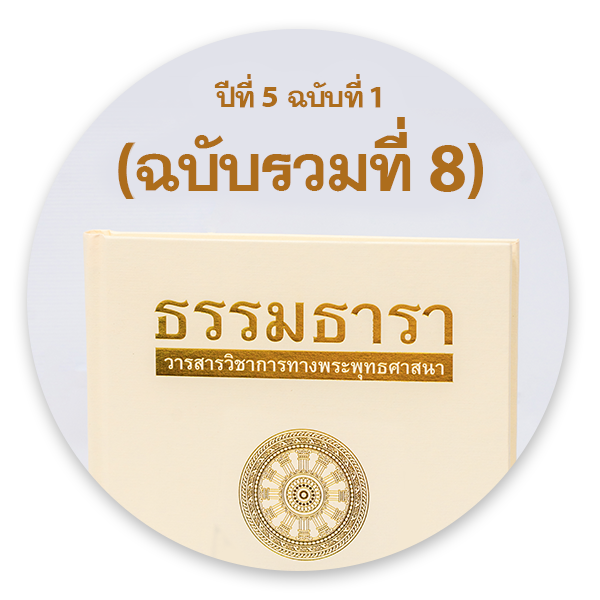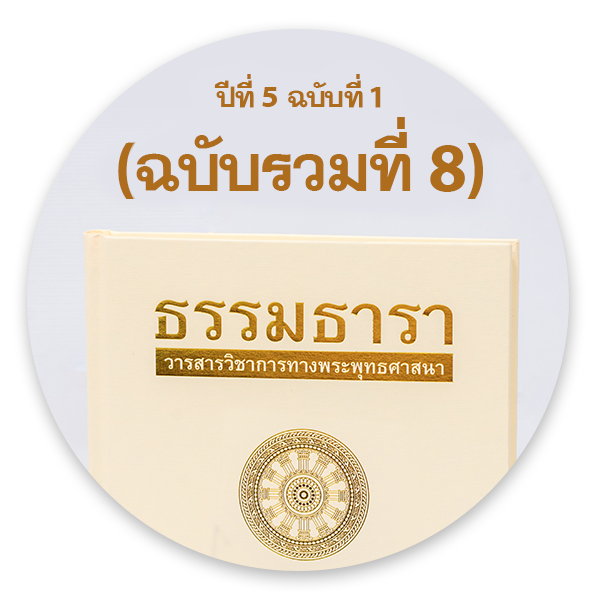
The Dhammadhara Journal has entered its 5th year with the publishing of its eighth issue.
In this issue, readers will read the article “A Comparative Study of Palm-leaf Manuscripts of the Pāli Canon for Analysis of Variant Readings: A Case Study from the Subhasutta of the Dīghanikāya” by Bunchird Chaowarithreonglith, Ph.D. This is a most useful article. Readers will obtain knowledge on the origins of the various versions of Pāli Tipiṭaka found in Thailand, Myanmar, Sri Lanka and Europe. Moreover, the fundamental knowledge of how to inspect the Tipiṭaka in an analytical manner can also be observed. It should be said that readers who are not yet proficient in Tipiṭaka or Pāli language can gradually understand it through reading articles such as these in Dhammadhara Journal.
Those who are interested in Buddhist matters and the historical carrying-down of palm-leaf tipiṭaka in Thailand and Cambodia for the past 700 hundred years should make sure to read the article “The Transmission of the Pāli Canon of Khom Script Manuscripts Found in Thailand and Cambodia” by Suchada Srisetthaworakul, Ph.D.
In today’s society, people are so entrapped into modern devices such as mobile phones and living on social media that they feel exhausted and stressed. The article “Buddhi-Paññā for Life Adjustment” by Associate Professor Suvin Ruksat, Ph.D. presents solutions based on Buddhist principles which suggest not refusing technologies but rather using them mindfully and living life with happiness and balance.
Last but not least, the Journal includes the translated article “Prospects of the Theory of the Origins of Mahāyāna Buddhism” Last but not least, the Journal includes the translated article “Prospects of the Theory of the Origins of Mahāyāna Buddhism” author Professor Sasaki Shizuka, Ph.D. and translated by Phramaha Pongsak Thaniyo, Ph.D. Apart from educating directly on different theories of the origins of Buddhism, the material also reveals the changes in hypothesises in the academic circle of the international Buddhist academic society. Some hypothesises are refuted and substituted with new ones which have stronger supporting evidence and reason, including research methods that improve upon the former studies. This cumulative and creative approach is a boon to the academic world focusing on the search for truth.
The Dhammadhara journal is determined to continue to be the center for top quality academic works in Buddhist studies in its full capacity. I hope to receive support from all readers. All constructive feedback is acknowledged by the editorial committee to improve the Journal to the next level.
Phragrupalad Suvattanabodhigun (Somchai Thanavuddho)
22 April 2019 (Earth day)
Published: 2019-04-22