
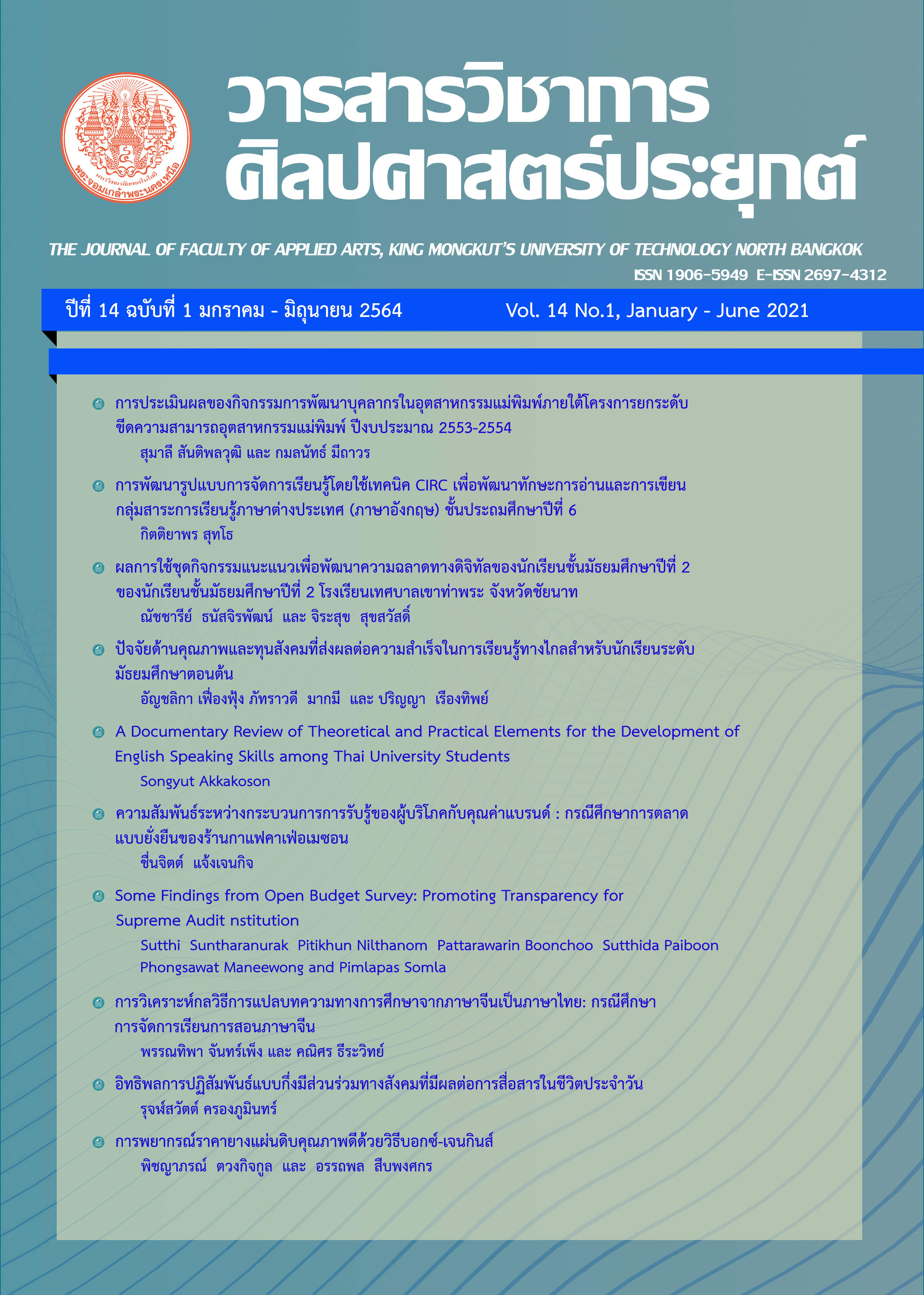
Some Findings from Open Budget Survey: Promoting Transparency for Supreme Audit Institution
Article Sidebar
Main Article Content
Abstract
The Supreme Audit Institution or SAI is the principal agency that plays a leading role in promoting transparency through government auditing. Likewise, it could support to fight against corruption. This paper discussed the role of SAIs and promoting transparency that is explained by using a basic econometric model. The authors investigated the Open Budget Survey (OBS), which is developed by the International Budget Partnership (IBP). The survey showed that the SAIs capacity could measure with an openness degree of SAIs information. The concept of information disclosure reflects the transparency of SAIs around the world.
In the meantime, the Corruption Perceptions Index (CPI) represents the transparency degree for each country in which Transparency International (TI) publishes CPI annually. The authors found that an openness degree of SAIs information related to CPI. The CPI affected positively to SAIs’ openness. Additionally,
the multiple regression model still shows that the SAIs’ openness degree had a positive relationship between public participation in the budget process and legislative oversight. Meanwhile, the econometric model found that SAIs' openness affected positively to CPI in which reflected causality relationship.
These findings strongly support the statement of the Moscow Declaration 2019 that the supreme audit institution can enhance the value of public auditing by extending the provision of audit-based advice on important and strategic issues of parliament, government, and public administration.
Article Details

This work is licensed under a Creative Commons Attribution-NonCommercial-NoDerivatives 4.0 International License.
1.The articles published in the Journal of Faculty of Applied Arts are the copyright of the journal. The use of the contents, texts, opinions, pictures, tables or any parts of the articles to be published in any format for the commercial use must be officially allowed in a written form by the authorized person of the editorial team.
2.The opinion exists in each article is the author’s responsibility. The editorial team of the Journal of Faculty of Applied Arts (FAA lecturers, staff, and any personnel) will not take any responsibility on that. The author of each article is the only person who will take full responsibility for his or her own article.
References
Dye, K. M. & Stapenhurst, R. (1998). Pillars of Integrity: The Importance of Supreme Audit Institutions in Curbing Corruption. WBI working papers Washington, D.C.: World Bank Group. Retrieved from http://
documents.worldbank.org/curated/en/199721468739213038/Pillars-of-integrity-the-importance-of-Supreme-Audit-Institutions-in-curbing-corruption
EUROSAI. (n.d.). SAI’s competency includes the audit of the state (governmental) budget. Retrieved from https://www.eurosai.org/handle404?exporturi=/export/sites/eurosai/.content/documents/congress/
congressV/Subtema2-ing.pdf
Gustavson, M. & Sundström, A. (2016). Organizing the Audit Society Does Good Auditing Generate Less Public Sector Corruption? Journal Administration & Society, 50 (10), 1508-1532.
International Budget Partnership. (n.d. a). Open Budget Survey (OBS) 2019: Key Findings. Retrieved from https://www.internationalbudget.org/sites/default/files/2020-04/2019_Key_Findings_EN.pdf
International Budget Partnership. (n.d. b). Open Budget Survey 2019. Retrieved from https://www.internationalbudget.org/sites/default/files/2020-04/2019_Report_EN.pdf
INTOSAI. (n.d. a). INTOSAI-P 1: the Lima Declaration. Retrieved from https://www.issai.org/pronouncements/
intosai-p-1-the-lima-declaration
INTOSAI. (n.d. b). INTOSAI-P 20: Principles of Transparency and Accountability. Retrieved from https://www.
intosai.org/fileadmin/downloads/documents/open_access/INT_P_11_to_P_99/INTOSAI_P_20/INTOSAI_P_20_en.pdf
INTOSAI. (2019). XXIII INCOSAI 2019: Moscow Declaration. Retrieved from https://www.rechnungshof. gv.at/rh/home/news/EN_Moscow_Declaration_300919.pdf
Irawan, A. B. (2014). The Role of the Public Accounts Committee: An Indonesian Case Study. West East Journal of Social Sciences, 3 (3), 1-7.
Kim, S. (2015). Side by Side with People: Korea’s Experiences on Participatory Auditing. World Bank. Retrieved from http://documents1.worldbank.org/curated/en/995101557837621617/pdf/Citizen-Participatory-Audit-in-the-Philippines-Pilot-Phase-I-2012-2014.pdf
Mark, S. & Reiner, E. (2010). Auditor and Fiscal Policy: Empirical Evidence on a Little Big Institution. Journal of Comparative, 38 (4), 357-380.
National Assembly of the Republic of Slovenia. (n.d.). The Commission for Public Finance Control. Retrieved from https://www.dz-rs.si/wps/portal/en/Home/ODrzavnemZboru/KdoJeKdo/DelovnoTelo?idDT=
DT015
Parliament of Australia. (n.d.). Joint Committee of Public Accounts and Audit. Retrieved from https://www.
aph.gov.au/Parliamentary_Business/Committees/Joint/Completed_Inquiries/jcpaa/index
Reporters Without Borders. (n.d.). 2019 World Press Freedom Index. Retrieved from https://rsf.org/en/
ranking/2019
Tan, M. G. (2019). Citizen Participatory Audit in the Phillippines-Pilot Phase I (2012-2014). Washington. World Bank. Retrieved from http://documents1.worldbank.org/curated/en/995101557837621617/pdf/
Citizen-Participatory-Audit-in-the-Philippines-Pilot-Phase-I-2012-2014.pdf
Transparency International. (n.d.). Corruption Perceptions Index. Retrieved from https://www.transparency.
org/en/cpi
Transparency International. (2020). Corruption Perceptions Index 2019. Retrieved from https://www.
transparency.org/en/cpi/2019
UK Parliament. (n.d.). Public Accounts Committee. Retrieved from https://www.parliament.uk/business/
committees/committees-a-z/commons-select/public-accounts-committee/?utm_content=buffer399
d5&utm_medium=social&utm_source=twitter.com&utm_campaign=buffer
Wooldridge, J. M. (2013). Introductory Econometrics A Modern Approach (5th ed.). Cengage Learning India Private Limited, Delhi, India.
